

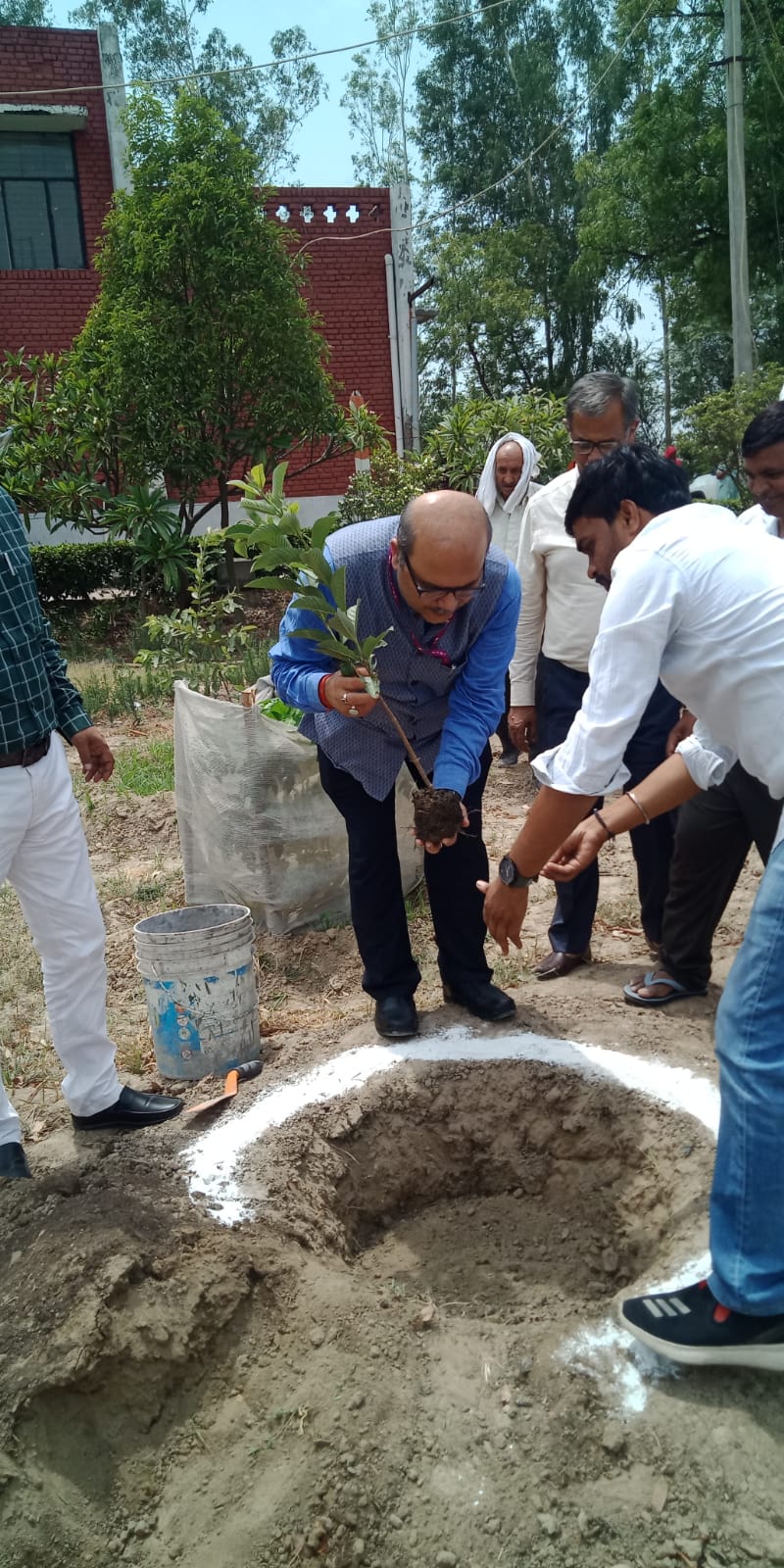
New Delhi, June 05: National Bank for Agriculture and Rural Development (NABARD) in collaboration with KVK Ujwa successfully organized a World Environment Day programme on 05 June 2026, bringing together scientists, officials, women farmers, and local farming communities to address critical issues of climate change, soil health, natural farming, and sustainable livelihoods in Delhi’s rural belt.
The event was led by KVK Prog. director Dr. T. K. Rana and Sh. Nabin Kumar Roy, Chief General Manager, NABARD, New Delhi Regional Office along with Sh. Vishal Sharma, DGM. The programme highlighted the urgent need to restore ecological balance in agriculture while improving farmers’ income through scientific and sustainable practices.
Strengthening Extension and Collaboration, the KVK Ujwa team outlined its role under the Indian Council of Agricultural Research (ICAR), with a multidisciplinary group of scientists specializing in horticulture, agronomy, soil science, veterinary science, home science, extension, and plant protection. NABARD and KVK jointly agreed to strengthen coordination, share field-level program schedules, and work closely with local coordinators to enhance outreach in villages.
Addressing Environmental Challenges in Agriculture, Speakers emphasized the growing environmental stress in Delhi’s rural regions, including declining soil fertility, groundwater salinity, and climate variability. Farmers were urged to adopt scientific soil management practices, including soil testing and balanced fertilizer application, rather than excessive use of chemical inputs. The analogy of “wrong medicine for the wrong disease” was used to explain nutrient mismanagement in fields.
Further, Sh. Nabin Kumar Roy underscored the need for broader policy recognition of Delhi’s farmers, noting gaps in institutional support due to urban classification. He reiterated NABARD’s commitment to raising these concerns at higher levels and supporting farmer-centric initiatives in partnership with KVK.
Natural and organic farming practices such as use of farmyard manure, crop rotation, green manuring, and residue composting were strongly promoted as sustainable alternatives to chemical-intensive agriculture.
The programme highlighted the importance of water conservation through rainwater harvesting and efficient usage. Participants were sensitized to visible climate changes, including irregular rainfall and temperature fluctuations, and encouraged to view these as warning signs requiring adaptive agricultural practices. KVK experts advocated integrated farming systems combining crops with dairy, poultry, fisheries, and horticulture to optimize income from small landholdings.
A five-day mango value-addition training programme scheduled for late June was also announced.
Fruit saplings were distributed to farmers as part of the Environment Day celebrations, with clear instructions on proper planting, mulching, and care. Farmers were encouraged to plant and protect these saplings to ensure long-term environmental and economic benefits.
The event concluded with a joint plantation activity, group interaction, and a reaffirmed commitment by KVK and NABARD to continue collaborative programmes on climate resilience, soil health, and rural livelihoods.