
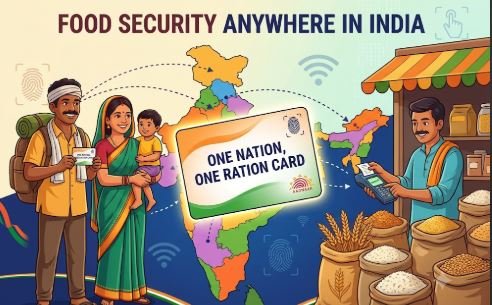
Access to food should never depend on where a person lives or works. For millions of migrant workers and families who move between states in search of employment, accessing subsidised foodgrains has often been a major challenge. The One Nation, One Ration Card (ONORC) scheme is changing this situation by allowing eligible beneficiaries to collect their foodgrain entitlements from any Fair Price Shop across India, without having to obtain a new ration card after relocating.
Launched in 2019 by the Department of Food and Public Distribution, the initiative has become an important reform of India’s Public Distribution System (PDS). By combining nationwide portability with digital authentication and technology-enabled distribution, the scheme is making food security more accessible, particularly for migrant households. Its growing reach also reflects how digital infrastructure can improve the delivery of essential public services and strengthen social protection.
Nationwide Portability Is Changing Foodgrain Access
The biggest advantage of ONORC is that it allows eligible beneficiaries covered under the National Food Security Act (NFSA) to access their entitled foodgrains from any Fair Price Shop in the country. Earlier, ration benefits were largely linked to the location where a ration card was registered, creating difficulties for families who moved to another state for work.
With nationwide portability, beneficiaries can access their entitlements wherever they reside, making the system more flexible and responsive to changing living and working conditions.
The initiative is particularly important for migrant workers, construction labourers, seasonal employees and families who frequently move between locations. Instead of losing access to subsidised foodgrains because of relocation, they can continue receiving their entitled benefits through the portability system.
The scale of implementation highlights its growing importance. ONORC has been rolled out across all 36 States and Union Territories, covering 100% of PMGKAY beneficiaries. The system facilitates approximately 3.27 crore portability transactions every month. Since its introduction, it has recorded more than 233 crore inter-state and intra-state portability transactions, enabling the distribution of over 614 lakh metric tonnes of foodgrains.
These figures demonstrate how portability is helping transform food distribution into a more accessible nationwide service.
Digitalisation Is Strengthening Transparency in the PDS
Alongside portability, the government has focused on making the Public Distribution System more transparent through digital records, electronic authentication and improved supply chain management.
As of October 2026, ration card and beneficiary databases have been fully digitised across all States and Union Territories, covering approximately 78.65 crore beneficiaries. This digital infrastructure makes beneficiary information more accessible and supports better monitoring of foodgrain distribution.
Aadhaar integration has also expanded significantly. Out of 20.51 crore ration cards in the Central System, approximately 20.27 crore, or 98.8%, have been Aadhaar-seeded. The number of beneficiaries with Aadhaar seeding stands at 76.97 crore. In addition, e-KYC had been completed for 71.52 crore beneficiaries as of September 30, 2026, representing around 91% of the total beneficiary base.
These measures are intended to improve identification, strengthen authentication and reduce the possibility of duplication in beneficiary records.
Technology is also being used to improve the functioning of Fair Price Shops. Of the country’s 5.51 lakh Fair Price Shops, approximately 5.50 lakh, or 99.8%, are operational with electronic Point of Sale (ePoS) devices. These systems support digital authentication and improve transaction records, helping make foodgrain distribution more accountable.
Technology Is Helping Reduce Leakages and Improve Delivery
A major challenge for large-scale welfare programmes is ensuring that benefits reach the people who are genuinely entitled to receive them. Digital records and data analytics are helping authorities identify suspicious entries and improve beneficiary targeting.
Under the Rightful Targeting initiative, data analytics flagged 5.95 crore suspicious records, leading to the deletion of 2.58 crore duplicate or ineligible entries under Version 1. Further efforts under subsequent versions have continued to identify and remove questionable records.
Such measures are intended to improve the accuracy of beneficiary databases and ensure that subsidised foodgrains reach eligible households.
The government is also strengthening supply chain monitoring through technology-based initiatives under the SARTHAK-PDS framework. NIRMAL focuses on improving data architecture and analytics, while SAKSHAM supports real-time data integration, including vehicle location tracking systems.
These initiatives aim to improve visibility across the foodgrain supply chain, from procurement and transportation to distribution at Fair Price Shops. Better monitoring can help authorities identify delays, strengthen accountability and improve last-mile delivery.
The SMART-PDS initiative also focuses on digitally integrating ration cards, foodgrain distribution, supply chains and grievance redressal systems. Together, these reforms are intended to create a more connected and efficient public distribution network.
Mera Ration App Makes Services Easier for Beneficiaries
Digital access is not limited to government administration. The Mera Ration mobile application has been introduced to help beneficiaries access important ration-related information and services directly through their smartphones.
Available in 13 languages, the application is particularly useful for migrant workers and families who may be unfamiliar with the local ration distribution system after moving to another location.
Through the app, users can check their monthly foodgrain entitlements, view previous transaction details, verify Aadhaar-seeding status and check their eligibility for national portability. It also allows beneficiaries to locate nearby Fair Price Shops using GPS and access navigation support to reach them.
The application helps reduce the need for repeated visits to government offices or dependence on local information networks. By bringing essential services onto a single digital platform, it makes the process more convenient and accessible.
For people who regularly move between states, the ability to identify nearby ration shops and check entitlements can make a meaningful difference in accessing food security benefits.
Grievance Redressal and Supply Chain Reforms Strengthen Accountability
Ensuring that beneficiaries receive their entitled foodgrains also requires an effective system for addressing complaints and monitoring distribution.
Transparency portals, online grievance systems and toll-free helplines are operational across all States and Union Territories. These facilities provide channels through which beneficiaries can raise concerns and seek assistance when they face difficulties accessing their entitlements.
Foodgrain allocation has also been computerised nationwide, while supply chain operations have been computerised in 31 States and Union Territories. These developments are helping improve coordination between different stages of distribution.
Under the SARTHAK-PDS umbrella, financial support is also provided for intra-state transportation, handling and Fair Price Shop dealer margins. The framework is intended to strengthen the operational infrastructure required to ensure that foodgrains reach beneficiaries efficiently. Its implementation is planned through March 2031.
The combination of digital monitoring, grievance support and supply chain improvements is aimed at making the PDS more reliable and accountable.
Supporting Migrant Families and Inclusive Food Security
The importance of ONORC extends beyond the technology used to operate it. Its greatest impact lies in addressing the difficulties faced by people whose livelihoods require them to move from one place to another.
Migrant workers often leave their home districts or states for employment in construction, manufacturing, agriculture, transport and other sectors. Their families may also relocate, creating challenges in accessing welfare benefits tied to a particular location.
ONORC helps address this issue by making foodgrain entitlements portable. It allows eligible beneficiaries to access subsidised foodgrains without having to restart the ration card registration process in a new location.
For families dependent on subsidised foodgrains, this flexibility can support household food security during periods of migration and employment uncertainty. It also strengthens the idea that access to essential welfare benefits should not be restricted by geographical boundaries.
Conclusion
The One Nation, One Ration Card scheme represents an important shift in India’s approach to food distribution. By enabling nationwide portability, strengthening digital authentication and improving supply chain monitoring, it is making the Public Distribution System more accessible to millions of beneficiaries.
Its implementation across all 36 States and Union Territories, more than 233 crore portability transactions and the expansion of digital infrastructure reflect the scale of this transformation. Initiatives such as the Mera Ration app, ePoS-enabled Fair Price Shops and SARTHAK-PDS further demonstrate the role of technology in improving transparency and delivery.
However, the success of the scheme will also depend on reliable technology, effective grievance redressal, awareness among beneficiaries and consistent implementation at the local level. Ensuring that migrant and vulnerable households can access their entitlements without difficulty must remain central to the programme.
Ultimately, ONORC is about more than making ration cards portable. It is about ensuring that food security follows people wherever life and work take them, creating a more inclusive, responsive and beneficiary-focused welfare system across India.
