

PM Modi’s Consumption Appeal Signals Strategic Economic Shift to Strengthen India’s Dollar Resilience Amid Global Uncertainty
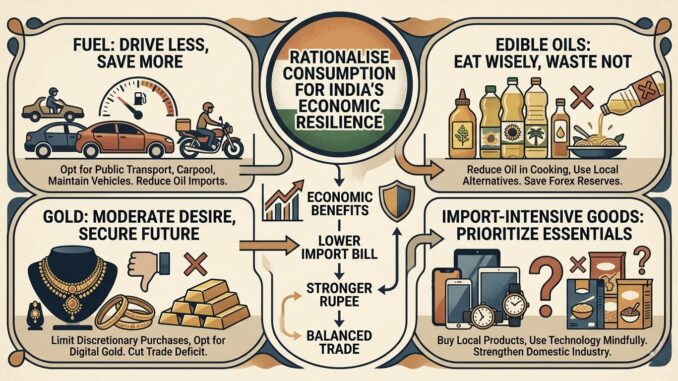
Prime Minister Narendra Modi’s recent appeal for citizens to rationalise consumption of fuel, edible oils, gold, and other import-intensive goods has sparked widespread discussion across economic and policy circles. While initially interpreted by some as a sign of external pressure, government officials and economists now describe it as a deliberate macroeconomic strategy aimed at strengthening India’s external sector resilience and conserving foreign exchange reserves.
Far from being a crisis response, the message is being framed as part of a broader effort to encourage responsible consumption patterns that align household behaviour with national economic priorities at a time of heightened global volatility.
A Call Rooted in External Balance Management
The Prime Minister has urged citizens to:
- Reduce dependence on petrol and diesel consumption wherever possible
- Moderate usage of imported edible oils
- Avoid non-essential gold purchases for a defined period
- Limit foreign travel that results in dollar outflow
- Embrace work-from-home arrangements where feasible
Officials clarify that these steps are intended to ease pressure on India’s foreign exchange reserves, which are impacted by large-scale imports of energy and commodities.
India’s import basket continues to be dominated by a few critical categories. In the 2025–26 fiscal year, total import outflows are estimated at approximately $77,500 crore, with a significant share concentrated in crude oil, gold, edible oils, and fertilisers.
Why These Four Sectors Matter Most
Each category highlighted in the appeal plays a disproportionate role in India’s external accounts:
- Crude Oil: India remains heavily dependent on imported crude, which is refined into petrol, diesel, and aviation fuel. Any rise in global oil prices directly amplifies the import bill and fuels inflationary pressure.
- Gold: Despite being a cultural and investment asset, gold imports place consistent strain on foreign exchange reserves.
- Edible Oils: A large portion of domestic consumption is met through imports, making this a sensitive inflation-linked category.
- Fertilisers: Essential for agriculture, fertiliser imports are vulnerable to global supply disruptions and price fluctuations.
Officials note that even marginal moderation in consumption across these categories can cumulatively translate into significant foreign exchange savings, helping stabilise the rupee and improve the current account balance.
Global Energy Shock and Geopolitical Pressure
The timing of the appeal coincides with heightened geopolitical tensions in West Asia, which have led to volatility in crude oil markets. Given India’s high dependence on imported energy, such disruptions directly affect domestic fuel pricing and fiscal stability.
Analysts say that global uncertainty has made demand-side management an important complement to supply-side reforms, particularly for large import-dependent economies like India.
Government Assurance: No Supply Disruption
To address public concern, the government has reiterated that there is no shortage of petroleum products or essential commodities in the country.
A high-level review chaired by Defence Minister Rajnath Singh confirmed:
- Adequate stocks of petrol and diesel for sustained consumption
- Stable availability of LPG for households
- Sufficient natural gas reserves and distribution capacity
- Functional and resilient supply chains for essential goods
Officials emphasised that the appeal is not linked to scarcity, but to long-term economic prudence and resilience-building.
From Consumption to Macroeconomic Strategy
Economists interpret the initiative as part of India’s evolving approach to macroeconomic management through behavioural participation, where citizens’ consumption choices contribute directly to national financial stability.
This aligns with broader policy objectives such as:
- Reducing import dependency in strategic sectors
- Strengthening domestic manufacturing under Atmanirbhar Bharat
- Improving foreign exchange reserve sustainability
- Enhancing energy security through demand moderation
- Encouraging local substitutes and efficiency-driven consumption
Experts note that India’s growth model is increasingly balancing high domestic demand with external sector discipline, especially as global markets remain volatile.
Behavioral Economics in National Policy
A key aspect of the approach is its reliance on voluntary behavioural change rather than regulatory restriction. Economists say this reflects a shift toward using citizen participation as an economic stabiliser, where small individual actions collectively influence national outcomes.
For example, a modest reduction in discretionary gold purchases or fuel consumption across millions of households can translate into substantial savings in foreign exchange outflows over time, improving macroeconomic buffers without disrupting growth momentum.
Broader Structural Context
The appeal also fits into India’s longer-term strategy of:
- Diversifying energy sources, including renewables and biofuels
- Expanding domestic refining and manufacturing capacity
- Promoting import substitution in non-essential goods
- Building resilience against global supply shocks
Policy experts argue that such measures are increasingly important as globalisation becomes more fragmented and supply chains face recurring disruptions due to geopolitical tensions.
Outlook
While the Prime Minister’s message has generated debate, policymakers maintain that it reflects a forward-looking economic framework rather than a short-term adjustment.
The underlying objective, officials say, is to ensure that India’s economic growth remains stable, self-reliant, and less vulnerable to external shocks, even as global uncertainties persist.
In the long term, the success of this approach will depend on a combination of citizen participation, structural reforms, energy diversification, and sustained domestic capacity building, positioning India for stronger financial resilience in the years ahead.