

The majority of roads you travel on throughout your life are going to have some type of intersection. Traditionally, intersections are among the most dangerous spots on the roadways. Vehicles running lights and stop signs, or not being able to stop in time, cause thousands of crashes every year. The issue is that all intersections rely purely on driver compliance. A sad fact of driving is that many drivers are not compliant and are instead only focused on their personal journey.
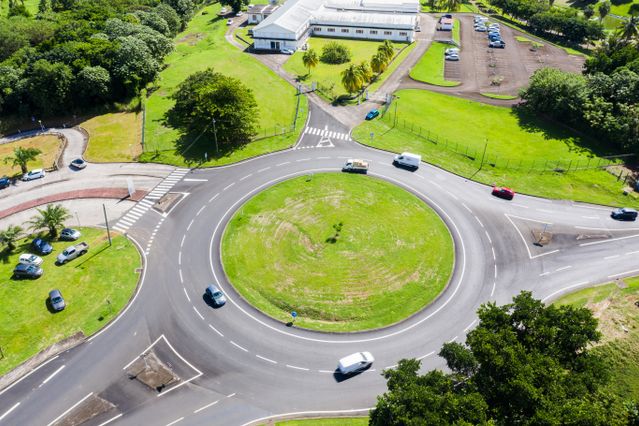
In an attempt to make intersections safer, transportation departments have increasingly turned to roundabouts as a modern solution. A roundabout is an intersection where traffic can move continuously around a center island, where only one lane has to stop to wait. Data consistently shows that replacing traditional intersections with roundabouts improves safety overall. That isn’t to say that roundabouts don’t have accidents. There are far fewer crashes involved with roundabouts, however. These flowing intersections change the fundamental dynamics of how vehicles interact.
The Geometry of Safety: Eliminating T-Bone and Head-On Collisions
Roundabouts are so effective at reducing accident risks because of how they change the dynamics of interacting vehicles at intersections. In a traditional intersection, you have a four-way stop where traffic moves in perpendicular lines. This creates what are known as conflict points — specific spots where two vehicles’ paths intersect. There can be 40 cars at an intersection, but if only one of them decides not to adhere to the rules, it can cause a massive accident.
With a roundabout, the number of conflict points drops by a factor of 75% on average, or three quarters. For instance, a traditional intersection on a highway has 32 conflict points. In a roundabout, that number drops to 8. All traffic is forced to travel in a single direction around a central island. Roundabouts all but eliminate the two most major types of intersection crashes:
1: T-bone (side-impact) Collisions
A t-bone crash usually occurs when a driver runs a red light or stop sign, or fails to yield while making a turn into oncoming traffic. Roundabouts entirely eliminate crossing traffic, making a t-bone highly improbable. Unless a driver is completely outside of their lane and cutting across the roundabout, a t-bone cannot happen.
2: Head-on collisions
All vehicles are traveling in the same direction around the circle, while opposite-facing traffic is on the other side of the roundabout and not even facing traffic head-on. This virtually eliminates all potential for a head-on collision.
Redesigning the geometric layout to allow for traffic to have a smoother, linear flow has successfully reduced the number of crashes. This is because roundabouts drastically reduce the conflict points that can lead to crashes to begin with. Accidents still do occur, of course. However, instead of t-bones and head-on collisions, the crashes are instead sideswipes and some rear-end collisions. These accidents have much less risk of serious damage or physical injuries.
Forced Deceleration: How Lower Speeds Save Lives
At any intersection, or other point on a highway where accidents often happen, speed is the number-one cause. A driver going over the speed limit trying to catch a yellow light, for instance, can speed through a red light and end up causing a serious crash. Injuries are far more likely when you’re dealing with speed. Pure physics are at play here: the faster the vehicle is going, the worse the crash. Intersections are a leading cause for injuries and the need for a car accident lawyer.
Roundabouts help to reduce accidents by significantly limiting driver speeds. Even if a driver decides that the speed limit doesn’t apply to them, they still slow down a lot in order to go around the island. Vehicles are forced to slow their acceleration. The typical speed for a roundabout is about 15–25 miles per hour. Crashes at this speed are almost always fender benders and not serious.
This forced reduction in speed provides several distinct safety advantages:
1: More time to react: Driving at slower speeds gives everyone on the roundabout more time to react. Drivers can potentially avoid colliding with someone, and potential victims of an accident may have time to see it coming.
2: Shorter stopping distances: You also have much shorter stopping distances when you’re traveling slower. Braking to halt from a speed of 20 miles per hour can be accomplished in less than a second with decent brakes.
3: Reduced impact force: Even if a driver makes a mistake and a collision occurs inside a roundabout, the low speed means the force of the impact is drastically reduced. This creates a fender bender, not a serious accident.
Protecting the Most Vulnerable: Pedestrians and Cyclists
Classic intersections are not only more dangerous for vehicles; they’re also a lot more dangerous for pedestrians and cyclists. Traditional intersections may have a crosswalk for pedestrians. When the walk sign is activated, people walk with the confidence that cars will halt. Unfortunately, hundreds of cases happen per year where drivers do not halt. Driver negligence causes many injuries and deaths every year. Cyclists are also at risk too. Even though there may be a designated bike lane, cars traveling at high speeds frequently swerve into that lane. Crashes can also spill over into those lanes and injure cyclists.
Roundabouts make it much safer for pedestrians and cyclists in numerous ways. First and foremost, pedestrians only have to deal with traffic in a single direction. Secondly, automobiles are traveling at much slower speeds. This gives vehicles time to react and stop.
In Conclusion
Roundabouts popping up in towns and cities all across the nation seem like an imposition for motorists at first. Having to slowly make your way through the road construction can seem annoying. However, after the construction is complete and the roundabout is ready, most drivers vastly prefer these intersection islands. It may take slightly longer to get through, but the end result is a safer experience for everyone involved. When there are accidents, they’re at much lower speeds and thus do not result in carnage like intersection accidents.
Of course, there are still accidents that can happen. Getting side-swiped or rear-ended are real possibilities due to the fact that some drivers just refuse to follow the law. If you have been involved in an accident, especially if you have been injured, it’s a good idea to reach out to a car accident lawyer. A qualified lawyer like those at Thomas Law Offices can help you navigate the complex legal processes involved in your case.