

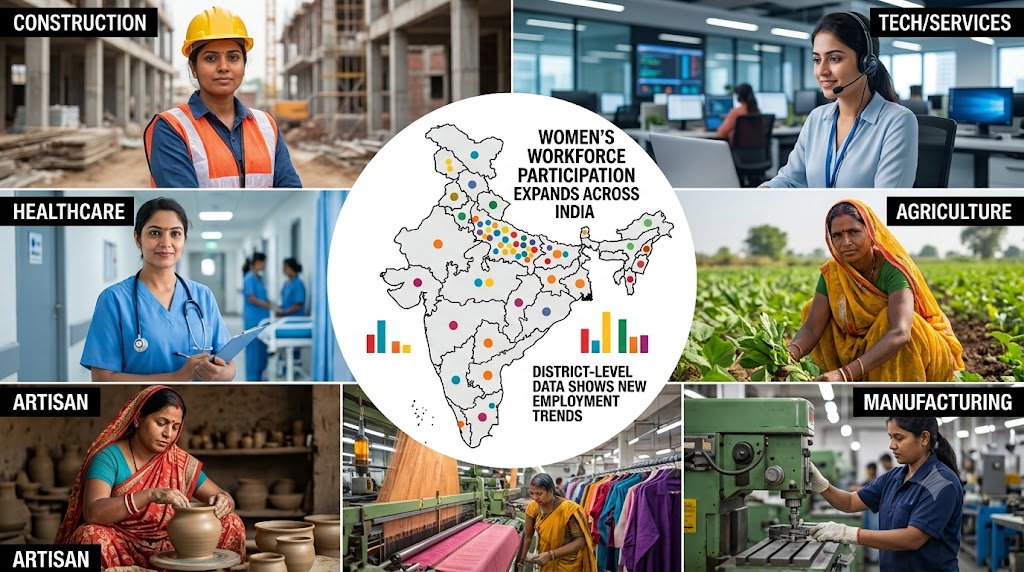
Women are becoming an increasingly visible part of India’s changing workforce, with new district-level employment data showing that female labour participation has gained ground across a large part of the country.
According to the latest data released by the National Statistical Office (NSO), 57.8 per cent of the districts surveyed recorded a female Labour Force Participation Rate (LFPR) of 40 per cent or more. The first district-level assessment offers a closer look at where women are participating in the labour market and how employment patterns differ across regions.
The numbers are important because women’s employment is closely linked with household incomes, financial independence and the broader strength of the economy. When more women enter productive work, businesses gain access to a larger talent pool while families can benefit from an additional source of income.
A changing picture of women at work
Recent labour market data also indicates that women’s participation has been gradually improving. Female LFPR among people aged 15 years and above reached 35.3 per cent in December 2025, while the rural female LFPR stood at 40.1 per cent, according to government data.
Urban and rural employment patterns, however, remain different. Rural women are more likely to participate in agriculture, self-employment and local economic activities, while urban women have greater access to opportunities in services, manufacturing, technology, retail and other organised sectors.
This difference highlights the need for employment strategies that reflect local economic conditions rather than relying on a single national approach.
Districts reveal where opportunities are emerging
The new data brings these regional differences into sharper focus.
Among the 100 districts covered, Surat recorded the highest overall LFPR at 68.6 per cent, followed by Araria in Bihar at 68 per cent and Salem in Tamil Nadu at 67.8 per cent. Surat also recorded a Worker Population Ratio of 67.8 per cent.
The figures show how employment opportunities can vary significantly depending on the economic structure of a district, the presence of industries, urbanisation, education and access to the labour market.
For women, these local factors can be particularly important. Availability of nearby jobs, safe transportation, childcare facilities, flexible working arrangements and access to skills can influence whether women are able to enter and remain in paid employment.
From employment to economic independence
A rise in female workforce participation has implications that go beyond employment statistics.
A woman with a regular source of income can contribute more directly to household financial security and make greater economic choices. For families, two sources of income can improve resilience during periods of rising costs or economic uncertainty.
At the community level, women’s earnings can also support spending on education, healthcare, housing and local businesses, creating a wider economic effect.
For employers, greater female participation means a larger and more diverse workforce. Industries expanding into smaller cities and districts can benefit from developing local female talent rather than depending entirely on workers migrating from other regions.
Rural women remain central to the workforce story
The relatively higher rural female LFPR recorded in recent data underlines the significant contribution of women outside major cities.
Women in rural areas are involved in agriculture, livestock activities, small businesses, self-help groups, handicrafts, food processing and a range of informal and self-employed activities. As rural economies become more connected to digital payments, e-commerce and organised markets, these activities can increasingly move towards larger and more formal markets.
Improved access to credit, digital skills, market linkages and entrepreneurship support can help women-owned enterprises expand beyond local markets.
Young women and the future workforce
The NSO’s district-level assessment also looks at young people aged 15-29 who are not in employment, education or training, commonly referred to as the NEET population.
The indicator is particularly relevant for young women because the transition from education to employment can be affected by several factors, including skills, mobility, family responsibilities and availability of suitable jobs close to home.
As India creates opportunities in areas such as electronics, manufacturing, digital services, healthcare, financial services and emerging technologies, ensuring that young women have access to relevant training will be important for widening their participation in these sectors.
Businesses can play a larger role
The changing workforce also presents an opportunity for companies.
Businesses expanding into emerging industrial and service centres can tap into local women workers through targeted recruitment, skill programmes, apprenticeships and workplace facilities that make employment more accessible.
For small businesses and startups, supporting women entrepreneurs can create another channel for economic growth. Access to finance, digital marketing, technology and formal markets can help women-led enterprises reach customers beyond their immediate communities.
The next phase of India’s workforce growth
The latest district-level figures provide a more detailed picture of India’s employment landscape and show that women’s participation is becoming an increasingly important part of the country’s economic story.
The challenge now is not only to bring more women into the workforce but also to expand access to stable, productive and better-paying opportunities. Skills, infrastructure, workplace safety, childcare, mobility and access to finance will all influence how effectively women can participate in India’s next phase of economic growth.
As more districts record higher levels of female labour participation, women’s contribution is becoming increasingly important to India’s businesses, households and local economies. The growth of the female workforce could therefore become an important part of the country’s broader journey towards a more inclusive and productive economy.