
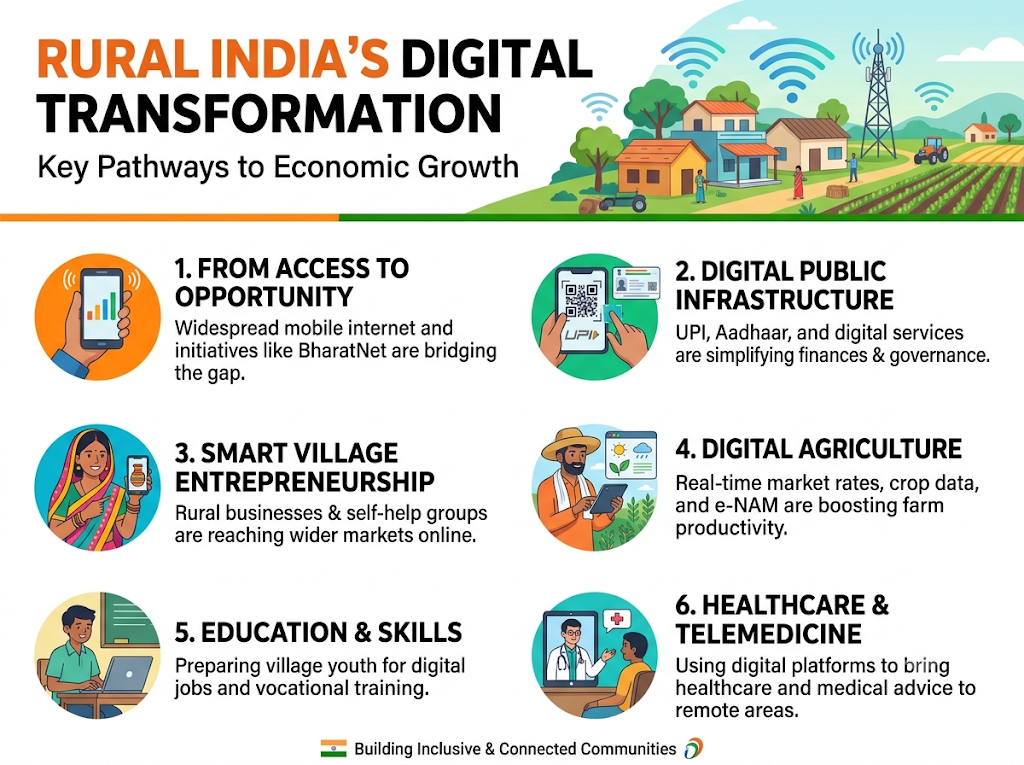
India’s digital transformation is gradually reshaping the country’s rural landscape, creating opportunities that extend far beyond internet access and mobile connectivity. From farmers using digital platforms to explore better markets to women entrepreneurs promoting local products online, technology is opening new pathways for economic participation in villages. Digital payments, online education, telemedicine and e-governance are also making essential services more accessible, bringing rural communities closer to the opportunities of a connected economy.
With the expansion of digital public infrastructure, affordable mobile internet and government-led connectivity programmes, rural India is becoming an increasingly important part of the country’s digital growth story. Initiatives such as BharatNet, Digital India and the expansion of 4G services are helping bridge geographical barriers and create the foundation for technology-enabled development.
However, the next stage of this transformation will depend on how effectively connectivity is converted into economic opportunity. Having internet access is only the beginning. Rural households and businesses also need affordable devices, reliable networks, digital skills and access to services that address their everyday requirements.
The encouraging development is that rural communities are no longer just consumers of digital services. They are increasingly becoming participants in online commerce, digital finance, agricultural innovation and technology-enabled entrepreneurship. With the right infrastructure and support, villages could emerge as important contributors to India’s next phase of digital and economic growth.
1. From Internet Access to Economic Participation: Rural India’s Digital Transformation
The expansion of telecommunications infrastructure has changed how rural communities access information and services. Affordable data plans, increasing smartphone adoption and wider mobile network coverage have brought digital platforms within reach of millions of people.
Government programmes are also strengthening this transition. BharatNet is aimed at extending broadband connectivity to Gram Panchayats, while BSNL’s 4G Saturation Project is intended to improve mobile connectivity in uncovered villages.
These developments are particularly important for communities that have traditionally faced geographical barriers to accessing banking, education, healthcare and government services.
However, the next priority is to improve the quality and consistency of connectivity. A village with basic mobile coverage may still struggle with slow internet speeds, network interruptions or limited broadband access. Reliable connections are essential for activities such as online learning, digital business operations, telemedicine and financial transactions.
For telecom operators, internet service providers and infrastructure companies, this presents an opportunity to expand rural broadband, improve network capacity and develop affordable last-mile connectivity solutions.
The real measure of progress will be how effectively rural residents can use digital infrastructure to improve their livelihoods and participate in the wider economy.
2. Digital Public Infrastructure Is Making Rural Services More Accessible
One of the strongest foundations of India’s digital transformation is its expanding digital public infrastructure. Aadhaar-enabled services, UPI and Direct Benefit Transfer have helped simplify financial transactions and improve access to government services.
For rural households, digital systems can reduce the need for repeated visits to administrative offices and make eligible welfare payments more convenient. Digital payments are also changing everyday business transactions, allowing village retailers, small traders and service providers to accept payments electronically.
UPI, in particular, has created a more accessible payment environment for small businesses that previously depended largely on cash. Digital transactions can help entrepreneurs maintain payment records, improve convenience and serve customers more efficiently.
The broader opportunity lies in connecting more rural businesses and households with formal financial services. Digital transaction histories, when combined with appropriate financial assessment, can support access to formal credit and other financial products.
However, awareness and trust remain essential. Rural users need guidance on safe transactions, fraud prevention and the responsible use of digital financial services. Strengthening financial and digital literacy will help ensure that technology delivers lasting benefits.
3. Smart Villages Are Creating New Opportunities for Rural Entrepreneurship
The concept of smart villages is evolving from basic digital connectivity towards a more comprehensive approach to rural development. It involves using technology to improve public services, strengthen local businesses and create better economic opportunities within communities.
Digital service centres, online marketplaces, community internet facilities and technology-enabled public services can help villages become more connected and economically active.
For local entrepreneurs, this transition creates several possibilities. Digital service centres can provide assistance with online applications, government services, bill payments and documentation. Local retailers can adopt digital inventory and payment systems, while artisans and small manufacturers can promote their products through online platforms.
Technology companies can also develop solutions specifically designed for rural markets, including local-language applications, affordable business management tools and digital customer support services.
The opportunity is particularly attractive for businesses that understand local requirements. Rural consumers often need simple, affordable and dependable services rather than complicated technology platforms.
By developing solutions around these practical needs, companies can build commercially sustainable operations while supporting wider rural development.
4. Digital Agriculture Can Improve Market Access and Farm Productivity
Agriculture remains one of the most important pillars of rural India’s economy, making digital adoption particularly valuable for farmers.
Access to timely information about weather conditions, crop prices, cultivation techniques and government schemes can help farmers make better-informed decisions. Digital agricultural platforms can also connect producers with buyers, improve market visibility and support more efficient supply-chain management.
The electronic National Agriculture Market (e-NAM) is an important example of how digital platforms can support agricultural marketing by connecting markets and facilitating online trading.
Beyond marketplaces, technology is creating opportunities in precision agriculture, soil monitoring, smart irrigation, drone-based services and crop analytics. These solutions can help farmers use resources more efficiently and respond to changing agricultural conditions.
For businesses, the agricultural technology market offers opportunities in equipment distribution, farm advisory services, digital marketplaces and data-driven agricultural solutions.
However, affordability and accessibility will determine how widely these technologies are adopted. Small and marginal farmers need solutions that are easy to operate, available in regional languages and supported by practical demonstrations.
Partnerships with farmer producer organisations, cooperatives and local agricultural institutions can help technology companies reach farmers more effectively.
5. Digital Education Can Prepare Rural Youth for Emerging Careers
A digitally connected village can offer young people access to learning opportunities that were previously restricted by geography.
Online educational platforms, virtual classrooms and digital libraries allow students to explore subjects beyond the resources available in their immediate surroundings. Access to vocational training can also help rural youth develop skills relevant to changing employment requirements.
Digital literacy, computer education, online communication, data management and basic programming are becoming increasingly useful across different industries. Training in digital marketing, accounting, e-commerce and customer service can also help young people pursue employment or start small businesses.
This creates opportunities for educational institutions, skill-development organisations, technology providers and vocational training companies.
Community-based digital learning centres could play an important role by providing computers, internet access and practical training in locations where individual households cannot afford such facilities.
The larger opportunity is to make rural youth active participants in India’s digital workforce rather than limiting their employment prospects to traditional local occupations.
6. Women-Led Enterprises Can Benefit From Greater Digital Access
Digital connectivity is creating new possibilities for women entrepreneurs, particularly those operating home-based businesses, self-help groups and small rural enterprises.
Women involved in handicrafts, food processing, tailoring, local products and other small-scale activities can use digital platforms to showcase their products, communicate with customers and receive payments.
Online marketplaces and social media can help these businesses reach customers in nearby towns and larger cities without requiring substantial investment in physical retail infrastructure.
Digital banking and financial services can also make business transactions more convenient and improve access to financial information.
Self-help groups can benefit from digital record-keeping, online training and access to information about government programmes and financial assistance.
However, meaningful participation requires more than network availability. Affordable smartphone access, independent device ownership, regional-language training and supportive community programmes are important to ensuring that women can use digital services confidently.
Businesses and financial institutions that develop accessible solutions for women-led rural enterprises can contribute to a growing market while supporting greater economic participation.
7. Rural SMEs and Local Businesses Can Expand Beyond Traditional Markets
The digital economy is changing the growth prospects of rural small businesses. Local retailers, artisans, food processors, service providers and small manufacturers can use technology to improve operations and connect with customers beyond their immediate markets.
A village-based enterprise can promote its products online, receive digital payments, maintain customer records and use basic business software to manage inventory and expenses.
E-commerce platforms can help traditional artisans and rural producers find new buyers, while digital marketing can improve the visibility of local products.
There are also opportunities for businesses providing cloud-based accounting, affordable billing systems, digital payment solutions, online branding and e-commerce support.
For rural SMEs, the greatest benefit may come from gradually adopting practical tools rather than making expensive technology investments. Even basic digital record-keeping and online customer communication can improve business efficiency.
This transition also creates an opportunity for local technology entrepreneurs who can provide installation, training, troubleshooting and ongoing support.
As more rural businesses become digitally active, they could contribute to a wider network of technology-enabled economic activity.
8. Telemedicine and Digital Governance Can Improve the Quality of Rural Life
The benefits of digital connectivity extend beyond commercial activity. Healthcare and public administration are important areas where technology can improve access to essential services.
Platforms such as eSanjeevani enable teleconsultations, allowing patients to connect with healthcare professionals without always travelling long distances for an initial consultation.
For rural communities, this can improve access to medical advice, particularly where specialist healthcare facilities are limited. Digital health services can also support follow-up consultations and reduce travel-related expenses for patients.
Similarly, e-governance platforms can make information about public services, certificates, welfare programmes and other administrative facilities more accessible.
The expansion of digital services creates opportunities for healthcare technology companies, local service centres, software developers and organisations providing digital assistance.
However, these services must complement, rather than replace, essential physical infrastructure. Reliable healthcare facilities, trained professionals and local support remain necessary for effective service delivery.
9. Digital Literacy and Cybersecurity Will Build Trust in Rural Technology
As more people enter the digital economy, the ability to use technology safely is becoming just as important as internet access.
First-time users may be unfamiliar with fraudulent payment requests, phishing links, fake customer-care numbers and other online scams. Such experiences can reduce confidence in digital banking and discourage people from using online services.
Digital literacy programmes should therefore include practical lessons on secure payments, password protection, personal information and identifying suspicious online activity.
Training must also be accessible to older residents, women, first-time smartphone users and people with limited formal education.
For businesses, this creates opportunities in cybersecurity awareness, digital training, assisted technology services and customer support.
Building trust through simple interfaces, transparent communication and accessible assistance will be important to increasing the adoption of digital platforms in rural markets.
10. The Next Opportunity Lies in Affordable and Inclusive Digital Infrastructure
Rural India’s digital future will depend on continued investment in broadband, electricity, mobile networks and affordable devices.
BharatNet and other connectivity initiatives provide an important foundation, but their long-term success will depend on reliable implementation, maintenance and last-mile service delivery.
Public-private partnerships can help expand infrastructure in remote locations, where the cost of network development may be difficult for individual service providers to justify.
There is also scope for greater investment in community Wi-Fi, village-level digital centres, affordable smartphones and local technical support.
For businesses, rural connectivity is not merely an infrastructure market. It is an opportunity to develop new customer segments across education, agriculture, healthcare, financial services and commerce.
Companies that combine affordable technology with local partnerships and practical training can help create a stronger foundation for rural economic participation.
Conclusion
Rural India is steadily moving towards a more connected future, supported by expanding telecommunications infrastructure, digital public services and growing interest in technology-driven entrepreneurship. From digital agriculture and online education to financial inclusion and rural e-commerce, technology is creating opportunities that can strengthen local economies and improve access to essential services.
The next phase of progress will depend on moving beyond basic internet coverage towards meaningful digital inclusion. Reliable broadband, affordable devices, digital literacy, cybersecurity awareness and accessible local services must develop together to ensure that rural communities can benefit fully from the digital economy.
For businesses, this transition offers considerable potential across telecommunications, fintech, agritech, education technology, healthcare, e-commerce and digital services. Rural SMEs, women entrepreneurs and young people can also become important contributors to this expanding ecosystem.
The future of India’s digital economy will not be shaped by its metropolitan technology centres alone. It will also depend on the ability of its villages to innovate, create businesses, access markets and participate in new economic opportunities. When connectivity is supported by skills, affordability and local enterprise, smart villages can become much more than digitally connected communities; they can emerge as important engines of inclusive economic growth.
