

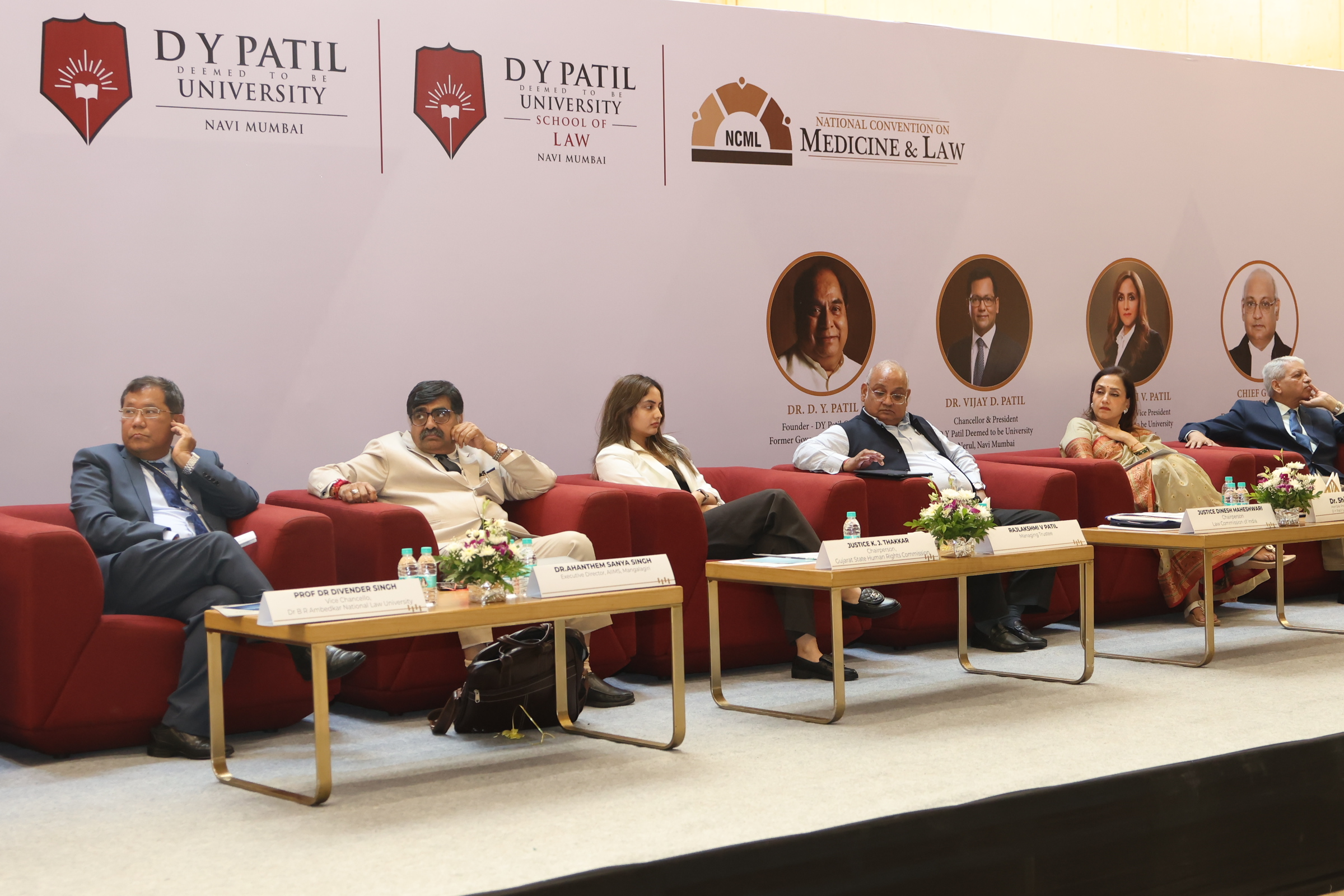
Mumbai, 29th September 2026: The 11th National Convention on Medicine & Law 2026 was held recently at the D Y Patil University Campus, Navi Mumbai. It was organised by the Institute of Medicine & Law in collaboration with D Y Patil University School of Law and Express Healthcare. The day-long Convention brought together eminent leaders from the judiciary, medicine, law, policy, academia, and healthcare administration.
Justice Dinesh Maheshwari, Chairperson of the Law Commission of India, was the Chief Guest at the Convention. He asserted that fundamental human dignity under Article 21 applies equally to patients, doctors, and judges. He said that both law and medicine ‘repair a running engine’ and require dynamic adaptation. He further proposed plain-language vernacular communication to make consent truly ‘informed,’ along with the adoption of paralegal and paramedical interpreter models.
Justice Amreshwar Pratap Sahi, President of the National Consumer Disputes Redressal Commission (NCDRC), commented that judges deal with fate while doctors sustain life. He highlighted heavy judicial caseloads and skewed judge-to-case ratios as the main reasons for delays in dispensing justice. He also proposed statutory price caps on pharmaceuticals and diagnostics.
Justice Dr. K J Thaker, Chairperson of the Gujarat State Human Rights Commission, referred to the tragic suicides of doctors caused by unjust criminal prosecutions. He criticised technical prosecutions under the PCPNDT Act and urged the immediate passage of the Central Healthcare Personnel and Healthcare Institutions (Prohibition of Violence) Bill.
Prof. (Dr.) Devinder Singh, Vice Chancellor of B R Ambedkar National Law University, highlighted that doctors handle up to 400 patients daily (30 seconds per patient) in OPDs. Therefore, it is essential to expand healthcare infrastructure and increase the number of doctors rather than penalising overworked medical professionals.
Dr. Ahanthem Santa Singh, Executive Director of AIIMS Mangalagiri, emphasised that integrating the ATCOM (Attitude, Ethics, and Communication) curriculum into medical training is vital. He noted that treating patients purely as ‘consumers’ has eroded traditional doctor–patient trust.
Ms. Rajlakshmi Vijay Patil, Managing Trustee of D Y Patil University, said that medicine and law must work together to honour human dignity and rights. She emphasised the need to evolve legal education alongside technology while relying on human judgement over AI. She concluded that interdisciplinary collaboration is key, as medicine protects life, law protects rights, and education prepares people to protect both.
The Convention commenced with four short plenary sessions on important contemporary medico-legal topics. This was followed by the traditional lamp-lighting ceremony and welcome addresses by Dr. Chirag Balyan of D Y Patil University School of Law and Mr. Ravindra Mangal, Executive Director, Institute of Medicine & Law.
Dr. Mukesh Yadav delivered the first ‘Justice Ravi Tripathi Oration in Healthcare Laws of India’ on “Healthcare Laws in India – Yesterday, Today & Tomorrow.” Dr. Yadav stressed the dynamic
and complex nature of medicine and law, and advocated for patient-centric care, continuous medico-legal education, and raising healthcare spending to 3% of GDP to curb defensive medicine.
The Convention also witnessed two significant milestones: the release of the ‘SOP on Patients’ Consent 2026’ and the launch of an international journal, “Lex Salus Politiae: International Journal of Medical Errors, Patient Safety, Policy & Law”. The objective of this journal is to understand how law and public policy can be used to minimise medical errors and maximise patient safety.
Two key closed-door breakout sessions were also held during the Convention:
The first breakout session, titled ‘Addressing Stress Among Medical Students: Policy Reforms,’ was moderated by Adv. R. Sunder Rajan, Hon. Additional Director, Institute of Medicine & Law. Deliberations focused on the alarming rise in stress, burnout, and mental health challenges among medical students and residents, and the urgent need for systemic reforms, including mentorship programs, accessible mental health services, duty-hour regulations, and grievance-redressal mechanisms.
The second breakout session, titled ‘Saving India’s Nursing Homes: Policy Reforms for Survival,’ was moderated by Dr. Amit Kumar, Assistant Professor at Maharashtra National Law University. The panel highlighted that small- and medium-sized nursing homes, the backbone of healthcare in semi-urban and rural India, are facing an existential crisis due to disproportionate regulatory burdens and rising costs. Experts called for differentiated regulation, financial incentives, and legal protection.
The Convention concluded with a consensus to develop a collaborative roadmap and submit key recommendations to the relevant authorities.