

(Bringing together academia, industry and CSR leaders to build sustainable partnerships for innovation, research and societal impact)
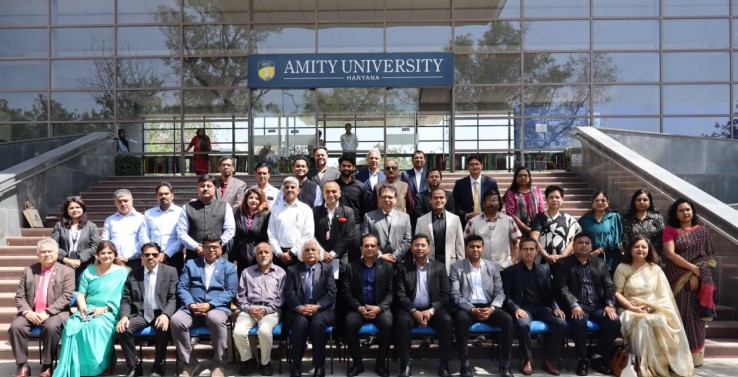
Gurugram, Apr 13: Amity University Gurugram successfully hosted a landmark Academic–Industry National Roundtable on “CSR-Driven Academic–Industry Partnerships for Research, Innovation and Institutional Growth,” bringing together eminent academicians, industry leaders and CSR experts on a common platform to deliberate on strengthening collaboration for a future-ready and innovation-driven education ecosystem.
The roundtable was conceptualised to leverage Corporate Social Responsibility (CSR) as a strategic bridge between academia and industry, enabling meaningful partnerships that go beyond traditional engagement to create long-term, measurable impact. It focused on exploring how CSR can support research and innovation in universities, identifying practical and scalable models of collaboration, fostering engagement with CSR leaders and building a roadmap for sustained partnerships that drive institutional growth and societal impact.
The programme commenced on an auspicious note with the rendition of Saraswati Vandana, followed by an engaging networking session that facilitated meaningful interactions and set the tone for insightful discussions.
Delivering the keynote address, Prof. (Dr.) P. B. Sharma, Hon’ble Vice Chancellor, Amity University Gurugram, underscored that “excellence is more important than mere relevance,” and described academia and industry as “lifelines of each other.” Prof Sharma emphasised that strong collaboration between the two is essential to drive innovation, enhance institutional excellence and ensure sustainable growth. Sharing a forward-looking vision, Prof. Sharma highlighted India’s economic trajectory from a $4.8 trillion to a $40 trillion economy, stressing that academia–industry partnerships will play a pivotal role in achieving this transformation. Introducing the concept of “(UNI)³–I Power,” Prof Sharma explained how the integration of universities and industry can multiply innovation, accelerate growth and create meaningful impact at scale. Prof Sharma also highlighted the importance of Institutional Social Responsibility (ISR), urging universities to actively contribute to societal development, sustainability, and nation-building.
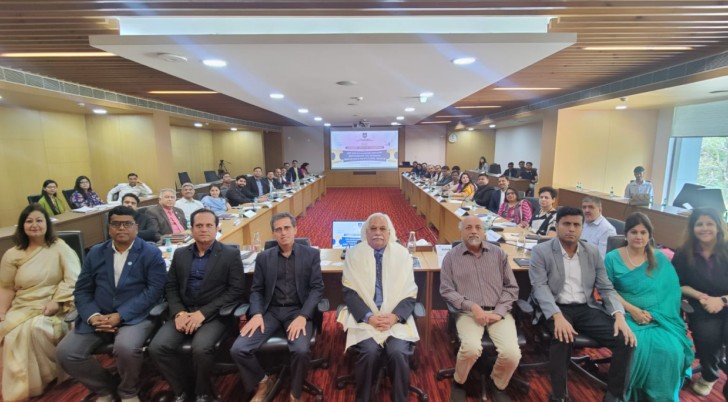
Prof. (Dr.) Ashok Nagawat, Hon’ble Vice Chancellor, Delhi Skill University, emphasised the need for experiential learning, critical thinking and adaptability in a rapidly evolving world. Prof Nagawat highlighted that universities must evolve beyond traditional roles to become centres of holistic development and innovation. Advocating the vision of Samarth Bharat, he stressed the importance of empowering individuals through skill development and capacity building. Prof Nagawat further underlined the need for structured training programmes for students and women, particularly in the use of technology, along with capacity-building initiatives for vendors to enhance skills such as hygiene and effective communication, thereby strengthening overall workforce readiness.
Prof. (Dr.) Vikas Madhukar, Pro Vice Chancellor, Amity University Gurugram, described academia–industry collaboration as a transformational opportunity that can significantly enhance innovation, employability and knowledge exchange. He emphasised the need to align research-particularly doctoral studies-with real-world applications, while drawing insights from global best practices and national initiatives such as Startup India and NITI Aayog.
Offering an industry perspective, Mr. Neeraj Narang, Senior Director – Global HCM Product Strategy and APAC Lead at Oracle, emphasised the need to strengthen India’s research and innovation ecosystem. He noted that, unlike countries such as the USA and China, research exposure in India remains limited and must begin at the foundational level. Advocating a shift from job-centric education to idea-driven and innovation-led learning, he encouraged students to think creatively and pursue innovation. Highlighting the immense potential of young minds, he remarked that even small encouragement can lead to significant outcomes, stressing the need to nurture an innovation mindset early to build a self-reliant and future-ready India.
Mr. R. Kartik, Director General, CIPU, emphasised the importance of structured dialogue, continuous engagement and global partnerships in bridging the academia–industry gap and enhancing the competitiveness of Indian higher education.
Prof. (Dr.) Sanjna Vij, Prof ,School of Liberal Arts & Director, Amity Academic Staff College, emphasised that “working in isolation is no longer viable in today’s interconnected world.” Prof Vij highlighted that impactful CSR outcomes can only be achieved through strong collaboration, where academia contributes intellectual capital, research capabilities, and young talent, while industry brings practical exposure, resources and real-world challenges. She further emphasised that such platforms are essential to foster innovation, problem-solving and societal impact, while also strengthening the culture of collaboration and collective action.
Prof. Abhishek Ranjan, a globally recognised leader in ESG and sustainability and Chairman, ASSOCHAM Karnataka, underscored the importance of shared values and collaborative partnerships in addressing complex societal challenges. He emphasised that CSR initiatives must be closely aligned with sustainability goals and driven by research-led, solution-oriented approaches. The discussions further highlighted the urgent need to move from theory to application by strengthening incubation ecosystems and developing industry-integrated learning models that foster innovation, practical exposure, and real-world impact.
The roundtable was structured around five critical themes: research that solves real-world problems; long-term and sustainable academia–industry partnerships; innovation and student startup ecosystems; skill development, trainings and experiential learning; and community development and social impact through CSR.
The open house discussion brought together diverse perspectives on bridging the gap between theory and practice, strengthening incubation ecosystems and building industry-integrated learning environments. Experts and participants emphasised the need for stronger collaboration, practical learning approaches, data sharing and long-term, value-driven partnerships. Key insights included the importance of ESG integration, demand-driven research, robust funding models and scalable innovations aligned with industry needs. The discussions underscored the need to actively engage students as key stakeholders driving innovation and real-world solutions.
The roundtable also witnessed valuable contributions from distinguished participants including Ms. Mamta Bhatia, University of Delhi; Mr. Vishal Bhardwaj, Head – CSR, Shree Cement Ltd.; Dr. Kadambari, AVP – ESG & CSR, Varun Beverages Ltd.; Mr. Gaurav Kumar, Head CSR, UNO Minda Group; Prof. Sapna Narula, Chaudhary Charan Singh University; Mr Bikram Ahluwalia and Mr. Jashandeep Singh from Chitkara University; Mr. Siddharth Shankar Tripathi, Bennett University; Mr. B. S. Patil, Dayananda Sagar University; Mr. Onkar Bagaria, Vivekananda Global University; Mrs. Meenakshi Gujral, KR Mangalam University; Mr. Pawan Kumar Verma, Lamrin Tech Skills University; Mr. Arun Arora, Director, Chetak Foundation; Mrs. Meeta Jain, Arpana Trust; Mr. Sachin Bedi, National Sports Federation of India (NSFI); Dr. Ravi Mahuja, Registrar, AUH; and Maj. Gen. J. S. Dhull, AUH, among others.
Way Forward and Key Takeaways
The discussions led to several key recommendations:
• Developing co-created research agendas aligned with real-world challenges
• Strengthening industry-integrated learning models
• Enhancing startup and incubation ecosystems
• Building long-term, measurable CSR partnerships
• Promoting skill development and future-ready education frameworks
Conclusion
In his closing remarks, Mr. Rusen Kumar, Founder, India CSR, emphasised the central role of students as drivers of innovation and institutional growth. He highlighted that CSR funding can play a transformative role in improving access, quality and industry relevance in higher education.
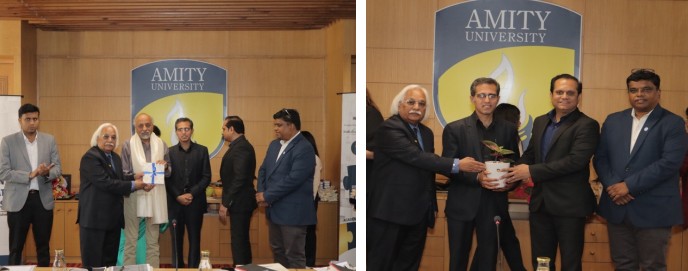
The event also featured the felicitation of distinguished dignitaries, recognising their valuable contributions and reinforcing the spirit of collaboration. The session concluded with a vote of thanks, followed by a networking lunch and group interaction, marking the successful culmination of a highly insightful, collaborative and action-oriented roundtable aimed at shaping the future of academia–industry partnerships in India.
