
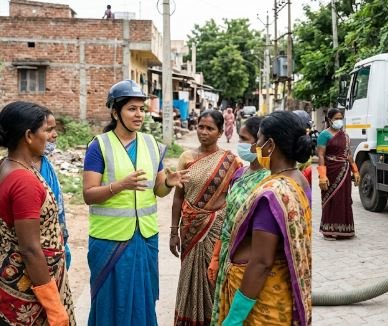
New Delhi, Nov 12: Women working in sanitation and waste management are moving towards safer livelihoods, financial independence and leadership roles with support from government initiatives such as the National Action for Mechanised Sanitation Ecosystem (NAMASTE) Scheme.
The experiences of six women from Telangana and Delhi highlight how financial assistance, mechanisation, occupational safety and community support can create new opportunities for women in the sector.
In Siricilla, Telangana, five women who previously worked as septic tank cleaning helpers have started their own mechanised sanitation enterprise. With financial support under the Swachhta Udyami Yojana, they acquired mechanised desludging vehicles and began providing sanitation services under the Siricilla Municipal Corporation.
The initiative has helped them move from physically demanding and risky work to operating and managing a business of their own. It has also strengthened their professional confidence and financial independence.
In Seemapuri, Delhi, Anita, a former waste picker, has emerged as a community leader. After starting with waste sorting and later running a small scrap shop, she became involved in a Self Help Group (SHG) and eventually took on the role of its president. She also began working as a Senior SHG Mobiliser and Community Mobiliser with a local NGO.
Through the NAMASTE Scheme, Anita received occupational safety training, personal protective equipment (PPE) and an Ayushman card. Her work with the NGO provides an additional monthly income of ₹10,000. She now helps other waste pickers understand the scheme, complete registration and access available government benefits.
These stories highlight how support for sanitation workers and waste pickers can go beyond improving working conditions. It can also help women become entrepreneurs, strengthen their financial position and take an active role in community development.
Through mechanisation, skill development, occupational safety measures and social security support, the NAMASTE Scheme aims to promote a safer and more dignified sanitation ecosystem.
The journeys of these women demonstrate how access to opportunities and institutional support can help workers move beyond traditional roles and build more secure futures for themselves and their communities.
