
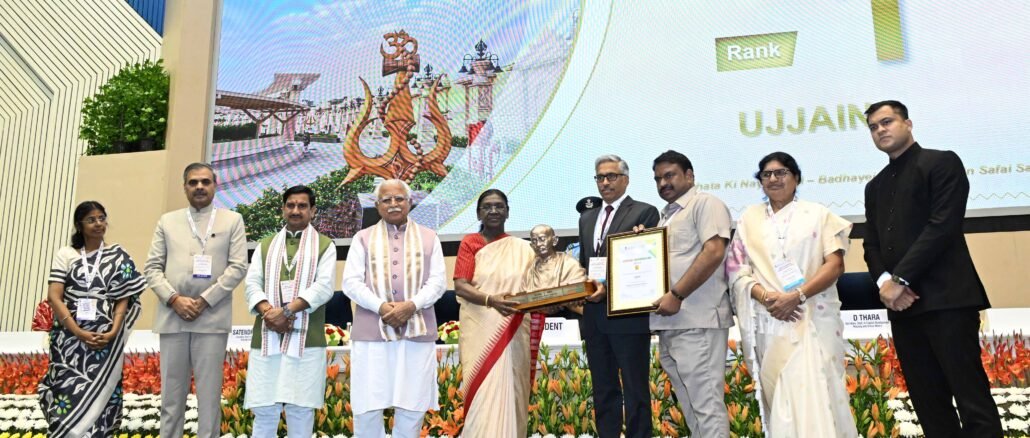
New Delhi, Nov 12: President Droupadi Murmu has called for a more inclusive and technology-driven approach to urban cleanliness, emphasising that cleaner cities depend on active citizen participation, accountable municipal bodies and innovative sanitation solutions. Addressing the presentation of the Swachh Survekshan Awards 2025–26 in New Delhi on Wednesday, she highlighted the need to move beyond cleanliness campaigns and build a culture of shared responsibility across Indian cities.
The President said cleanliness should not be viewed simply as an effort to improve the appearance of streets and public spaces. It is equally important for public health, social awareness and effective administration. Lasting progress, she noted, begins with responsible habits at the household level and grows through the collective efforts of neighbourhoods, communities and local governments.
Murmu urged citizens, particularly young people, women, Resident Welfare Associations and community organisations, to take a more active role in maintaining their surroundings. She stressed that residents should communicate local problems to municipal authorities and share their experiences so that shortcomings can be addressed promptly. Regular interaction between citizens and civic bodies, she said, can strengthen transparency, public trust and administrative accountability.
Citizen Feedback Should Drive Better Civic Services
Emphasising the importance of public participation, the President said residents are best positioned to judge the cleanliness of their neighbourhoods. Their feedback should therefore serve a practical purpose beyond surveys and city rankings.
Municipal administrations need to use public responses to identify service gaps, improve waste collection and strengthen sanitation facilities. A more responsive system can help civic bodies understand neighbourhood-level problems and direct resources where they are needed most.
This approach also places greater responsibility on urban local bodies to deliver consistent services rather than treating cleanliness as an occasional public campaign. For residents, better sanitation management can translate into healthier neighbourhoods, improved public spaces and a better quality of urban life.
Sanitation Innovation Opens Opportunities for Startups
The President also highlighted the growing importance of technology in addressing India’s sanitation challenges. She called for solutions that are effective, affordable and safe, while appreciating the work being undertaken by IITs and other scientific research institutions.
She noted that startups are emerging in the sanitation sector and can play a meaningful role in solving practical problems while creating employment opportunities.
The expanding need for efficient sanitation systems offers scope for innovation in waste processing, recycling, wastewater treatment, collection systems and sanitation equipment. Startups and smaller businesses can contribute by developing cost-effective technologies and providing specialised services to municipalities and communities.
Closer cooperation between research institutions, entrepreneurs and civic administrations could help move promising solutions from development to practical use. It could also create new business opportunities while supporting cleaner and more resource-efficient cities.
Tier-2 and Tier-3 Cities Need Stronger Urban Planning
Murmu placed particular emphasis on improving the capacities of Tier-2 and Tier-3 cities, describing them as rapidly growing urban centres with their own development needs and challenges.
As these cities expand, pressure on waste management, drainage, sanitation and basic civic infrastructure is likely to increase. The President stressed that their development must follow a national framework while remaining responsive to local conditions.
She also encouraged planners in smaller cities to learn from the experiences of Tier-1 cities. Understanding the challenges faced by larger urban centres could help emerging cities plan infrastructure more effectively and avoid repeating earlier mistakes.
The issue is particularly important as smaller cities increasingly become centres of economic activity, investment and employment. Their ability to provide reliable civic services will influence their attractiveness for businesses as well as their long-term liveability.
Organised by the Union Ministry of Housing and Urban Affairs, the Swachh Survekshan Awards recognise India’s cleanest cities and acknowledge their contributions to the Swachh Bharat Mission-Urban.
The President’s address highlighted a wider shift in the country’s urban development priorities. Cleaner cities will require more than rankings and infrastructure investments; they will depend on responsible citizens, responsive municipal institutions and practical innovation. Strengthening these areas can improve public health, support sanitation-based enterprises and help India’s growing cities become healthier, more efficient and better places to live and work.
