
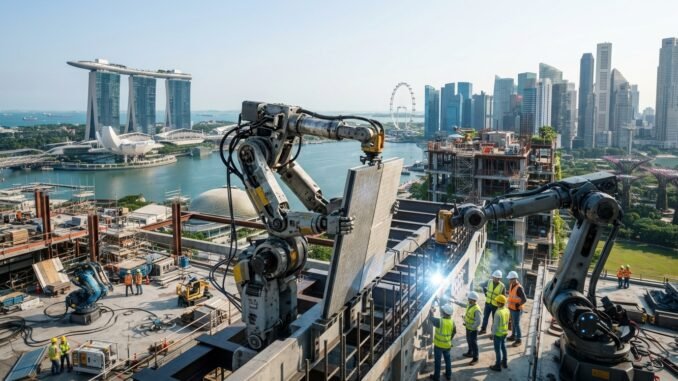
Nov 06: Singapore is accelerating its efforts to modernise the construction industry through robotics, automation and artificial intelligence. As the country addresses rising construction demand, labour constraints and productivity challenges, embodied AI is emerging as a promising technology that could reshape how buildings and infrastructure are developed.
Unlike conventional AI systems that primarily process information, embodied AI connects intelligence with physical machines, allowing robots to perceive their surroundings, make decisions and perform tasks in real-world environments. In construction, this could enable robots to handle repetitive, physically demanding and precision-based activities while supporting human workers on complex projects.
With government-backed initiatives, robotics research and growing industry participation, Singapore is positioning itself to become an important market for construction automation.
Singapore Strengthens Its Embodied AI Ecosystem
Singapore has steadily expanded its robotics capabilities through research programmes, industry partnerships and technology development initiatives. The National Robotics Programme, established in 2016, has supported the development and adoption of robotics across different sectors.
The country is also exploring real-world environments where companies can test and refine robotics solutions. The Punggol Digital District, for example, has been positioned as a testbed for emerging technologies, including robotics and embodied AI applications.
Another development is the launch of CoLab EAI on 28 October 2026 by Enterprise Singapore, the Building and Construction Authority (BCA) and The GEAR by Kajima. The initiative is designed to help startups develop, test and commercialise embodied AI solutions for construction.
Applications are expected to open in early 2027, with potential use cases including material handling, façade installation and surface finishing. Such initiatives could help bridge the gap between laboratory research and practical deployment at construction sites.
Construction Robotics Could Address Singapore’s Productivity Challenges
Singapore’s construction sector faces growing demand for infrastructure, residential developments and commercial properties. The BCA has projected that construction demand could reach S$39 billion to S$46 billion annually between 2027 and 2030.
Meeting this demand will require improved productivity, more efficient project management and better use of available manpower. Robotics could help construction companies complete repetitive tasks faster while improving consistency and reducing dependence on manual processes.
1. Autonomous Excavators and Heavy Equipment
Autonomous construction equipment is among the most promising applications of embodied AI. Excavators, compactors and other heavy machinery can be equipped with sensors, cameras and intelligent control systems to perform selected operations with limited human intervention.
A pilot involving JTC and Kajima, launched in September 2026 at the Jurong Innovation District’s Bulim Autonomous Yard, is exploring autonomous excavators and compactors. The initiative aims to reduce the need for skilled equipment operators, with a target of one operator remotely supervising two machines.
The ability to retrofit existing machinery could also make adoption more practical for construction companies that do not want to replace their entire equipment fleet.
2. Autonomous Material Handling
Moving construction materials across large sites can consume considerable time and manpower. Autonomous mobile robots could transport tools, equipment and building materials between designated locations.
Using sensors, cameras and navigation technology, these machines can identify obstacles, adjust routes and operate within changing site conditions. This could improve material movement while allowing workers to focus on specialised construction activities.
3. Robotics for Flooring and Finishing Work
Flooring, screeding, grouting and surface finishing require precision and consistency. Robotics can support these activities by reducing repetitive manual work and maintaining more uniform results.
Singapore has already seen industry applications in this area. Fabrica AI and Woh Hup have worked on robotic floor-tile grouting solutions, demonstrating how automation can be incorporated into actual construction projects.
Such applications could become increasingly relevant as developers and contractors look for ways to improve productivity without compromising finishing quality.
4. Smart Construction Sites and Worker Safety
Construction sites involve heavy machinery, changing work environments and multiple teams operating simultaneously. Embodied AI systems could improve site safety by helping machines recognise workers, detect obstacles and respond to potential hazards.
Cameras, LiDAR sensors, geofencing and computer vision can support real-time monitoring and safer equipment operation. The JTC-Kajima autonomous machinery pilot incorporates technologies such as LiDAR, geofencing and emergency-stop controls.
Although these systems cannot eliminate every workplace risk, they could provide an additional layer of protection when combined with established safety procedures and human supervision.
5. Integration with Building Information Modelling
The integration of robotics with Building Information Modelling (BIM) and digital twins could improve coordination between design and construction teams.
Digital models can provide robots with information about layouts, dimensions and construction sequences. This could help automate selected installation activities, improve measurement accuracy and reduce material waste.
As construction projects become more digitally connected, the ability to translate digital plans into physical operations could become an important competitive advantage.
Government Support Could Accelerate Robotics Adoption
Government support will play an important role in determining how quickly construction robotics moves from pilot projects to widespread commercial use.
The BCA has been exploring ways to make robotics more accessible to contractors, including potential discounted equipment-leasing arrangements. Such measures could help smaller construction companies overcome the high initial costs associated with automation.
Singapore’s Built Environment Accelerated Movement for the Productivity (BEAMP) initiative also supports efforts to improve productivity and encourage technology adoption across the built environment sector.
In October 2026, Enterprise Singapore and HDB announced plans for a new research and development workspace at the HDB Centre of Building Research, alongside S$4 million in funding for the Cool Ideas Enterprise call for proposals. These initiatives could encourage more collaboration between technology developers, research institutions and construction companies.
Business Opportunities for Robotics and Technology Companies
Singapore’s growing interest in embodied AI could create opportunities for both local and international businesses.
Robotics manufacturers could develop machines designed for specific construction activities, while AI companies could provide software that helps equipment understand and respond to changing site conditions.
Other opportunities could emerge in:
-
Sensor and computer vision technology.
-
Autonomous machinery and robotic equipment.
-
Robotics integration and maintenance services.
-
Equipment leasing and automation-as-a-service models.
-
BIM and digital twin integration.
-
Workforce training and robotics education.
Startups could also collaborate with established construction companies to test solutions in real projects. These partnerships would help technology developers understand practical site requirements while giving contractors access to emerging automation tools.
Workforce Transformation Will Be an Important Consideration
The adoption of robotics is likely to change the skills required across Singapore’s construction industry.
While machines may take over certain repetitive and physically demanding activities, human workers will remain essential for planning, supervision, technical decision-making and complex construction tasks.
Demand could increase for robotics technicians, automation specialists, equipment supervisors and workers trained to operate intelligent machinery. Construction companies may therefore need to invest in reskilling programmes to help their employees adapt to changing job requirements.
The long-term opportunity lies in creating a more technology-enabled workforce rather than simply replacing manual labour with machines.
Challenges That Could Influence Adoption
Despite its potential, construction robotics faces several challenges before it can achieve widespread adoption.
Construction sites are unpredictable environments. Uneven surfaces, changing layouts, weather conditions and the movement of workers and equipment can make autonomous operations difficult.
The initial investment required for robotic equipment, software integration and maintenance may also discourage smaller contractors. Companies will need to assess whether productivity improvements justify the costs.
Safety certification, cybersecurity, data management and compatibility with existing construction systems are additional considerations. Successful deployment will depend on reliable technology, appropriate regulations and effective coordination between machines and human workers.
Singapore’s Construction Industry Moves Towards an Automated Future
Singapore’s investment in embodied AI and construction robotics reflects a broader shift towards technology-driven infrastructure development. From autonomous excavators and material-handling robots to automated finishing systems, intelligent machines could gradually become part of everyday construction operations.
Government-backed initiatives, startup participation and partnerships with established contractors are helping build the foundation for this transition. However, widespread adoption will depend on the ability to demonstrate measurable productivity gains, maintain safety standards and make automation financially viable.
As the technology matures, Singapore could strengthen its position as a regional centre for construction robotics and embodied AI innovation. The future of the industry is unlikely to be defined by machines working independently, but by intelligent systems and skilled workers collaborating to build more efficiently, safely and sustainably.
