
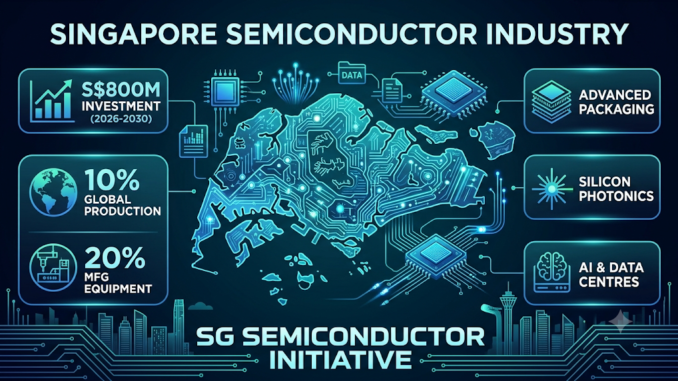
Singapore is strengthening its position in the global semiconductor industry at a time when artificial intelligence, data centres and next-generation computing are reshaping the world’s technology landscape. As demand for advanced chips increases, the country’s established manufacturing capabilities, research infrastructure and international business partnerships are creating new opportunities for investment and industrial growth. With Singapore accounting for approximately 10% of global semiconductor production and 20% of semiconductor manufacturing equipment output, the sector has become a significant pillar of its technology-driven economy.
The focus is now shifting towards higher-value manufacturing, advanced packaging, silicon photonics and semiconductor research. Backed by an S$800 million investment commitment for 2026–2030 under the SG Semiconductor initiative, Singapore is looking to strengthen its role across the global semiconductor supply chain.
For businesses, this expansion represents more than an increase in manufacturing capacity. It offers opportunities to enter specialised technology markets, build partnerships with international manufacturers, develop advanced components and provide services to an increasingly sophisticated industry. As competition for semiconductor capabilities intensifies worldwide, Singapore is positioning itself as a strategic destination for companies seeking long-term growth in advanced manufacturing.
SG Semiconductor Initiative: Building a Stronger Business Ecosystem
A major development in Singapore’s semiconductor strategy is the launch of SG Semiconductor, jointly introduced by the Agency for Science, Technology and Research and the Economic Development Board (EDB).
Supported by S$800 million in investment between 2026 and 2030, the initiative aims to strengthen Singapore’s international reputation, encourage research collaboration and accelerate the commercialisation of semiconductor technologies.
The programme focuses on seven priority areas:
- Advanced packaging
- Silicon photonics
- Power electronics
- Radio-frequency gallium nitride (RF GaN)
- Piezoelectric micro-electromechanical systems (piezoMEMS)
- Flat optics
- Integrated circuit design
These technologies represent important areas of future industry development. They support applications ranging from high-performance computing and data transmission to energy-efficient electronics and advanced industrial systems.
For businesses, the initiative provides a clearer direction for investment and collaboration. Semiconductor manufacturers, equipment suppliers, technology developers and research organisations can explore opportunities in areas receiving strategic attention.
An important part of this approach is connecting research with commercial manufacturing. Developing new technology is only one stage of the process; businesses must also be able to manufacture it reliably, control production costs and bring products to international markets. Strengthening this connection could help Singapore attract companies looking for both research capabilities and a dependable manufacturing environment.
International Investments Strengthen Singapore’s Manufacturing Position
Singapore’s semiconductor expansion is being supported by investments and collaborations involving major international technology companies. These partnerships are helping develop specialised manufacturing capabilities while creating opportunities for local suppliers and service providers.
Applied Materials is expanding its research and manufacturing footprint through advanced packaging projects, including Phase 4 development. This reflects the growing commercial importance of packaging technologies as semiconductor manufacturers look for ways to improve chip performance and production efficiency.
Another significant development is the opening of Advanced Substrate Technologies’ first high-end flip-chip ball-grid-array (FC-BGA) substrate manufacturing facility in Singapore. The joint venture between Broadcom and Toppan is expected to create more than 330 engineering and technical jobs.
FC-BGA substrates are important components in advanced semiconductor packages. As processors become more complex, demand for specialised substrates and precision manufacturing capabilities is increasing. The facility therefore represents an opportunity to strengthen Singapore’s position in a specialised segment of the global semiconductor supply chain.
Meanwhile, Vanguard International Semiconductor and NXP’s joint venture, VSMC, has opened a new 12-inch wafer fabrication facility, with mass production scheduled to begin in the first quarter of 2027.
Such investments can create business opportunities beyond chip production itself. Equipment suppliers, engineering companies, industrial service providers and materials manufacturers may benefit from the growing requirements of an expanding semiconductor manufacturing base.
Advanced Packaging Creates New Growth Opportunities
Advanced packaging is becoming one of the most commercially important areas of semiconductor development. The rapid expansion of AI applications and data centres is increasing demand for processors capable of handling larger workloads with greater speed and efficiency.
Traditionally, improvements in chip performance have relied heavily on increasing transistor density. However, manufacturers are increasingly exploring approaches that combine multiple semiconductor components within a single package.
Technologies such as chiplets, heterogeneous integration and hybrid bonding allow different components to work together as a more sophisticated computing system. These approaches can improve performance, support compact designs and help address challenges involving energy consumption and data transfer.
For Singapore, this creates opportunities to develop specialised capabilities in packaging equipment, substrates, precision engineering and manufacturing processes.
Businesses operating in these segments could benefit as semiconductor manufacturers invest in more advanced production technologies. The opportunity also extends to smaller suppliers capable of providing specialised materials, testing solutions and technical services.
As advanced packaging becomes increasingly important to next-generation processors, companies with strong engineering expertise and reliable production capabilities could become valuable partners in the global semiconductor ecosystem.
Silicon Photonics Opens Opportunities in AI and Data Centres
Silicon photonics is another technology area attracting growing industry attention. It combines optical and electronic functions on semiconductor platforms, using light to transmit data in applications where conventional electrical connections face performance and efficiency limitations.
The technology has potential applications in high-speed communications, data centres and advanced computing infrastructure. These markets are becoming increasingly important as AI systems require faster data movement between processors, memory and other computing components.
Singapore is strengthening its capabilities through developments involving GlobalFoundries and STATS ChipPAC, particularly in 300mm silicon photonics wafers and co-packaged optics.
Co-packaged optics brings optical communication components closer to electronic processing systems. This approach aims to improve data transmission efficiency and address the growing communication requirements of advanced computing infrastructure.
For businesses, the commercial opportunities extend across optical components, semiconductor manufacturing, packaging technologies, specialised equipment and materials. Companies that develop solutions for faster and more efficient data communication could find new opportunities as global investment in AI infrastructure expands.
Manufacturing Expansion Creates Opportunities for Supporting Businesses
The growth of semiconductor manufacturing creates demand across a much wider industrial ecosystem. Every new production facility requires specialised equipment, precision components, industrial materials, maintenance, logistics and technical support.
This means the benefits of semiconductor investment can extend beyond large manufacturers to smaller companies supplying essential products and services.
For example, equipment maintenance providers, engineering firms, industrial automation companies and materials suppliers can all play a role in supporting semiconductor operations. As production becomes more advanced, demand for specialised technical solutions is also likely to increase.
However, entering the semiconductor supply chain requires considerable preparation. Manufacturers operate under strict requirements for quality, reliability and consistency. Suppliers must demonstrate that they can meet technical specifications, maintain dependable delivery schedules and support long-term production needs.
For smaller businesses, developing specialised capabilities and building relationships with established manufacturers could provide an entry point into this high-value industrial market.
Skilled Talent Becomes a Competitive Business Advantage
Singapore’s semiconductor industry employs more than 35,000 workers, supporting a broad range of technical and professional roles across manufacturing, research, engineering and chip development.
As the industry moves towards advanced packaging, silicon photonics and other specialised technologies, access to skilled talent becomes increasingly important. Businesses need engineers, technicians, researchers and production specialists who understand complex manufacturing processes.
Micron Technology’s operations in Singapore, including its global Centre of Excellence for NAND flash memory, demonstrate the country’s importance as a location for specialised semiconductor expertise.
The industry’s expansion also creates opportunities for universities, research institutions and training providers to strengthen their connections with businesses. Industry-linked education and technical training can help prepare workers for emerging roles while supporting companies that need specialised skills.
For investors, workforce availability is an important consideration when choosing a manufacturing location. A strong talent base can help businesses establish operations, improve productivity and introduce new technologies more effectively.
Key Business Opportunities in Singapore’s Semiconductor Sector
The expansion of Singapore’s semiconductor industry is opening opportunities across several high-value segments.
- Advanced packaging: Businesses can explore chiplets, hybrid bonding, substrates and specialised packaging equipment.
- Silicon photonics: Companies can develop optical communication components and technologies for data centres and advanced computing.
- Integrated circuit design: Growing demand for specialised chips creates opportunities for design companies and semiconductor technology developers.
- Manufacturing equipment: New production facilities require precision machinery, automation systems, maintenance and process-control solutions.
- Materials and components: Semiconductor manufacturers depend on specialised substrates, industrial materials and precision-engineered components.
- Engineering services: Expanding facilities create demand for installation, testing, equipment support and technical maintenance.
- Research and development: Collaboration with research institutions can help businesses develop technologies and move them towards commercial production.
For companies considering expansion, the opportunity lies in identifying specific areas where they can offer technical expertise, competitive products or reliable services. Rather than competing directly with large semiconductor manufacturers, smaller businesses may find stronger opportunities by supporting their specialised production requirements.
Singapore’s Semiconductor Strategy: What It Means for Investors
Singapore’s semiconductor strategy reflects a broader shift in the global technology industry. Countries and businesses are increasingly focusing on supply-chain resilience, advanced manufacturing and access to specialised semiconductor technologies.
The combination of public investment, international partnerships and research capabilities could strengthen Singapore’s appeal to companies seeking to expand their manufacturing or technology operations.
For investors, the most attractive opportunities may emerge in specialised segments where demand is growing and technical capabilities are difficult to develop quickly. Advanced packaging, silicon photonics, manufacturing equipment and semiconductor materials are among the areas receiving increasing attention.
However, semiconductor investment requires a long-term perspective. High capital requirements, complex production processes, technological changes and the need for skilled workers can create significant challenges. Businesses must carefully assess market demand, operating costs, technology requirements and potential commercial returns before committing capital.
The Business Outlook for Singapore’s Semiconductor Industry
Singapore’s semiconductor industry is moving towards a more specialised and innovation-driven business model, with advanced manufacturing at the centre of its growth strategy. The S$800 million SG Semiconductor initiative, major corporate investments and focus on technologies such as advanced packaging and silicon photonics demonstrate the country’s ambition to strengthen its position in the global technology supply chain.
For businesses, the opportunity extends well beyond chip manufacturing. Equipment suppliers, engineering companies, materials producers, research organisations and technology developers can all participate in the expanding ecosystem. The growth of the sector can also support skilled employment, industrial innovation and stronger international business partnerships.
The next challenge will be turning investment commitments and research capabilities into commercially successful products, competitive manufacturing operations and sustainable business growth. Companies that combine technical expertise with reliable partnerships and a clear understanding of global demand could find valuable opportunities in Singapore’s semiconductor market.
As AI, data centres and advanced computing continue to reshape the technology industry, Singapore’s focus on high-value semiconductor manufacturing could make it an increasingly important destination for investment and business expansion.
