
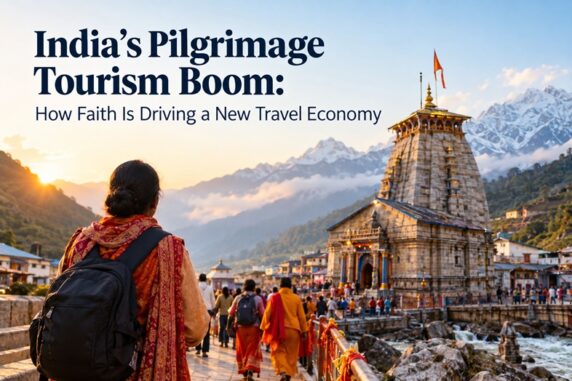

Sept 22: For many Indians, a pilgrimage has always been a journey of faith. But increasingly, it is also a journey involving travel, accommodation, food, local experiences and significant spending.
That is changing the scale of pilgrimage tourism in India.
From Ayodhya and Varanasi to Tirupati, Puri, Bodh Gaya, Amritsar and Vaishno Devi, religious destinations are attracting large numbers of domestic travellers while also gaining attention among international visitors.
The opportunity extends well beyond temples and shrines. Hotels, restaurants, airlines, railways, taxis, tour operators, local retailers, guides and digital businesses are all becoming part of the growing spiritual-travel ecosystem.
In 2026, pilgrimage tourism is increasingly becoming a tourism and business story as much as a religious one.
India’s Huge Domestic Travel Market Is Fueling Pilgrimage Tourism
The scale of India’s overall tourism market provides the foundation for this growth.
The Ministry of Tourism’s India Tourism Data Compendium 2025 recorded 2,948.19 million domestic tourist visits in 2024, up 17.51% from the previous year. Foreign tourist visits reached 20.94 million during the same period.
The Ministry’s tourism dashboard subsequently recorded 4,286.90 million domestic tourist visits and 25.27 million foreign tourist visits in 2025.
These figures represent tourism as a whole, not pilgrimage alone. But they show the enormous travel market in which India’s religious destinations operate.
The government is also separately studying domestic travel expenditure, including spending associated with pilgrimage and religious activities. That focus is significant because the real impact of pilgrimage tourism is not just the number of visitors — it is what those visitors spend along the way.
A Pilgrimage Creates an Entire Local Economy
A traveller rarely spends money only at a temple or shrine.
There is the journey to the destination, a hotel or homestay, meals, local transport, religious offerings, shopping and often souvenirs or handicrafts.
That means a busy pilgrimage destination can support thousands of businesses that may never be directly involved in religious tourism.
This is particularly important for smaller cities and towns where tourism can become an important source of local income.
The government’s PRASHAD scheme, which focuses on pilgrimage and spiritual destinations, also reflects this wider approach to developing tourism infrastructure. The Ministry’s Annual Report 2024–25 reported 48 projects sanctioned under the scheme at a total cost of ₹1,646.99 crore as of December 2024.
Ayodhya Shows What Can Happen When Pilgrimage Meets Infrastructure
Ayodhya is one of the clearest recent examples of how a pilgrimage destination can transform.
According to data presented by the Ministry of Tourism, visitors to Ayodhya district increased from around 6 million in 2020 to more than 164 million in 2024.
Such a dramatic increase does not affect only the religious site.
It changes demand for hotels, restaurants, taxis, public transport, retail, tour operators and local services.
For other pilgrimage destinations, Ayodhya offers an important lesson: attracting visitors is only one part of the equation. The surrounding tourism ecosystem needs to be ready for them.
The Next Wave May Come From Lesser-Known Spiritual Destinations
India’s pilgrimage map extends far beyond its most famous temples and shrines.
Destinations such as Lepakshi in Andhra Pradesh, Kainchi Dham in Uttarakhand, Gavi in Kerala and Mawphlang in Meghalaya represent a broader category of spiritual and culturally rooted travel experiences.
These places may not attract the same volumes as Ayodhya or Varanasi, but their quieter character can itself become an attraction.
For travellers looking to combine spirituality with nature, heritage or reflection, smaller destinations can offer a different experience from heavily crowded pilgrimage centres.
For local tourism businesses, this also creates an opportunity to develop carefully designed itineraries rather than relying entirely on large seasonal visitor flows.
Younger Travellers Are Discovering Pilgrimage Differently
Pilgrimage is also finding a new audience among younger travellers.
For many younger Indians, a spiritual trip may sit alongside interests in heritage, architecture, photography, food, wellness or local culture.
And discovery increasingly happens through digital platforms.
A short video of the ghats of Varanasi, a temple architecture Reel, a creator’s account of a pilgrimage journey or a travel guide on YouTube can put a destination on someone’s travel list.
This does not necessarily mean that the spiritual purpose of the journey has changed. It means the way people discover and plan the journey has changed.
For destinations and businesses, that makes digital storytelling increasingly important.
International Travellers Are Discovering India’s Spiritual Side
India’s spiritual appeal also has an international dimension.
For overseas travellers, places such as Varanasi, Bodh Gaya and Amritsar can offer much more than a religious visit. They connect faith with architecture, history, philosophy, food, music and culture.
The Maha Kumbh in Prayagraj demonstrated the international interest in India’s spiritual traditions, with visitors from several countries travelling to experience the event and surrounding destinations.
This creates an opportunity for India to position pilgrimage tourism as part of a broader cultural travel experience.
But there is an important balance to maintain. Religious traditions should not be reduced to tourist attractions. The cultural and spiritual character of these places needs to remain central to how destinations are presented.
The Modern Pilgrimage Is Becoming More Experience-Led
A pilgrimage today can look very different from the traditional journey.
A visitor to Puri may combine a temple visit with Odisha’s food and handicrafts. A traveller in Varanasi may explore its ghats, architecture, music and local cuisine. A visit to Bodh Gaya may include meditation and Buddhist heritage.
This creates opportunities for destinations to encourage longer stays and spread tourism spending across more local businesses.
The idea is not to turn a pilgrimage into a conventional holiday.
Instead, the surrounding cultural and historical experiences can make the journey richer while giving local communities more opportunities to benefit from tourism.
Infrastructure Will Decide How Sustainable the Growth Is
Large visitor numbers bring their own challenges.
Roads can become congested. Hotels can run short of rooms. Public spaces can become overcrowded. Waste management and sanitation can come under pressure.
For destinations attracting millions of visitors, infrastructure is therefore not a supporting issue. It is central to the tourism experience.
The government’s investment in pilgrimage infrastructure through PRASHAD and the broader destination-development approach under Swadesh Darshan 2.0 show the growing focus on improving visitor facilities while encouraging more sustainable tourism development.
The real test will be whether destinations can grow without losing the character that made people want to visit them in the first place.
Digital Discovery Is Changing How Pilgrims Plan
The pilgrimage journey increasingly starts before the traveller leaves home.
People search online for temple timings, accommodation, routes, transport, festivals, local restaurants and nearby attractions.
That makes digital marketing increasingly important for pilgrimage destinations and businesses.
Hotels can publish practical destination guides. Tour operators can create itinerary content. Local restaurants can promote regional cuisine. Guides can use social media to showcase experiences. Small businesses can make themselves easier to find through search and digital listings.
For international visitors, good digital information can make an unfamiliar destination considerably easier to navigate.
The government’s Incredible India digital initiatives are also moving towards a more connected digital journey, providing information for travellers researching destinations and planning trips.
Small Businesses Could Be Among the Biggest Winners
One of the most interesting aspects of pilgrimage tourism is the number of small businesses that can benefit.
A taxi driver, homestay owner, restaurant, handicraft seller, photographer or local guide can all become part of the visitor economy.
But simply having more tourists does not guarantee that local businesses will benefit.
They need to be visible, accessible and easy to transact with.
Digital payments, online listings, social media, multilingual communication and better customer service can help smaller businesses compete in a tourism market that is becoming increasingly digital.
The Opportunity Is Moving Beyond Festival Seasons
Major religious festivals can bring extraordinary visitor numbers, but the longer-term opportunity lies in making pilgrimage destinations attractive throughout the year.
This could mean developing heritage walks, local food experiences, craft trails, wellness programmes, cultural events and carefully planned regional circuits around major pilgrimage sites.
For hotels and travel companies, this can help reduce dependence on a few peak periods.
For local businesses, a more evenly distributed visitor flow can create steadier demand.
The goal is to build a year-round tourism ecosystem around pilgrimage destinations, rather than treating them as places that become busy only during major religious occasions.
The Next Challenge Is Sustainable Pilgrimage Tourism
India’s pilgrimage destinations cannot simply focus on bringing in more visitors.
Sacred rivers, historic neighbourhoods, temples, forests and mountain ecosystems can be vulnerable to overcrowding and poor waste management.
The next phase of pilgrimage tourism therefore needs to focus on responsible growth.
That means better public transport, waste management, water conservation, crowd management and heritage protection.
The goal should not simply be to increase visitor numbers. It should be to create destinations where large numbers of people can visit without damaging the places they have come to experience.
India Has a Unique Global Opportunity
Few countries have India’s combination of living religious traditions, ancient heritage, architecture, philosophy and cultural diversity.
That gives India an unusual opportunity to build a global identity around spiritual and pilgrimage travel.
But international visitors need more than attractive promotion.
They need reliable transport, clean facilities, clear information, trained guides and experiences that are respectful of local traditions.
India’s opportunity is therefore not just to attract more international pilgrims. It is to make their journeys easier, more meaningful and more comfortable.
The Future of Pilgrimage Tourism in India
Pilgrimage tourism is no longer just a niche part of India’s travel industry.
It sits at the intersection of faith, tourism, culture, infrastructure and local economic development.
Domestic travellers will remain the foundation of the market, while international visitors can add another layer of global interest. At the same time, younger, digitally connected travellers are discovering spiritual destinations in new ways, while lesser-known destinations have an opportunity to develop more intimate and experience-led forms of tourism.
For businesses, that means opportunities across hotels, transportation, food, retail, travel services, technology and digital marketing.
For destinations, the challenge is managing growth without compromising heritage.
And for travellers, a pilgrimage can increasingly become a journey that connects faith with India’s history, food, architecture, culture and local communities.
The opportunity for India is therefore much bigger than simply attracting more pilgrims.
It is about building a year-round, sustainable tourism ecosystem around some of the country’s most meaningful places — while ensuring that the places themselves remain at the heart of the experience.