

The digital landscape has shifted. Just a few years ago, AI-generated content was a novelty; today, it is the engine behind millions of blogs, academic essays, and marketing campaigns. However, as AI models like ChatGPT and Claude have become more sophisticated, so too have the “gatekeepers”—the AI detectors.
For students, content creators, and SEO professionals, this has created a high-stakes game of cat and mouse. How do you leverage the efficiency of artificial intelligence without being flagged? The answer lies in undetectable AI.
In this comprehensive guide, we will dive into what makes content “detectable,” how to bypass AI detection, and why “humanizing” your content is the key to long-term digital success.
Understanding the Gatekeepers: How Does an AI Detector Work?
Before we can learn how to bypass the system, we must understand how the system thinks. Tools like GPTZero, Originality.ai, and Copyleaks don’t actually “read” your content the way a human does. Instead, they use mathematical models to look for patterns.
Most AI detectors rely on two primary metrics:
- Perplexity: This measures the complexity of the text. AI models are designed to be helpful and clear, which often results in very predictable word choices. Low perplexity is a huge red flag for detectors.
- Burstiness: This refers to the variation in sentence length and structure. Humans tend to write in “bursts”—a long, flowing sentence followed by a short, punchy one. AI, conversely, tends to produce sentences of very similar length and rhythm.
When an AI detector sees low perplexity and low burstiness, it assigns a high “AI probability” score. To achieve undetectable AI, you must disrupt these patterns.
Why the Need for Undetectable AI?
You might wonder: “If I’m using AI to help me write, why do I need to hide it?” The reality is that the “AI label” carries significant weight in different industries.
1. For Content Creators and SEOs
Search engines, particularly Google, have clarified that they don’t penalize AI content if it is high-quality and helpful. However, “mass-produced, low-effort AI content” is frequently targeted by spam updates. By focusing on bypass AI techniques, creators ensure their content feels original, maintains brand voice, and provides the “human touch” that readers crave—and search engines reward.
2. For Students and Academics
The academic world is currently in a state of flux. While AI can be an incredible research assistant or tutor, many AI detectors are prone to “false positives”—flagging original student work as AI-generated. For students, using undetectable AI tools or techniques is often a defensive measure to ensure their legitimate work isn’t unfairly penalized by imperfect software.
3. For Freelance Writers
Clients often pay for a human perspective. If a writer uses AI to draft but fails to humanize it, they risk losing credibility. Learning to create undetectable AI content allows writers to maintain their productivity while delivering a product that meets professional standards.
The Art of the Bypass: How to Make AI Text Undetectable
Bypassing AI detection isn’t about “tricking” a machine; it’s about making the content objectively better. Here are the most effective strategies to bypass AI filters.
1. Manual “Humanization” (The Gold Standard)
The most reliable way to create undetectable AI content is to rewrite the AI’s output.
- Inject Personal Anecdotes: AI doesn’t have a life. It can’t tell a story about a “difficult client I had last Tuesday” or “how the smell of coffee reminds me of my grandmother.” Adding these details instantly breaks the AI pattern.
- Adjust the Tone: AI tends to be overly formal or “middle-of-the-road.” Use slang, industry-specific jargon, or a touch of humor to make the voice unique.
2. Utilizing “Undetectable AI” Rewriting Tools
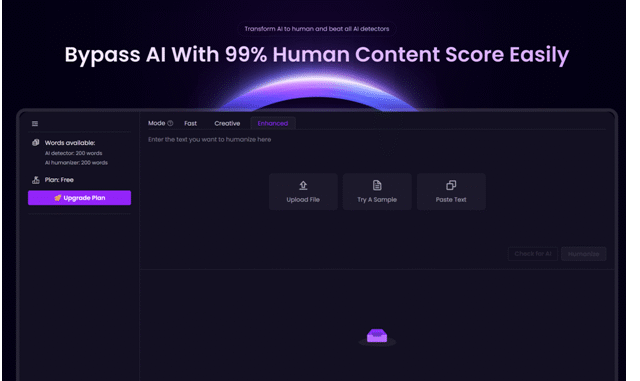
There is a new generation of tools specifically designed to bypass AI detectors. These tools (often called “Humanizers”) take a standard AI-generated paragraph and intelligently rephrase it to increase perplexity and burstiness. They replace common word pairings with more creative synonyms and vary the sentence cadence to mimic human speech.
3. The “Prompt Engineering” Approach
You can often bypass an AI detector simply by changing how you ask the AI to write. Instead of saying “Write a blog post about SEO,” try:
“Write a blog post about SEO using a conversational tone, varying your sentence lengths significantly. Avoid using overly common transition words like ‘Furthermore’ or ‘In conclusion.’ Use a mix of complex and simple sentences.”
Key Strategies for Crafting Undetectable Content
If you want to ensure your content stays under the radar, follow these four pillars of human-centric writing:
1. Avoid “AI Transitions”
AI loves certain words. If your article is filled with “In the rapidly evolving landscape of…”, “It is important to note that…”, or “In conclusion…”, an AI detector will flag it instantly. Replace these with more natural transitions like “The truth is…”, “Here’s the catch…”, or “So, what does this mean for you?”
2. Use Data and Citations
While AI can hallucinate facts, humans (usually) cite their sources. By manually adding links to recent studies, quotes from experts, or specific statistics, you ground the article in reality, making it much harder for a detector to claim it’s purely synthetic.
3. Break the “Perfect” Grammar
AI produces grammatically perfect, yet sterile, text. Humans sometimes use sentence fragments for emphasis. Like this. Or they might use a slightly unconventional metaphor. Embracing these “imperfections” is a hallmark of undetectable AI.
4. Fact-Check Everything
The biggest giveaway of AI isn’t just the style—it’s the content. AI often misses nuance or gets facts wrong. A human editor who checks the logic and updates the information for 2026 standards will naturally change the structure of the text, helping to bypass AI detection.
The Ethics of Bypassing AI Detection
As we discuss how to bypass AI, we must address the “why.” Using these tools to spread misinformation or to cheat on exams is a misuse of technology.
However, using undetectable AI as a productivity multiplier—to help you get your ideas onto the page faster and then refining them into a professional, human-sounding piece—is simply the future of work. The goal isn’t to replace human thought, but to bridge the gap between AI efficiency and human creativity.
Conclusion: The Future is Hybrid
The era of “copy-paste” AI content is over. As AI detectors become more intelligent, the bar for “good” content continues to rise. To succeed as a student or creator today, you must master the balance of using AI for the heavy lifting and applying “humanizing” techniques to ensure your work is truly undetectable AI.
Remember: the best way to bypass AI detection is not just to change the words, but to add the one thing a machine doesn’t have—your unique perspective.
Do you have a favorite strategy for making AI content feel more human? Or perhaps a specific tool that has helped you navigate the world of AI detectors?