
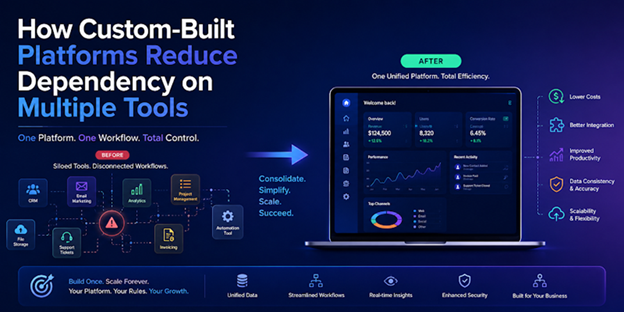

The Hidden Cost of a Fragmented Tech Stack
Every growing business eventually hits the same wall. What started as a manageable collection of tools, each solving a specific problem, slowly becomes a tangled web of subscriptions, integrations, and workarounds. Your CRM does not talk to your billing software. Your reporting tools pull data in different directions. Your team spends more time managing tools than actually using them to drive results.
This is not a technology problem. It is an architecture problem.
Businesses that invest early in custom software development services are far better positioned to scale without the friction that comes from stitching together off-the-shelf products. A purpose-built platform consolidates functionality, reduces redundancy, and gives your organization full control over how technology evolves alongside your business goals.
The impact of a fragmented stack goes beyond internal inefficiency. It affects the experience your customers have with your brand at every touchpoint. When backend systems are disconnected, front-end experiences suffer. Slow load times, inconsistent data, and broken workflows all trace back to platforms that were never designed to work together in the first place. Addressing this at the architecture level is what separates businesses that scale smoothly from those that constantly fight their own systems.
Nowhere is this more visible than in the mobile space. Companies that have invested in custom mobile application development services understand that a tailor-made mobile experience is not a luxury. It is a competitive necessity that directly impacts user retention, operational efficiency, and brand perception in an increasingly mobile-first world.
The question for today’s business leaders is not whether to invest in custom platforms. It is whether you can afford not to.
What Defines Enterprise-Grade Applications
Before evaluating whether your current stack is holding you back, it helps to understand what a well-built, enterprise-grade application actually looks like.
Scalability is the ability of a platform to handle growing workloads without a full rebuild. Scalable applications are designed with future demand in mind, not just current usage patterns.
Security goes beyond passwords and firewalls. Enterprise applications are built with security at the architecture level, including role-based access control, data encryption, audit trails, and compliance with regulations such as GDPR or HIPAA depending on your industry.
Performance means the platform holds up under pressure. Whether you have 100 users or 100,000, the experience should remain fast, consistent, and reliable across every device and location.
Reliability refers to uptime, disaster recovery, and fault tolerance. Enterprise applications are designed to minimize downtime and recover quickly when something goes wrong, so your business operations are never left exposed.
Integration capabilities allow the platform to connect seamlessly with third-party systems, APIs, and data sources without requiring constant custom workarounds. A truly enterprise-grade system is built to serve as the central hub of your operations while still communicating cleanly with the tools that surround it.
Key Pillars for Long-Term Growth
Building for the future means making architectural decisions today that will not become obstacles tomorrow. There are four pillars that define a future-ready platform.
Modular Architecture
The debate between microservices and monolithic architecture has evolved over the years. Early-stage businesses often benefit from starting with a well-structured monolith that can be broken into services as complexity grows. What matters most is that your codebase is modular, meaning individual components can be updated, replaced, or scaled independently without bringing down the entire system.
A modular approach reduces risk, speeds up development cycles, and allows your engineering team to move quickly without disrupting existing functionality.
Cloud-Native Development
Cloud-native platforms are built to take full advantage of cloud infrastructure. This means on-demand scalability, pay-as-you-go cost structures, geographic distribution, and built-in redundancy. Businesses that build cloud-native from the start avoid the painful and expensive process of migrating legacy systems later on.
Beyond cost savings, cloud-native architecture enables faster deployment cycles and better collaboration across distributed teams, which matters more than ever in today’s working environment.
Data-Driven Decision Making
A custom platform gives you complete ownership of your data and how it flows through your organization. This is a significant advantage over third-party tools that often silo data or restrict how it can be accessed and analyzed.
When your platform is designed with data architecture in mind, you gain the ability to build real-time dashboards, run predictive analytics, and make faster, more informed decisions at every level of the business without waiting on a vendor to release a new reporting feature.
Automation and AI Readiness
The organizations winning in their industries are the ones that have embedded automation into their core operations. From automated reporting and workflow triggers to AI-powered recommendations and predictive maintenance, custom platforms can be designed with these capabilities built in from day one.
Off-the-shelf tools often offer limited automation features or charge a premium for them. A custom-built system can be architected to support intelligent automation at scale, without being constrained by a vendor’s product roadmap or pricing tier.
Common Mistakes Businesses Make
Understanding what to do right requires knowing what others have done wrong.
Short-term development mindset. Many businesses build software to solve today’s problem without considering what the system will need to do in three years. The result is a platform that requires a costly rebuild the moment growth accelerates beyond what the original architecture was designed to handle.
Ignoring scalability early. Scalability is not something you add later. It needs to be baked into the architecture from the beginning. Databases, APIs, and server infrastructure all need to be designed with scale in mind, even if current usage is modest.
Choosing the wrong tech stack. Not every technology is right for every use case. Selecting a framework or language based on what is trendy rather than what fits your business requirements can lead to performance bottlenecks and talent shortages that are difficult to reverse.
Underestimating integration complexity. Businesses often assume that connecting a new platform to existing tools is straightforward. In reality, poorly planned integrations create data inconsistencies, security vulnerabilities, and maintenance burdens that compound significantly over time.
Neglecting user experience in favor of functionality. A platform loaded with features that nobody uses effectively is a wasted investment. User experience should be treated as a core requirement, not something that gets addressed after launch.
Best Practices for Building Future-Ready Applications
Strategic planning before development. The most successful digital platforms begin with a thorough discovery phase. This includes defining business objectives, mapping user journeys, auditing existing systems, and documenting technical requirements in detail. Time spent here directly reduces costly revisions during development and costly regrets after launch.
Choosing the right development partner. This decision carries more weight than most business leaders realize. The right partner brings not just technical expertise but also strategic thinking, industry experience, and a clear process for managing complex projects. Look for partners who ask questions about your business goals before talking about technology choices.
Building with APIs first. Designing your platform with an API-first philosophy ensures that every component can communicate cleanly with other systems. This future-proofs your architecture and makes it significantly easier to add new features, integrations, or channels over time without disrupting what already works.
Continuous optimization and iteration. Launching a platform is not the finish line. The most effective digital products are treated as living systems that are continuously monitored, tested, and refined based on real usage data. Teams that commit to regular iteration cycles consistently deliver better outcomes over time.
Investing in documentation and knowledge transfer. Custom platforms represent significant intellectual investment. Proper documentation ensures that your team is not dependent on any single developer or vendor for ongoing maintenance, which protects your investment well into the future.
Real-World Example: How Architecture Drove Business Growth
Consider a mid-sized logistics company that was managing operations across four different platforms: one for dispatch, one for driver tracking, one for customer communication, and a separate billing tool. Each system required manual data entry to keep information synchronized, which led to frequent errors, delayed invoicing, and frustrated customers.
After a thorough technology audit, the company invested in a unified custom platform that replaced all four tools. The new system consolidated dispatch, real-time GPS tracking, automated customer notifications, and invoicing into a single interface. Integrations with existing accounting software were built directly into the platform from day one.
Within six months of launch, invoice processing time dropped by 60 percent, customer complaint volume fell significantly, and the operations team was able to manage a 30 percent increase in order volume without adding headcount. The platform was also built to scale, so as the business expanded into new markets, onboarding new regions required configuration rather than redevelopment.
The key was not just the technology. It was the upfront investment in architecture that made everything else possible.
Conclusion: The Case for Building Smart from the Start
The businesses that will lead their industries over the next decade are not necessarily the ones with the biggest budgets. They are the ones making smarter technology decisions today.
A fragmented tech stack creates friction at every level of an organization. It slows teams down, introduces errors, inflates operating costs, and limits your ability to adapt quickly when the market shifts. A well-architected, custom-built platform eliminates those bottlenecks and gives your business a foundation it can genuinely build on without constantly patching the cracks.
The investment required to build a platform the right way is real. But so is the cost of building it the wrong way and having to do it again in three years with more complexity, more legacy baggage, and more users depending on a system that was never designed to carry that weight.
If you are evaluating where your technology strategy needs to go, the most important first step is not choosing a tool. It is finding the right partner to help you think through the architecture before writing a single line of code. That conversation, approached with clarity and intention, is where lasting competitive advantage is built.