

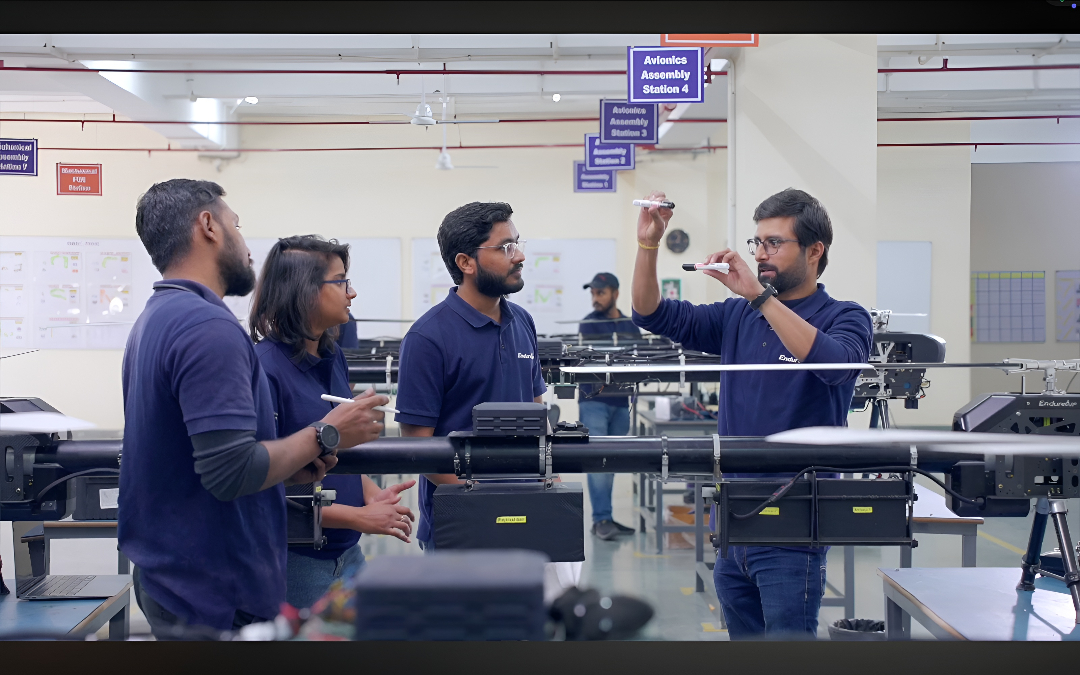
India, May 20: EndureAir Systems Pvt. Ltd., an Uncrewed Aerial System (UAS) design and manufacturing startup from Noida, has secured INR 30.01 crore under the Research and Development Initiative (RDI) fund, from the Department of Science and Technology, with support from the Technology Development Board. Notably, in the first cohort announced under the initiative, EndureAir is the first drone company to receive this support. The funding, structured as patient capital, will support the development of its SABAL–200 kg drone project as it progresses from Technology Readiness Level (TRL) 5 to TRL 9, accelerating indigenous technology advancement.
The capital will be deployed across research and development, technology upgrades, manufacturing capability, and field-testing infrastructure. The move is expected to strengthen India’s efforts to build high-payload drone systems domestically. SABAL–200 kg is a Vertical Take-Off and Landing (VTOL) UAS designed to carry payloads of up to 200 kg. It offers an endurance of 2.5 hours and an operational range of 200 km. The platform combines a variable-pitch rotor architecture with a turbocharged internal combustion engine and an advanced mechanical powertrain, enabling sustained heavy–lift operations over long distances.
“Building deep-tech aerospace systems is a long-cycle effort that extends well beyond prototyping. It requires sustained investment across testing, iteration and validation before systems are ready for deployment,”said *Dr. Abhishek, Founder & Director, EndureAir Systems Pvt. Ltd. “The RDIF support allows us to take SABAL–200 kg from an advanced development stage to a field-ready platform, while continuing to build on indigenous design and engineering capabilities.”_ EndureAir’s platforms are built on over a decade of rotorcraft research and development. Its earlier UAV systems, including SABAL-20 and SABAL-40, have seen deployments across defence and civilian applications, with operations in high-altitude and difficult terrains. SABAL–200 kg builds on this foundation to address logistics challenges in environments where conventional access remains limited. In defence settings, it supports the movement of critical supplies to forward locations. In civilian contexts, it enables infrastructure work in remote and hard-to-reach regions.