
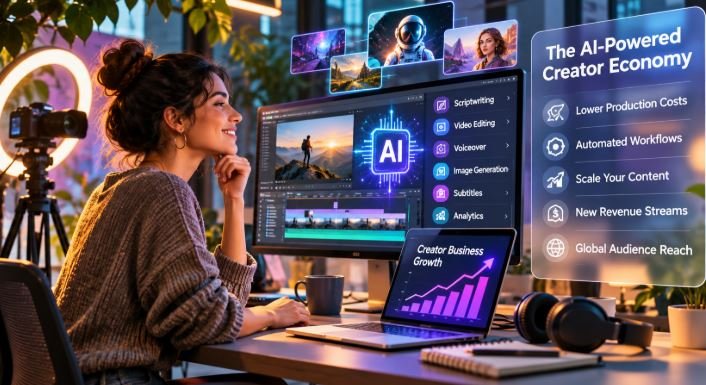
Artificial intelligence is rapidly changing the economics of the global creator economy, opening new business opportunities for independent creators, entrepreneurs, startups and established companies. From AI-powered content production and digital marketing to automated workflows and new monetisation models, technology is transforming how creative businesses are launched, managed and scaled.
What was once an industry largely dependent on expensive production teams, specialised expertise and substantial marketing budgets is becoming increasingly accessible. Today, individual creators and small businesses can use AI tools to develop professional content, build digital brands, reach international audiences and create new revenue streams with fewer resources.
This shift is creating a new commercial landscape in which creativity is no longer limited by traditional production costs. Independent creators are emerging as entrepreneurs, content is becoming a strategic business asset, and companies are rethinking their marketing investments to compete in an increasingly digital marketplace.
However, the real business opportunity extends beyond producing more content at a lower cost. As AI-generated material becomes increasingly common, the ability to build audience trust, establish a distinctive brand identity and deliver authentic human experiences is becoming a critical competitive advantage.
For businesses, the message is clear: artificial intelligence is changing the way the creator economy operates, but sustainable growth will depend on how effectively companies combine technological innovation with human creativity, strategic thinking and meaningful customer relationships.
AI Is Lowering the Barriers to Entering the Creator Economy
For years, professional content production was largely associated with significant financial investment. Creating a high-quality video, developing a brand campaign or producing professional marketing materials often required multiple specialists, expensive equipment and considerable time.
Artificial intelligence is changing this equation.
Tools such as ChatGPT, Adobe Firefly, Midjourney and Runway are allowing independent creators to manage several stages of the creative process using accessible digital platforms.
From writing scripts and generating visual concepts to editing videos, producing subtitles and developing marketing campaigns, AI is making sophisticated production capabilities available to individuals and small businesses.
This development is particularly important for emerging entrepreneurs.
A startup launching a new product can now develop promotional content, prepare social media campaigns and experiment with different creative approaches without immediately hiring a large marketing team.
Similarly, an independent filmmaker, designer or educator can use AI-assisted workflows to bring ideas to life while controlling production expenses.
The economic significance is substantial. Lower entry barriers mean more people can participate in the creator economy, while businesses can explore creative opportunities that might previously have been financially impractical.
However, access to technology does not automatically translate into business success. Creative judgement, market understanding and the ability to communicate a compelling message remain essential.
The Rise of the One-Person Creative Business
One of the most important developments in the AI-powered creator economy is the emergence of the independent creator as a business owner.
Creators are increasingly moving beyond producing content for social media platforms. They are building personal brands, launching digital products, offering professional services and developing communities around their expertise.
Artificial intelligence is helping accelerate this transition by reducing the operational workload associated with running a creative business.
For example, a creator can produce one long-form video and use AI tools to transform it into shorter videos, blog articles, newsletters, social media captions and promotional materials.
AI can also assist with audience research, content scheduling, transcription, keyword research and performance analysis.
This creates an opportunity to distribute ideas across multiple platforms without repeating the entire production process.
For independent creators, the benefit is not simply increased productivity. It is the ability to spend more time developing commercial opportunities, building relationships and creating products that generate income.
The creator is increasingly becoming a combination of content producer, entrepreneur, marketer and business strategist.
How AI Is Creating New Business Opportunities for Creators
The expansion of AI is opening new revenue opportunities across the creator economy.
Rather than relying exclusively on advertising revenue or brand sponsorships, independent creators can develop multiple income streams around their knowledge, skills and audiences.
Some of the emerging business opportunities include:
AI-powered content production services: Independent professionals can offer video editing, graphic design, social media management, content repurposing and digital marketing services to businesses.
Digital products and online education: Creators can develop online courses, e-books, templates, workshops and specialised learning resources with more efficient production workflows.
Personalised content services: AI can help businesses and creators develop content adapted to different languages, industries, customer segments and regional markets.
Virtual influencers and digital twins: AI-generated digital identities can support brand communication, multilingual campaigns and certain forms of licensed digital content production. Consent and transparent disclosure remain important.
AI-powered creative agencies: Small teams can use integrated AI tools to offer services that traditionally required larger production departments.
For entrepreneurs, the opportunity lies in identifying a specific customer need and developing a commercially sustainable solution around it.
AI can reduce the cost of launching a business, but understanding the customer and delivering genuine value remain the foundations of a successful business model.
Why Businesses Are Investing in AI-Powered Content Marketing
The creator economy is no longer relevant only to influencers and independent digital personalities. It is becoming an important part of how businesses communicate with customers.
Companies are increasingly recognising that digital content plays a central role in brand visibility, customer acquisition and long-term engagement.
AI-powered content marketing is helping businesses accelerate the development of campaigns, produce multiple creative variations and adapt communication for different audiences.
An e-commerce company, for example, can use AI to develop product descriptions, promotional videos, advertising concepts and customer education materials.
A startup can experiment with different marketing messages before committing substantial resources to a campaign.
A regional business can create multilingual promotional content to communicate with customers across different markets.
These capabilities are particularly valuable for small and medium-sized enterprises that need to manage marketing budgets carefully.
Nevertheless, businesses must recognise the difference between content production and effective marketing.
Publishing more frequently does not necessarily produce more customers. Successful marketing still depends on a clear brand identity, a relevant message, appropriate distribution and an understanding of consumer behaviour.
The companies that benefit most from AI will be those that use technology to improve marketing decisions rather than simply increase content volume.
Human Creativity Is Becoming the Creator Economy’s Biggest Competitive Advantage
As artificial intelligence becomes capable of generating increasingly sophisticated images, videos, articles and marketing materials, a new challenge is emerging: differentiation.
When almost anyone can produce professional-looking content, audiences have more choices than ever before.
This makes authenticity, originality and human experience increasingly important.
People often follow creators because they connect with their personalities, perspectives and stories. They value personal experiences, honest opinions and insights developed through real-world challenges.
An AI system can help write a business article, but it cannot independently replace the experience of an entrepreneur who has built a company, managed a team or overcome a difficult market situation.
Similarly, AI can generate an advertisement, but understanding the emotional and cultural context of a customer requires human judgement.
For businesses, this distinction has direct commercial implications.
Customers are more likely to develop meaningful relationships with brands that communicate consistently, demonstrate credibility and understand their needs.
Brands that rely entirely on generic automated content risk losing their individual identity in an increasingly crowded digital marketplace.
The future competitive advantage will therefore come from combining AI efficiency with original thinking, storytelling and genuine human connections.
Digital Marketing Is Moving Towards Smarter and More Personalised Experiences
Another major development is the growing role of artificial intelligence in digital marketing.
Traditional campaigns often required lengthy production cycles and substantial coordination between creative, marketing and distribution teams.
AI-assisted workflows are making it easier to develop campaign variations, analyse audience behaviour and adapt content according to customer interests.
Businesses can use AI to:
- Identify content opportunities through audience research.
- Develop different advertising concepts and headlines.
- Create multilingual marketing materials.
- Repurpose content across digital platforms.
- Analyse engagement and campaign performance.
- Automate routine marketing operations.
- Support personalised customer communication.
This creates opportunities for businesses to become more responsive to changing market conditions.
However, personalisation must be supported by responsible data practices. Customer privacy, transparency and appropriate consent should remain central to AI-driven marketing strategies.
Technology should improve the customer experience, not compromise consumer trust.
Digital Twins and AI Influencers: A New Commercial Frontier
One of the more distinctive developments in the creator economy is the emergence of virtual influencers and AI-powered digital twins.
A digital twin can be a synthetic representation of a real individual, designed to support certain forms of digital communication and content production.
For creators and businesses, these technologies could enable multilingual content, virtual brand experiences and additional forms of audience engagement.
A creator, for example, may be able to license an authorised digital representation for specific promotional or educational activities without personally recording every piece of content.
For international businesses, virtual personalities may provide a way to adapt communication across different languages and markets.
However, the commercial potential comes with important responsibilities.
Creators need control over their digital identities, clear licensing arrangements and safeguards against unauthorised reproduction.
Businesses must also ensure that audiences understand when they are interacting with synthetic personalities or AI-generated representations.
The success of this emerging market will depend not only on technological quality but also on transparency and trust.
The Challenges: Content Saturation, Copyright and Business Sustainability
Despite the opportunities, the rapid expansion of AI-generated content raises important questions about the future of the creative industry.
Content saturation: As production becomes easier, the volume of digital material is increasing. Creators may find it more difficult to attract attention and maintain audience engagement.
Copyright and intellectual property: Questions around training data, creative ownership, licensing and the use of existing artistic work remain important for creators and businesses.
Platform dependency: Many creators depend heavily on social media algorithms for audience reach and revenue. Changes in platform policies can affect their businesses significantly.
Quality and credibility: AI-generated information can contain errors, misleading claims or fabricated details. Human review and fact-checking remain essential.
Over-automation: Excessive dependence on AI can make content repetitive and weaken the personal connection between creators and audiences.
These challenges highlight why AI adoption needs to be accompanied by responsible business practices.
Creators should focus on building independent audiences, developing recognisable brands and diversifying their revenue sources rather than depending entirely on platform-driven visibility.
Businesses, meanwhile, need clear guidelines around AI-generated content, intellectual property, customer data and human oversight.
What the AI-Powered Creator Economy Means for Entrepreneurs and Small Businesses
For entrepreneurs, the changing creator economy represents an opportunity to build businesses with relatively lean operational structures.
AI tools can help reduce early-stage production expenses, test business ideas and support digital marketing activities.
A small business can establish its online presence, develop educational content and communicate its products to potential customers without immediately building a large internal marketing department.
Independent professionals can also turn their specialist knowledge into commercially valuable digital products and services.
This is particularly relevant in emerging digital markets, where small businesses and individual entrepreneurs are looking for affordable ways to reach customers beyond their immediate geographical locations.
However, technology should be treated as an enabler rather than a business strategy in itself.
A sustainable creator-led business still requires a clear target audience, a differentiated offering, a reliable revenue model and consistent delivery.
The creators and entrepreneurs who understand these fundamentals will be better positioned to turn AI-assisted productivity into long-term commercial growth.
The Skills That Will Matter in the Future of the Creator Economy
The growing adoption of AI is changing the capabilities required to succeed in creative businesses.
Technical production skills remain valuable, but they are increasingly complemented by broader business and creative capabilities.
Some of the most important include:
- Creative direction: Developing original concepts and maintaining a distinctive creative identity.
- Storytelling: Communicating ideas in ways that connect with audiences.
- AI literacy: Understanding how to select and use AI tools effectively.
- Business development: Identifying customers, partnerships and revenue opportunities.
- Digital marketing: Building audience reach and converting attention into business value.
- Critical thinking: Evaluating information, checking accuracy and maintaining content quality.
- Brand management: Establishing credibility and long-term customer relationships.
The future creator will not necessarily be the person who uses the greatest number of AI tools. It will increasingly be the person who knows how to combine technology, creativity and business judgement.
The Future of the Creator Economy: Technology Will Scale Production, Humans Will Create Meaning
The creator economy is entering a new phase in which artificial intelligence is becoming an important part of the infrastructure behind creative production and digital business.
It is lowering entry barriers, creating new revenue models, improving marketing efficiency and allowing independent creators to compete in markets that were once difficult to access.
For businesses, AI offers opportunities to rethink creative operations, reduce repetitive work and develop stronger digital engagement strategies.
For entrepreneurs, it provides new ways to test ideas, launch services and build scalable business models.
But the long-term value of the creator economy will not be determined by production speed alone.
As synthetic content becomes more accessible, audiences will continue to look for original ideas, credible voices and meaningful human experiences.
Businesses that combine technological efficiency with authenticity and strong creative direction will have a greater opportunity to establish lasting relationships with customers.
The next chapter of the creator economy will therefore be shaped by a partnership between human imagination and artificial intelligence.
AI may make content creation faster and more accessible, but human creativity will determine what is worth creating, why it matters and how it creates value.
