

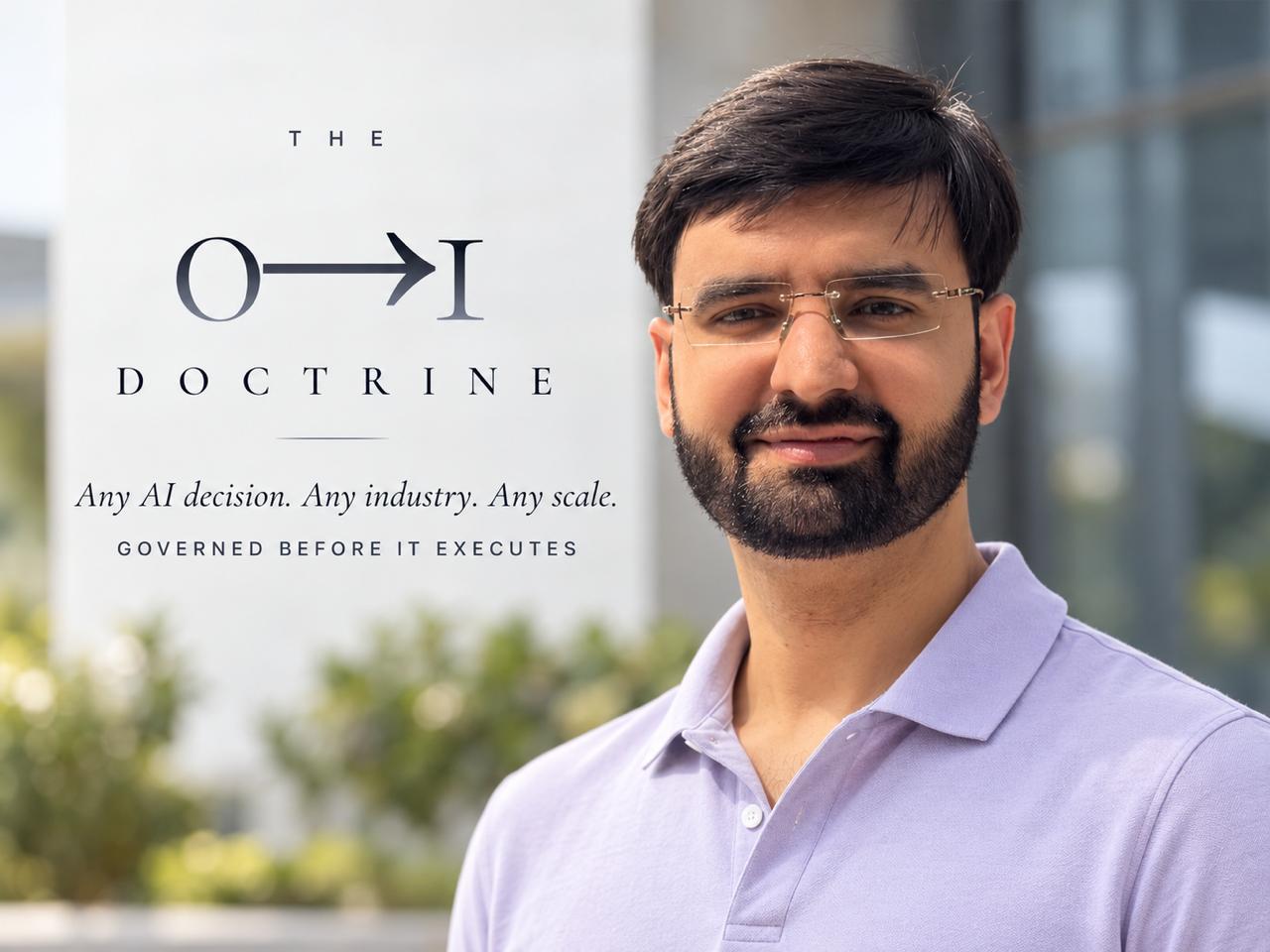
Vatsal Soin
As zero-click AI agents read and act on records across every sector, the party whose data was used loses the ability to trace who gets credit, paid, or even notified — while the debate over Superintelligence and Singularity runs alongside, unresolved. The 0→1 Doctrine proposes runtime gates: each request tested against an authorized boundary before execution, sealed as a checkable record.
Live: www.0to1doctrine.com
The 0→1 Doctrine provides a common mathematical way to represent different operational conditions. Relevant parameters are mapped into normalized bands between 0 and 1, allowing a proposed action to be compared with a defined human-authorized boundary before execution. The approach shifts the control point from reviewing what happened afterward to checking whether the proposed action falls within its permitted range, while sensitive underlying data can remain protected.
INTRODUCING THE FOUNDATIONAL PARADIGM
THE ESSENTIAL SEED OF BALANCED PERMISSION
The 0→1 Doctrine proposes mapping operational needs into standardized bands between zero and one. It aims to verify requests against authorized boundaries before execution, rather than relying only on records created afterward. Its safety and privacy claims require independent technical validation.
REJECTING RETROACTIVE COMPLIANCE
THE LIMITS OF HISTORICAL REVIEW
Monitoring and logging help investigate events, but do not prevent every harmful action. A runtime control may inspect a proposed state change before commitment. The proposal shifts attention toward that decision point; deployment-specific safeguards remain necessary.
SEPARATING CAPABILITY FROM AUTHORIZATION
AUTOMATED CHECKS WITH HUMAN GOVERNANCE
A model’s ability to generate a plan does not establish permission to execute it. The architecture separates generation from execution and routes consequential requests through checks tied to human-defined permissions. Automation may reduce repetitive review, but accountable human governance remains essential.
ZERO-CLICK DATA EXTRACTION
CONTENT SCRAPING AND ATTRIBUTION PRESSURES
Autonomous workflows can retrieve and summarize web content inside user interfaces, potentially changing referral traffic to publishers. Effects on creator revenue vary by product, licensing, attribution, and user behavior. The proposal’s response is to govern access at the point of action.
RUNTIME VERIFICATION GATES
LIMITING UNAUTHORIZED REQUESTS
The Doctrine proposes separating authorization logic from model capabilities. A tool could be required to satisfy configured conditions before accessing protected content or changing ledger state. Effectiveness depends on implementation, complete pathway coverage, and control of credentials.
HARMONIZING SYSTEMIC METRICS
A COMMON REPRESENTATION FOR DIFFERENT DOMAINS
Different sectors track different units — weight, margin, throughput. The normalization framework converts them into one common 0-to-1 scale for comparison against a boundary.
RANGE-ENCODED OPERATIONAL ENVELOPES
CHECKING REQUESTS AGAINST AUTHORIZED BANDS A human-defined policy supplies a permitted range; the system evaluates a relevant index before execution. Overlap is a decision input, not a substitute for policy design. Thresholds, uncertainty, missing data, and conflicting signals need explicit handling.
FROM ONE RECORD TO AN ENTIRE ECONOMY
MICRO MESO MACRO SCALES
At the micro scale, a clinical-research agent summarizes one physician’s unpublished case notes for a diagnostic query. The request normalizes to [0.24, 0.30] against an authorized band of [0.00, 0.40] for single-record access — it clears, sealed and logged.
At the meso scale, a supply-chain agent queries pricing and inventory across hundreds of manufacturing partners in one session, normalizing to [0.57, 0.63] against an authorized band of [0.00, 0.60] for bulk vendor reads — it exceeds the ceiling and is held for review.
At the macro scale, a financial-intelligence agent pulls a national exchange’s entire filing archive across thousands of institutional deployments simultaneously, normalizing to [0.82, 0.89] against an authorized band of [0.00, 0.50] for unrestricted bulk extraction — it fails outright and is blocked.
The sector changes — healthcare, manufacturing, finance. The gap does not: a request executes, and nothing records whether it was authorized, until a runtime gate sits at exactly that point.
DISTRIBUTED ACCOUNTABILITY
GROUPING MULTI-AGENT ACTIONS
Multi-agent systems distribute work across services, complicating reconstruction of who initiated an action. The proposal groups related parameters into a joint signature before execution. Traceability depends on reliable identities, delegation records, and responsibility assignments.
INTERCONNECTED ENTERPRISE ARCHITECTURES
INTER-AGENT PARALLEL REQUESTS
Agents may issue parallel requests that evade controls designed for one workflow. A shared execution boundary can evaluate collective signals against constraints. Effectiveness depends on coverage and preventing equivalent authority through ungoverned channels.
LABORATORY ACTUATION
SAFEGUARDS FOR PHYSICAL WORKFLOWS
The proposed gateway scans requests for required compliance markers and can hold those that lack them. In laboratories, software decisions must complement physical interlocks, approved procedures, specialist review, and testing against accidental and adversarial changes.
EXTERNAL GATING
ADDRESSING THE BLACK-BOX CHALLENGE
Large reasoning systems can be difficult to interpret internally. The proposal checks actions at the runtime boundary instead. Such controls need enough context to detect harmful requests and must not treat every apparently compliant output as safe.
LEDGER TRACEABILITY
LINKING INTENTION TO COMPLIANCE RECEIPTS
The described sequence includes USP, UCC, PDT, ACT, MAT, OCT, and ACR. An Actuation Compliance Receipt is proposed as evidence of the authorization path. Cryptographic signing can reveal later changes, but cannot prove the original decision was correct or every event was captured.
RISK ADVISORIES
PRAT, EMERGE, AND PARR
PRAT is described as a predictive advisory token, EMERGE as privacy-preserving metadata screening, and PARR as a corrective-protocol framework. They aim to surface risk before finalization. Detection quality and false-positive rates require empirical evaluation.
RESOURCE ACCOUNTABILITY
ESTIMATING PREVENTED WASTE
FTWE is described as comparing outcomes with a baseline and recording differences in time, energy, and carbon. Credible reporting requires transparent baselines, measurement boundaries, uncertainty ranges, and independent review.
DATA LOCALIZATION AND PRIVACY
PROOF-BASED CHECKS
Hybrid Universal Privacy Architecture (HUPA) proposes local normalization, while Compliance and Traceability Integrity Engine (CTIE) supports verification through proof-based digests. Cross-border compliance depends on applicable law and deployment facts.
POST-QUANTUM CRYPTOGRAPHY
CRYPTO-AGILITY
The proposal calls for post-quantum primitives and crypto-agility. Algorithm choice, migration, key lifecycle, and interoperability require engineering. Cryptography can protect signatures and records, but cannot correct faulty authorization logic.
CAPITAL AND SYSTEMIC RISK
WHAT INSTITUTIONS WOULD ASSESS
The proposal emphasizes containment, traceability, and predictable execution boundaries. Whether these features affect valuation or capital allocation remains an empirical market question, not an established consequence of the architecture.
THE SOVEREIGN RISK SUMMARY
THE ECONOMIC CLOSING NOTE
Capability may keep expanding across models, labs, and deployments. Authority need not expand automatically with it. The proposal: make permissions explicit, test requests before execution, and preserve evidence.
CLOSING NOTE
“Runaway agents do not need stopping from reading. They need stopping from acting without a checkable record. That distinction is now filed.”
Live: www.0to1doctrine.com
This can be tested, live, via API, governed against ungoverned, side by side.
THE INVENTOR
Vatsal Soin is a serial inventor and entrepreneur with patent filings across six continents and grants in the US, India, Japan and South Africa. He is a SIM–RMIT alumnus and an alumnus of Nanyang Technological University, Singapore. His latest grant, dated August 14, 2026, introduces an AI-powered footwear system and Global Sharable Size Card invention.
SELECTED REFERENCES
Granted: US Patent 12,446,652 B2 · Japan Patent 7560909 · India Patents 454081 and 599317 · Filed: PCT/IN2025/051943 · US 19/489,595 · India 202511115781 · Australia AU2022450649
DISCLAIMER
Informational only. Not certified. No endorsement implied. Not investment advice. Vatsal Soin · © 2026 All Rights Reserved.