

Welcome to Rocket City—where a 1-gigabyte game download can finish before the launch countdown hits zero. According to 2025 FCC availability data, more than eight in ten Huntsville homes already have fiber, and the rest can tap high-speed cable or 5G. That abundance is great until you must choose: Which company keeps the speed it advertises? Whose “limited-time” rate doubles after month twelve? Below, we rank eight real options, tally the two-year cost for each plan, and flag the fine-print traps so you can pick with confidence.
How we ranked the providers

Before we crown any winner, we need a fair scorecard. We studied eight Huntsville providers and judged them through the same lens you use at the kitchen table: How fast, how reliable, and how much will this cost once the honeymoon ends?
Speed came first. We looked at headline numbers and day-to-day reality—download, upload, and average latency pulled from recent public speed-test batches. If a plan says “gig,” we expect you to see something close to a gig in prime time, not just at 3 am.
Price followed, but we stretched the view to a full two-year span. Intro discounts are great, yet the bill that lands after month twelve is the one that hurts. We added modem rentals, unlimited-data surcharges, and any contract exit fees so the math matches your statement.
Reliability carried equal weight. Fiber routinely tops customer-satisfaction polls, so we fact-checked against a 2026 ACSI report: AT&T Fiber scored 78 out of 100, and Google Fiber came in at 76. We also scanned Huntsville Reddit threads for outage gripes and praise to see how those scores feel on the ground.
Data policy matters in a streaming world, so we penalized hard caps and favored plans that stay unlimited without extra cash or fine print.
Finally, we added a lighter column for perks—free mesh gear, price locks, or scheduled multi-gig upgrades already hitting Huntsville streets. These sweeteners cannot hide a bad network, but they can break a tie when two providers look neck and neck on the basics.
That rubric produced a weighted score out of 100 for every ISP. The next sections walk through the list from highest to lowest, starting with the local value champ that surprised even us.

WOW! Internet – Huntsville’s budget-friendly gigabit
Years of threading coax and fiber through Rocket City mean the 1 Gig and 1.2 Gig tiers now reach about three-quarters of local addresses. According to WOW!’s Huntsville, AL Internet Provider page, the network hits 99.9 percent reliability and skips data caps or annual contracts, perks that reinforce its budget edge.
WOW Internet Huntsville budget-friendly gigabit plan screenshot
The company’s focus on expanding its infrastructure has been a key factor in its growing customer base.
Why we ranked WOW! first
You spot the red-and-white WOW! trucks on nearly every block for a reason. Years of threading coax and fiber through Rocket City mean the 1 Gig and 1.2 Gig tiers now reach about three-quarters of local addresses. That footprint, paired with a price that beats every wired rival over a 24-month span, puts WOW! at the top of our list.
While Google and AT&T offer multi-gig symmetry, WOW! wins the everyday math test. New customers pay about $55 a month for the first year, then around $75 once the promo ends. Even after adding a self-owned modem or an unlimited-data upgrade, the two-year bill stays below any fiber or cable alternative.
Freedom is another plus. Service is month-to-month, so if a new fiber build hits your street next spring you can switch without a fee. Until then, the 1.2 Gig plan removes the data cap and includes a gateway at no extra charge, a perk no rival matches at this price.
To see whether your home is eligible, enter your address in WOW!’s online availability checker. We break down speeds, caps, and reliability below, but the headline is simple—WOW! delivers the most gigabit for the fewest dollars.
Speed and real-world performance
WOW!’s gigabit tier delivers 1 Gbps down and 50 Mbps up. The Ultra plan bumps download speed to 1.2 Gbps, drops the data cap, and waives the modem fee. Uploads are not symmetrical, yet 50 Mbps still supports a high-quality Zoom call while a console pushes cloud updates.
Latency averages in the mid-20-millisecond range to Atlanta game servers, only a hair above local fiber. Night congestion is mild thanks to node splits completed in 2024, though Saturday SEC kickoffs may shave a bit off throughput when half the street streams 4K.
Reddit chatter paints a mixed picture. One user jokes WOW! stands for “Wow, the router’s rebooting again,” while another says they have not lost service in months. Reality sits between the extremes: brief hiccups appear a few times per year, but outages rarely last longer than a coffee break.
Upgrades are in the queue. WOW! piloted high-split uploads and DOCSIS 4.0 gear in Florida last winter; Huntsville is slated to receive the same hardware in late 2026. The refresh should quadruple upstream capacity and trim ping spikes. Sign up now and you buy into a path that narrows the fiber-versus-cable gap without forcing a future switch.
Bottom line: you give up symmetrical uploads, but you gain strong download speed, standout value, and a roadmap that keeps improving. For streaming and weekend gaming, that trade feels worth it.
Google Fiber: fastest pipe in Rocket City
Step into any tech meetup downtown and you will hear the same refrain: “Just get Google Fiber if you can.” The praise is earned. Huntsville Utilities’ open-access backbone lets Google serve about 95 percent of city addresses with a line that now reaches 5 Gbps symmetrical, a tier the company launched in late 2023.
Pricing is simple. One Gig costs $70, Two Gig is $100, and the new Five Gig plan is $125. No equipment fees, no contracts, and no data cap. You pay the sticker price, and that is the whole story.

Google Fiber Huntsville multi-gig internet plans screenshot
Speed is only half the appeal. Latency to East-coast game servers sits in the low twenties and seldom wavers. Outage posts on local Reddit threads feel like Bigfoot sightings; few people can show proof. That reliability, paired with a customer-satisfaction score that trails only AT&T’s 78 out of 100 according to the 2026 ACSI report, helps Google Fiber secure our silver medal despite the higher monthly bill.
If you see the green “Service available” button after entering your address, congratulations. You have one of the fastest residential connections in the country and may never think about buffering again.
Plans, performance, and perks
The entry plan is anything but basic. The 1 Gig tier delivers a steady 940-plus Mbps both ways, enough to back up a photo library while four 4K streams run in the next room. The 2 Gig tier doubles that headroom for $30 more, a smart choice for creator households. The headline 5 Gig tier offers five thousand megabits in each direction over an XGS-PON line and includes a Wi-Fi 6E mesh kit that would cost competitors hundreds.
Latency hovers around 22 ms to Atlanta AWS zones and rarely jitters. Because the fiber is buried, service often stays live during power outages; plug your router into a battery pack and you keep working while neighbors look for candles.
Customer experience seals the deal. Installation usually fits in a two-hour window. Technicians mount a sleek wall plate, run a speed test on your phone, and leave without pitching TV bundles. Billing arrives as a one-page PDF that never changes, with no modem fee now or later. That predictability fuels Google’s high satisfaction ranking.
Perks round out the value. Each account comes with a Wi-Fi 6 router, up to two mesh extenders, 24 / 7 chat support, and an app that lets you pause the connection with one tap. If hardware fails, Google overnight-ships replacements instead of scheduling another truck visit. The service feels more like a utility that fades into the background; that is how fast internet should behave.
AT&T Fiber: reliability king with city-wide reach
Blue-and-white gateways on porches across Huntsville are not a coincidence. Over the past decade, AT&T has trenched fiber through nearly every subdivision, giving the company about 93 percent address coverage, according to 2025 FCC data. That reach supports an uptime record some users call boring—in the best way.
Surveys back up that reputation. The 2026 ACSI report gave AT&T Fiber a score of 78 out of 100, the highest among national fiber brands. Local speed tests echo the rating: most gig customers see more than 950 Mbps up and down with latency in the high teens.
Pricing starts at $48 for the 1 Gig tier during year one, then moves to $90. The 2 Gig and 5 Gig plans follow the same pattern with first-year savings. Equipment and unlimited data are baked into the sticker price, so there is no modem fee, but plan for the year-two bump.

AT&T Fiber Huntsville gigabit internet pricing screenshot
Installation is typically free. The technician leaves a Wi-Fi 6 gateway that works with popular mesh kits if you need wider coverage. Power users can switch the gateway to passthrough mode and run their own router with minimal fuss.
Add it all up and AT&T Fiber behaves like a set-and-forget utility. If you work from home or just dislike surprises, this is the safe pick that seldom needs a reboot.
Xfinity: cable giant with growing upload muscle
Comcast’s Xfinity network covers about 84 percent of Huntsville addresses, making it the default choice where fiber has not yet reached the pole. The Gigabit Extra plan advertises 1.2 Gbps down and 35 Mbps up, but a 2025 ten-gig mid-split upgrade pushed many homes past 100 Mbps upstream, and a 2 Gbps tier is now live in select ZIP codes.
Intro pricing sits near $80 a month with a two-year price guarantee. After that window the plan climbs to roughly $113, and unlimited data costs another $30 unless you rent Comcast’s gateway bundle. Add those extras and Xfinity ends up pricier than a flat-rate fiber bill, though it still beats going without fast internet in a non-fiber pocket.
Reliability is solid for a cable plant. Neighborhood nodes now serve fewer homes than they did five years ago, so peak-hour slowdowns are rare, and latency to regional game servers stays near 25 ms. Storms can knock lines out, but recovery is quick and the Xfinity app posts live ETAs.
Bundle hunters may like the ecosystem. Xfinity Mobile rides on Verizon towers and offers steep phone discounts to internet customers, while the free Flex 4K streamer pulls Peacock, Netflix, and local channels into one remote. If you want one bill for internet, TV, and wireless, no rival matches that breadth.
The trade-offs are clear: higher second-year costs and a 1.2 TB data ceiling versus fiber’s unlimited runway. Yet for thousands of Huntsville homes outside Google or AT&T territory, Xfinity brings genuine gigabit speed and uploads that finally feel 2026-ready. It remains the strongest cable safety net in Rocket City.
EarthLink Fiber: same glass as AT&T, different handshake
EarthLink is the veteran brand you may remember from the dial-up era, but in 2026 its Huntsville role is simple: it resells AT&T’s fiber lines under its own support umbrella. That means identical speed tiers—1, 2, and 5 Gbps symmetrical—plus the same unlimited data pipe beneath your lawn. Performance mirrors AT&T almost bit for bit; most gig customers see about 940 Mbps up and down with latency in the teens.
So why pick EarthLink over the network owner? Two reasons top user-forum threads. First, some residents prefer a smaller provider’s call-center cadence. EarthLink leans on U.S.-based support and shorter hold times. Second, a few households are willing to pay extra for that service style. Recent promos price the 1 Gig tier at around $75 a month, which is higher than AT&T’s first-year discount. After month twelve the bill rises to about $90.
There are trade-offs. The intro rate requires a twelve-month contract, and canceling early can cost up to $200. Installation still relies on AT&T crews, so scheduling can feel like a relay race. Any outage on the shared backbone affects both companies, so you are buying a billing and support wrapper, not unique infrastructure.
Bottom line: EarthLink Fiber makes sense if you want AT&T-grade speeds paired with boutique customer care and you are comfortable signing a one-year agreement. Everyone else can skip the middle layer and go straight to the source.
Mediacom: gigabit lifeline for north-side pockets
Mediacom’s footprint in Huntsville is small, covering parts of Meridianville, Chase, and a few older subdivisions where Comcast never obtained a franchise. For those streets, it is often the only wired path to gigabit service.
Performance is solid. The 1 Gig plan advertises 1,000 Mbps down and 50 Mbps up, and local tests usually land between 800 and 950 Mbps during off-peak hours. Uploads trail fiber but can still push large photo libraries overnight. Latency sits near 30 ms to Birmingham game servers, acceptable for casual play and slightly high for esports.
Costs have improved this year. The gig tier now sells for about $50 a month with a three-year price lock. Mediacom also removed data caps on gigabit plans, so the six-terabyte ceiling is gone and there is no longer a $30 fee for unlimited data.
The plan includes a modem and an eero Wi-Fi router at no extra charge, though one-time installation and activation fees still apply. With the flat rate and unlimited data, the offer is stronger than it was a year ago.
Who should consider Mediacom? Residents inside its narrow service islands who need wired stability over variable 5G and homeowners who want a dependable cable connection. Treat the three-year lock as a solid medium-term solution and start exploring alternatives before the rate reset arrives.
T-Mobile 5G home internet: wireless speed on training wheels
T-Mobile’s magenta gateway pulls internet from the same mid-band 5G towers that power your phone. Plug it in, find the strongest signal with the companion app, and you are online in about fifteen minutes—no trenching or technician required. Typical Huntsville users report 100 to 300 Mbps downloads and 10 to 25 Mbps uploads. That is enough for two 4K streams plus a video call, but it does not rival fiber.
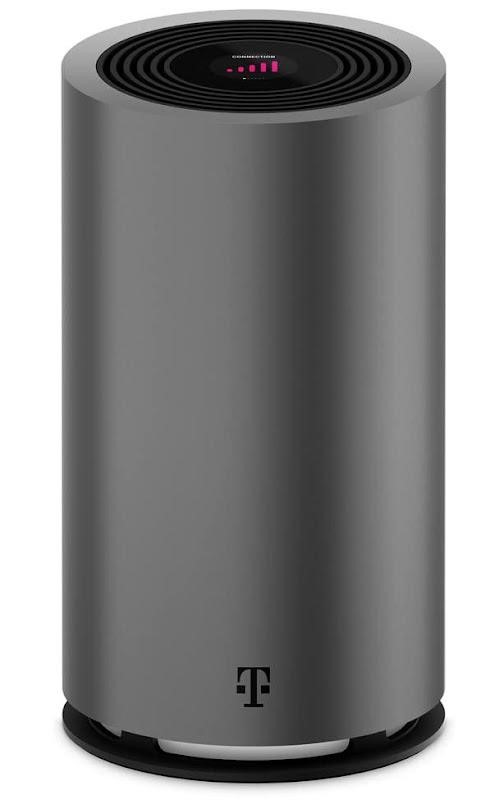
T-Mobile 5G Home Internet gateway product photo
What you give up in raw speed you gain in simplicity. Service costs $50 a month, or $35 if you already have an eligible T-Mobile phone plan. Taxes and fees are added, but equipment is included, and there is no annual contract. A fifteen-day “test drive” lets you return the gateway for a full refund if the signal disappoints.
Performance swings with tower congestion. On quiet weekday mornings you may see peaks near 500 Mbps, while prime-time scrolling can drop speeds below 100. Latency averages around 40 ms, fine for casual gaming but behind wired options. T-Mobile also applies a soft cap near 600 GB per month; past that point traffic is deprioritized during busy hours, though there are no overage fees.
So who wins with 5G home internet? Renters who cannot drill cable outlets, edge-of-town residents waiting for fiber crews, and budget-minded households that stream more than they upload. Treat it as a flexible bridge until a faster line reaches your address.
Verizon 5G home internet: occasional gig bursts, steady budget play
Verizon’s 5G Home and 5G Home Plus plans use a different slice of wireless spectrum than T-Mobile. In a handful of Huntsville blocks near downtown business corridors, a millimeter-wave Ultra Wideband signal can reach 1 Gbps down and more than 50 Mbps up. Most addresses connect on C-band and see 150 to 350 Mbps with latency around 35 ms.
Pricing matches the magenta rival: $50 a month, or $35 if you have an eligible Verizon Unlimited phone plan. The Plus tier locks that rate for four years and includes a streaming device or gift card, a modest but welcome perk in a no-contract world.
Setup is simple. The white cube router points itself to the strongest signal, and the My Verizon app guides placement. You can bridge your own mesh system if you need wider coverage. Data is unlimited with no formal deprioritization cap, though real-world congestion still slows speeds on busy nights and weekends, especially in crowded apartment towers.
Verizon 5G Home is a bit of address roulette. If the coverage map shows Ultra Wideband on your roof, you may enjoy near-fiber downloads at dinner-out pricing. If not, expect cable-like bandwidth at a discount, along with the normal ups and downs of wireless. Either way, it serves as a friction-free backup or a solid primary for lighter households while you wait for fiber.
Side-by-side snapshot
Numbers tell the story faster than prose, so here is the quick-glance matrix we built before scoring each provider. Prices reflect the most common Huntsville offers as of May 8, 2026, with modem fees and unlimited-data add-ons included in the two-year cost.
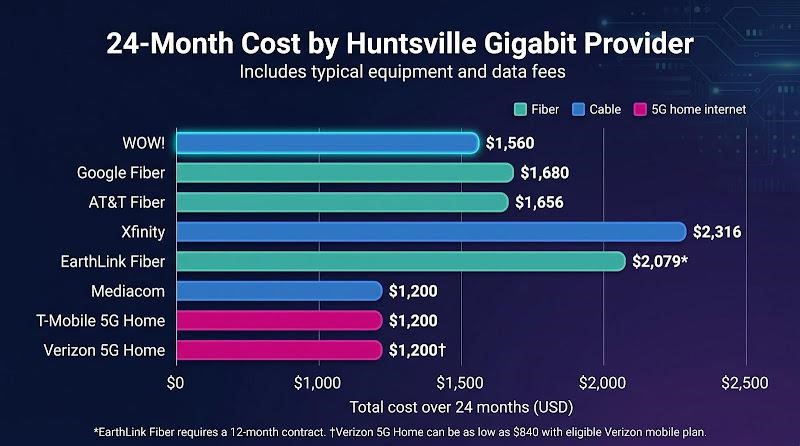
| Provider | Connection | Max speed (down / up) | Intro monthly price | Month-13 price | Data cap | Contract | 24-month cost |
| WOW! | Cable | 1.2 Gb / 50 Mb | $55 | $75 | 3 TB (unlimited on 1.2 Gb tier) | No | $1,560 |
| Google Fiber | Fiber | 5 Gb / 5 Gb | $70 | $70 | None | No | $1,680 |
| AT&T Fiber | Fiber | 5 Gb / 5 Gb | $48 | $90 | None | No | $1,656 |
| Xfinity | Cable | 1.2 Gb / 100 Mb | $80 | $113 (+$30 for unlimited) | 1.2 TB | Optional | $2,316 (add $720 if unlimited) |
| EarthLink Fiber | Fiber (AT&T lines) | 5 Gb / 5 Gb | $75* | $90 | None | 12 mo | $2,079 |
| Mediacom | Cable | 1 Gb / 50 Mb | $50 | $50 | None | No | $1,200 |
| T-Mobile 5G Home | Fixed wireless | ~300 Mb / 20 Mb | $50 | $50 | None† | No | $1,200 |
| Verizon 5G Home | Fixed wireless | ~350 Mb / 25 Mb (1 Gb peaks) | $50 ($35 with mobile) | $50 | None | No | $1,200 (or $840 with mobile) |
*Requires a 12-month contract.
†Traffic above roughly 600 GB per month is deprioritized during congestion but never billed.
Use this grid as your reality check. If the plan you are eyeing costs far more than the two-year averages above, call the provider and negotiate, or move down the list to the next best fit.
Conclusion
Huntsville residents enjoy an enviable lineup of gigabit-class choices. WOW! takes the value crown, Google Fiber offers the city’s fastest symmetrical speeds, and AT&T Fiber provides rock-solid reliability almost everywhere. Cable and 5G options fill the gaps where fiber has yet to land. Match your household’s priorities—price, upload performance, contract flexibility—to the summaries above, and you will land a plan that keeps Rocket City living up to its name.
Disclaimer: The information provided in this article, “8 Best Gigabit Internet Providers in Huntsville Alabama,” is for general informational and comparison purposes only. Provider availability, pricing, internet speeds, promotional offers, and service terms may vary by location and are subject to change without notice. Rankings and recommendations are based on publicly available information, user reviews, and editorial analysis, and do not constitute official endorsements. Readers are encouraged to verify plans, coverage, and terms directly with the respective internet service providers before making any purchasing decision.