

New Delhi, June 5 : TEXMiN, the Technology Innovation and Translation Research Park at IIT Dhanbad, formally kicked off the Satellite of the UK-India Critical Mineral Supply Chain Observatory, marking a significant step in strengthening India’s critical mineral security and supply chain resilience. The initiative is being developed in collaboration with the University of Cambridge under the broader India–UK Technology Security Initiative and aligns with the Government of India’s National Critical Mineral Mission .
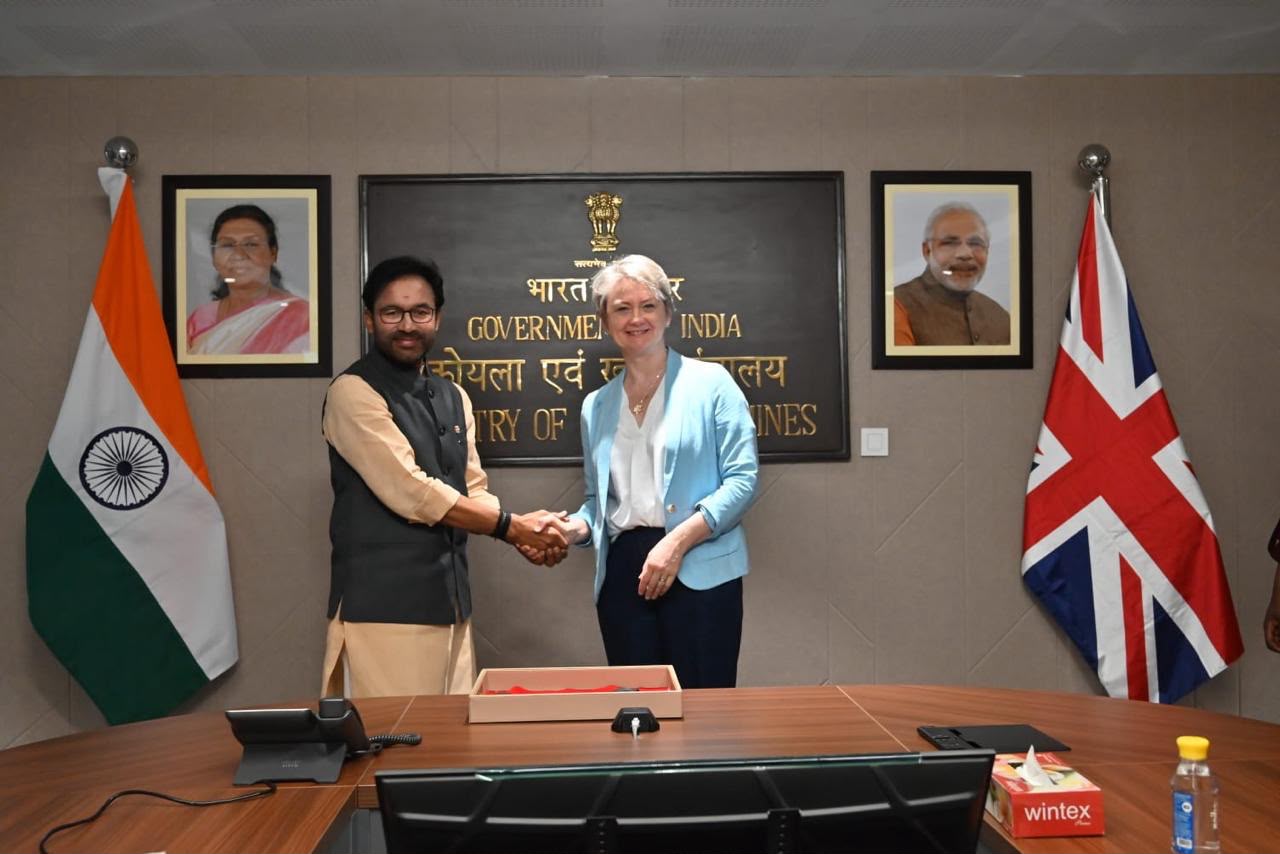
The formal project kick-off was held in the presence of Shri G. Kishan Reddy, Union Minister for Coal and Mines, Government of India, and The Rt. Hon. Yvette Cooper, Foreign Secretary of the United Kingdom, reaffirming the strategic importance of critical minerals in the India–UK partnership. The event also witnessed participation from several distinguished dignitaries, including Lindy Cameron, British High Commissioner to India; Ben Mellor, Deputy Head of Mission, British High Commission; Harjinder Kang, HM Trade Commissioner for South Asia; Sarah Cooper, Director – Development, Climate, Science and Technology, British High Commission; along with senior representatives from the University of Cambridge, IIT Dhanbad, TEXMiN, and the Ministry of Mines. The gathering underscored the shared commitment of both nations to building resilient, transparent, and future-ready critical mineral supply chains through technology-driven collaboration and strategic cooperation.
The formal kick off marks the operational commencement of the Observatory following the Letter of Intent signed between TEXMiN and the University of Cambridge in October 2025. The GSCO will serve as a world-class digital intelligence and risk analytics platform designed to enhance visibility, traceability, transparency, and resilience across global critical mineral supply chains.
The initiative was jointly announced by the Prime Minister of India, Shri Narendra Modi, and the Prime Minister of the United Kingdom under the India–UK Technology Security Initiative framework, underscoring the strategic importance of critical minerals in enabling clean energy transitions, advanced manufacturing, semiconductors, electric vehicles, batteries, electronics, and defence technologies.
Hosted at IIT Dhanbad through TEXMiN and supported by the Department of Science and Technology , Government of India, the Observatory will integrate advanced technologies including artificial intelligence, machine learning, satellite and geospatial monitoring, big data analytics, ESG and sustainability auditing, supply chain stress testing, and cloud-native digital infrastructure to create a comprehensive mineral intelligence ecosystem.
Speaking on the occasion, Prof. Sukumar Mishra, Director, IIT Dhanbad and Chairman, Hub Governing Board, TEXMiN, said,
“The formal kick off of the Satellite of the UK -India Critical Mineral Supply Chain Observatory represents a transformative step in India’s journey towards critical mineral security. As global competition for critical minerals intensifies, access to reliable intelligence, predictive analytics, and supply chain visibility will become increasingly important. Through this initiative, TEXMiN and IIT (ISM) Dhanbad are proud to contribute towards building a sovereign capability that will support informed decision-making, sustainable resource management, and resilient supply chains for the future.”
Commenting on the significance of the project, Prof. Dheeraj Kumar, Deputy Director, IIT (ISM) Dhanbad and Project Director, TEXMiN, said,
“The Observatory brings together leading institutions, industry stakeholders, policymakers, and technology experts to address one of the most strategic challenges of our time. By leveraging AI-driven analytics, mineral traceability systems, and digital intelligence platforms, we aim to create a globally connected ecosystem that not only strengthens India’s strategic preparedness but also contributes to building secure and sustainable critical mineral value chains worldwide.”
Speaking on this, Dr. Mukesh said,
“Critical minerals are no longer just a resource challenge; they are a strategic imperative for economies worldwide. The UK -India Critical Mineral Supply Chain Observatory represents a unique opportunity to build a trusted intelligence platform that enhances visibility, resilience, and sustainability across mineral value chains. Through this India–UK collaboration, we are creating a globally connected ecosystem that can help governments, industries, and research institutions navigate emerging risks and opportunities in the critical minerals landscape while supporting a secure and sustainable energy future.”
The Observatory will support India’s efforts to monitor global mineral flows, identify potential disruptions, assess geopolitical and ESG risks, strengthen mineral traceability, advance circular economy initiatives, and enhance recycling and resource intelligence capabilities. It will also contribute to the development of indigenous technological capabilities in Mining 4.0, digital mining infrastructure, AI-driven analytics, and mineral intelligence systems.
As the project enters its implementation phase, the Observatory is expected to emerge as a critical national asset, supporting policymakers, industry leaders, researchers, and strategic sectors with actionable insights and data-driven intelligence. The initiative further reinforces India’s ambition to become a global leader in critical mineral intelligence, sustainability auditing, and resilient mineral value chains, while advancing the vision of Atmanirbhar Bharat and Viksit Bharat 2047.