

New Delhi, Mar 31: The FICCI Ladies Organisation the women’s wing of the Federation of Indian Chambers of Commerce & Industry marked the successful culmination of its 42nd Annual Session in New Delhi, highlighting a year of significant national impact and transformative initiatives that reached over 16 lakh women across India.
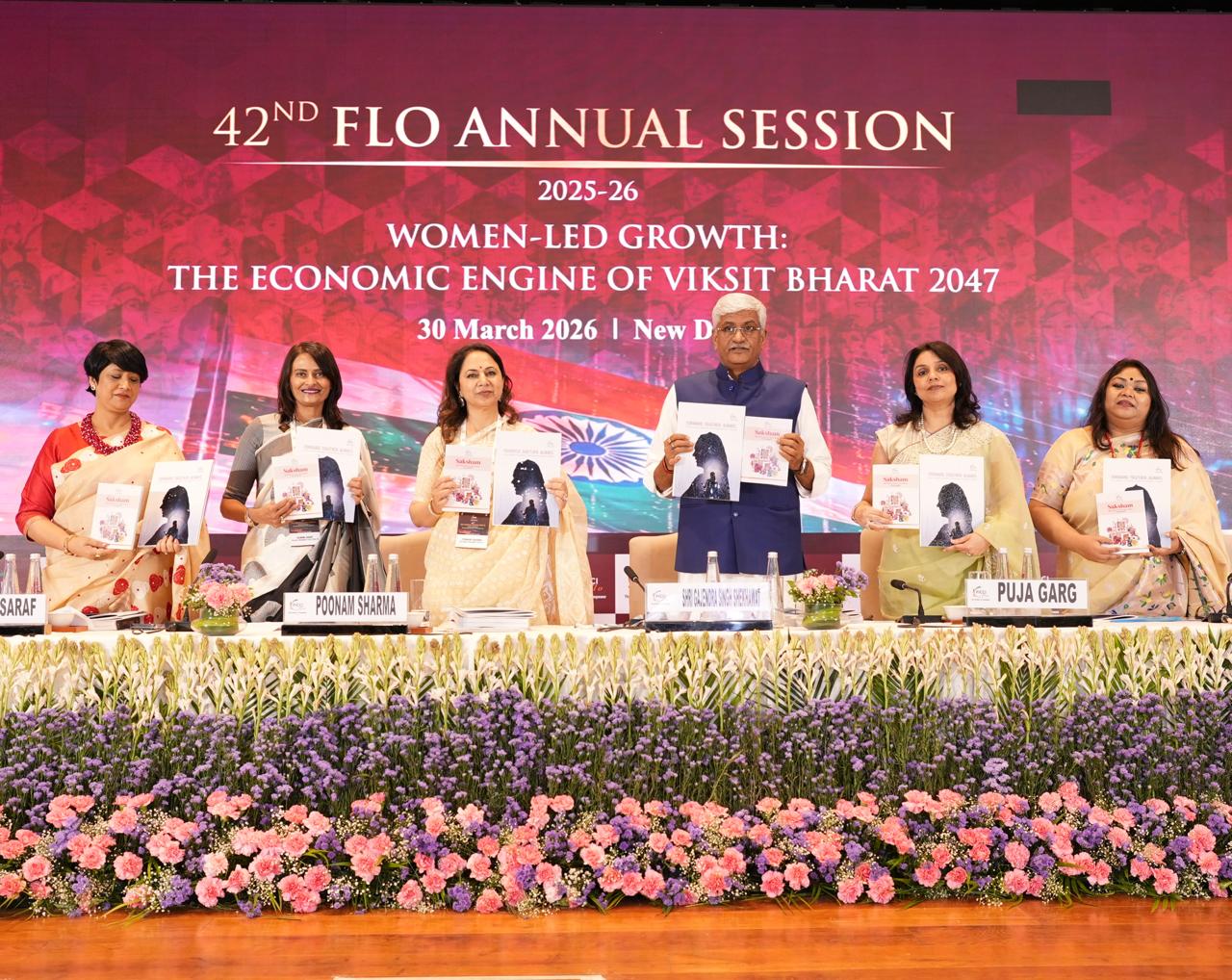
Celebrating its 42nd year, FICCI FLO showcased its expanding footprint across urban and rural India through a wide spectrum of initiatives focused on entrepreneurship development, skilling, financial literacy, leadership, and grassroots livelihood creation. The organisation’s efforts over 2025–26 underscore its growing role as a catalyst for women-led development, aligned with the vision of Viksit Bharat 2047.
The event was graced by Shri Ashwini Vaishnaw, Union Minister for Railways, Information & Broadcasting, and Electronics & Information Technology, Government of India, and Shri Gajendra Singh Shekhawat, Honourable Union Minister of Tourism and Culture, Government of India. The event was further enriched by the participation of prominent voices from across media, industry, policy, and public life, reflecting the broad-based national momentum around women-led development and inclusive growth.
Shri Ashwini Vaishnaw, Union Minister for Railways, Information & Broadcasting, and Electronics & Information Technology, Government of India,said,
“India is today witnessing rapid growth across some of the most advanced sectors such as semiconductors, electronics, space, and artificial intelligence, and this transformation is reshaping industries and opportunities across the country. In the electronics manufacturing sector alone, India has seen six-fold growth in the last decade, with exports rising and mobile exports increasing nearly 27 times, with women comprising nearly 60–70% of the workforce in this sector. This reflects the true spirit of women-led development. As India moves towards becoming a $4 trillion economy and beyond, quality, innovation, and efficiency will define our global competitiveness. I urge organisations like FICCI FLO to lead initiatives in lean systems and AI adoption, especially at the application level, to drive meaningful change across industries and contribute to nation-building.”
Shri Gajendra Singh Shekhawat, Union Minister of Tourism and Culture, Government of India, said,
“I extend my heartfelt congratulations to Smt. Poonam Sharma, the National President of FICCI FLO, along with all esteemed dignitaries, past presidents, and office bearers, for their remarkable leadership and commitment. I also express my sincere appreciation to FICCI FLO for its impactful contribution towards women’s empowerment, spanning grassroots communities to global platforms. Their consistent efforts in enabling opportunities, building capabilities, and fostering leadership among women are truly commendable and play a vital role in shaping a more inclusive and progressive India.”
Speaking on the occasion, Poonam Sharma, National President, FICCI FLO, said,
“2025–26 has been a defining year for FICCI FLO, marked by scale, inclusivity, and measurable impact. Reaching over 16 lakh women across India reflects the strength of our collective efforts to enable entrepreneurship, build skills, and create sustainable livelihoods. Our initiatives – from FLO KAVACH to grassroots skilling and enterprise support-are designed to address real challenges faced by women at every stage of their journey.”
During the session, FICCI FLO also unveiled a thought leadership report titled ‘Gender Diversity & Career GAP- India’s Services Sector and Recommendations to Increase Women’s Participation’, highlighting the critical role of women’s participation in India’s services sector as a catalyst for inclusive economic growth. India’s services sector stands at a defining inflection point, poised for accelerated growth yet constrained by a persistent gender participation gap. Out of India’s total 643 million workforce, women account for just 40.3%, highlighting a vast untapped opportunity. While services contribute ~55% to GDP, they generate only ~30% of jobs, making increased women’s participation a high-impact GDP multiplier. However, inclusion remains uneven: healthcare (52%) and education (48%) show strong representation; tech/BPM (36%) and BFSI (35%) are moderate; while professional services and retail (20%), hospitality (18%), and logistics (12%) continue to lag.
The report findings highlighted that the core challenge lies not in entry (35–45%) but in continuity and advancement. A pronounced “leaky pipeline” causes sharp mid-career drop-offs (3–8 years), with less than 7% women reaching leadership roles. This is driven by structural barriers, including rigid work structures, safety and mobility constraints, disproportionate care burdens, limited access to P&L roles, and sponsorship gaps. Sectorally, leadership conversion remains weak despite strong entry pipelines.
At the same time, ~2.1 lakh women on career breaks in tech (~58% re-employable) present a critical opportunity. While policy frameworks such as POSH, the Maternity Benefit Act, BRSR, and BharatNet provide a strong base, coordinated action across government, industry, and sector bodies is essential- focusing on retention, returnships, care infrastructure, and leadership pathways to enable women-led growth aligned with Viksit Bharat 2047.
Over the past year, FLO’s pan-India chapters have driven meaningful change through targeted interventions to enhance employability, enable entrepreneurship, and strengthen women’s participation in the economy. Flagship initiatives such as FLO KAVACH have created a comprehensive support ecosystem offering legal, financial, mental health, and cybersecurity assistance. FLO also expanded its MSME Assist Cell and Startup Cell, providing mentorship, funding access, and market linkages. Nationwide digital skilling and financial literacy programs further enabled women to tap into emerging, technology-driven opportunities, while grassroots efforts focused on livelihoods, self-help groups, artisan support, and community development.
Aligned with the vision of Viksit Bharat 2047, FLO continues to scale its impact and outreach, as reflected in its Annual Report 2025–26. The organisation remains committed to building an inclusive ecosystem where women emerge as leaders, innovators, and decision-makers, driving sustainable and equitable economic growth across India.
