

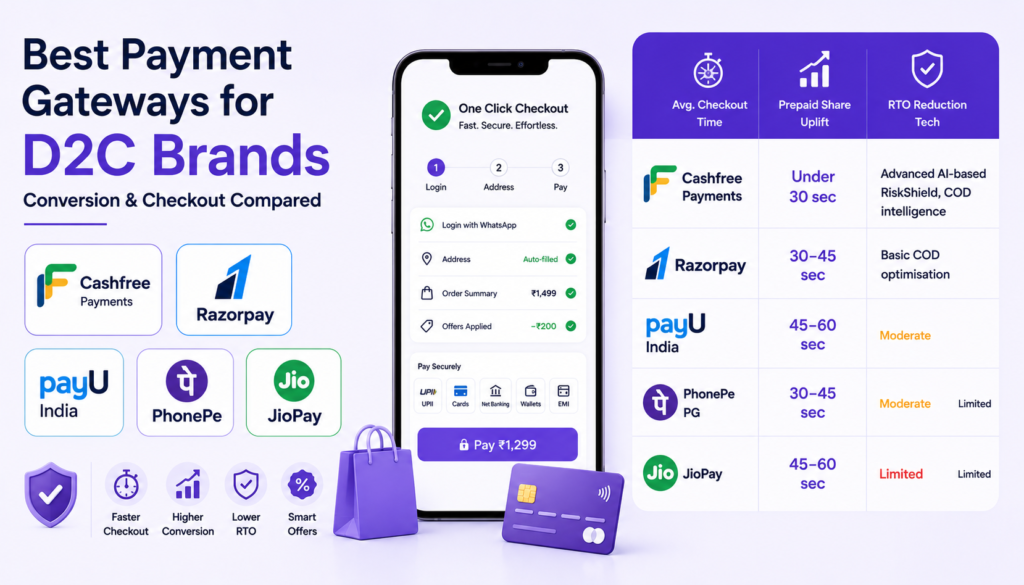
For most D2C brands, the biggest revenue leak isn’t bad advertising. It’s losing the customer right after they tap “Buy Now.” A typical Indian D2C brand spends a large chunk of its monthly budget running and optimising Meta and Google ads to pull shoppers to its site, and then watches a big share of them drop off at the last step.
Cart abandonment sits around 70% across most industries, and it is worse on mobile. That gap between acquisition spend and actual revenue is where margins quietly disappear.
Two things drive most of that drop-off:
- Checkout friction
- Overdependence on Cash on Delivery
Customers abandon carts when they have to manually type phone numbers, addresses, PIN codes, and payment details on a small mobile screen. COD lifts order volume, but it also brings higher Return to Origin (RTO) risk, fake orders, delivery refusals, and working-capital delays.
So the right payment gateway for a D2C brand isn’t the one with the lowest transaction fee. It’s the one that improves conversion and the checkout experience.
The D2C Checkout Audit: 4 Metrics That Reveal the Difference
Time to checkout. Every extra form field raises the odds of abandonment, because shoppers don’t want to hand over more than they have to. Traditional flows that span multiple screens and manual address entry add 60 to 90 seconds or more. The highest-converting D2C checkouts now aim for sub-30-second completion.
Address prefill accuracy. Address entry is one of the biggest friction points in mobile commerce. The better checkout systems use verified customer identity networks, past purchase records, and OTP-based authentication to auto-populate shipping details, which cuts typing effort and form abandonment.
Offer visibility and auto-applied discounts. A lot of shoppers leave the checkout to hunt for a coupon, fail to find one, and never come back. Modern checkouts surface eligible bank offers, EMI promotions, cashback, and discount codes right in the flow, which reduces decision fatigue and lifts conversion.
Native payment success rates. A failed payment is a lost customer, whichever gateway you use. Look for smart routing, bank-level optimisation, UPI redundancy, and payment retry logic. That is the infrastructure that protects checkout completion and stops carts from being abandoned.
Top Payment Gateways for D2C Brands in India: Compared
Cashfree Payment
Cashfree is a trusted name in the payment gateway space, popular amongst tech-first businesses for its pricing, features, and dedicated support, and it offers a flat 1.6% MDR for all businesses. It has gone well beyond being a payment processor and built one of the most D2C-focused checkout stacks available in India today.
Checkout UX. Cashfree’s standout is One Click Checkout, which pre-fills the customer’s details using WhatsApp OTP login and address prefill, so payment can be completed in a single, fast flow. First-time shoppers share their details once, but returning shoppers often finish in under 30 seconds, which removes the typing friction that is the single biggest conversion bottleneck for mobile-first brands.
Conversion uplift. Cashfree’s D2C stack is built around prepaid conversion, so bank offers and coupons show up automatically and shoppers don’t leave to look for them. It also runs automated WhatsApp recovery nudges and reduces drop-offs through smart checkout design. Because it plugs into Shopify and WooCommerce, brands can switch these workflows on without rebuilding their checkout.
COD and RTO mitigation. RiskShield and RTO intelligence read customer behaviour and risk signals before allowing a COD order, so you can configure COD dynamically. That cuts fake orders while keeping genuine conversions, and for brands fighting high RTO, it feeds straight into contribution margin.
Backing all of this is a dedicated account manager, on email and chat, who actively helps protect revenue leakage and optimize conversion, available even to smaller brands.
Razorpay
Razorpay is another player in Indian payments, and on the product side it is good enough for most teams getting started, which is why many D2C brands begin here.
Checkout UX. Magic Checkout trims the number of steps in the journey, so repeat users pay faster and complete more often.
Conversion uplift. Address autofill and saved customer details improve visibility and conversion, and brands benefit from Razorpay’s large merchant network and integration ecosystem.
COD and RTO mitigation. Razorpay offers prepaid conversion tools and checkout optimisation, but its COD risk layer is generally less specialised than platforms built specifically around RTO reduction.
The trade-offs show up later. Razorpay charges a premium, so your effective cost tends to run higher than newer players, and at scale the bigger issue is support: across independent review platforms the recurring complaints are fund holds and account freezes with no clear explanation and generic ticket responses, with dedicated support reserved for enterprise-level customers. For a cash-flow-sensitive D2C brand, that is worth weighing.
PayU India
PayU keeps a meaningful presence in Indian ecommerce, with smart routing and BNPL that lift success rates at the enterprise end.
Checkout UX. The checkout is reliable and familiar to Indian shoppers, and PayU supports a broad range of payment methods plus international acceptance.
Conversion uplift. Offer management, payment optimisation, and broad acceptance all support conversion.
COD and RTO mitigation. PayU offers standard checkout controls but puts less emphasis on dedicated COD-to-prepaid migration. More broadly, it is built for the enterprise end, so its growth tooling has not kept pace and support leans toward large accounts rather than smaller, fast-growing D2C brands.
PhonePe Payment Gateway
PhonePe is a relatively new entrant on the gateway side, and most of its traction comes from the strength of the PhonePe consumer brand rather than the gateway itself.
Checkout UX. The experience is tuned to mobile-first consumer behaviour, so shoppers who already use PhonePe tend to complete payment quickly.
Conversion uplift. That consumer familiarity and trust help checkout completion, which is a genuine plus for mobile-first brands. The merchant-facing growth stack, though, is still being built out.
COD and RTO mitigation. There is limited focus on advanced RTO prediction and COD intelligence compared with D2C-specialised checkouts, so brands can see returned orders without the tooling to prevent them.
JioPay
Still in a developing stage, JioPay continues to expand among digital-commerce merchants with a growing feature set.
Checkout UX. It offers a streamlined payment experience and benefits from integration across the wider Jio ecosystem.
Conversion uplift. UPI-centric flows reduce friction for mobile users, and smart routing helps payments go through.
COD and RTO mitigation. JioPay’s current capabilities focus on payment acceptance rather than advanced RTO prevention.
Quick Comparison: Best Payment Gateways for D2C Brands
| Payment Gateway | Average Checkout Time | Average Prepaid Share Uplift | RTO Reduction Tech |
| Cashfree Payments | Under 30 seconds | Up to 44% to 65% | Advanced AI-based RiskShield, COD intelligence, partial COD |
| Razorpay Magic Checkout | 30 to 45 seconds | Moderate | Basic COD optimisation |
| PayU India | 45 to 60 seconds | Moderate | Basic |
| PhonePe PG | 30 to 45 seconds | Moderate | Limited |
| JioPay | 45 to 60 seconds | Limited | Limited |
Conclusion
For most D2C brands, the payment gateway is no longer just a transaction processor. It is a conversion engine. The gateways that lower typing friction, push prepaid adoption, and reduce RTO exposure are the strongest contenders, because they directly lift payment success rates.
Viewed that way, Cashfree’s mix of One Click Checkout, prepaid-share uplift, and AI-driven COD intelligence makes it one of the most complete checkout optimisation stacks available to Indian D2C brands in 2026.