
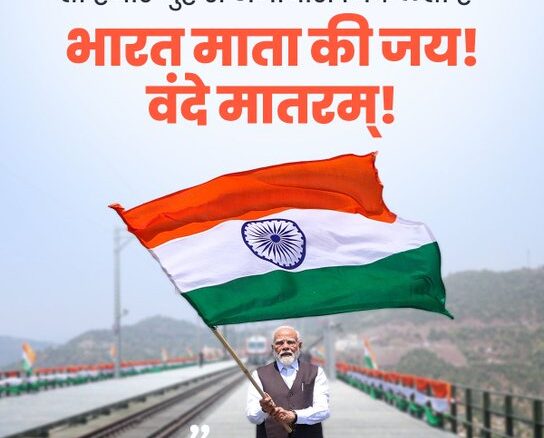

New Delhi, November 7, 2025: India today celebrated a moment of national pride as Prime Minister Narendra Modi inaugurated the year-long commemoration of 150 years of Vande Mataram, the national song that inspired India’s freedom movement and continues to unite the country in spirit and purpose. The grand ceremony was held at the Indira Gandhi Indoor Stadium in New Delhi, marking the beginning of celebrations that will continue till November 7, 2026.
A Grand Tribute to the Song of the Nation
To mark the occasion, the Prime Minister released a commemorative coin and postal stamp dedicated to Vande Mataram and inaugurated a thematic exhibition highlighting the song’s historical and cultural journey. He was joined by Delhi Chief Minister Rekha Gupta, Union Minister for Culture and Tourism Gajendra Singh Shekhawat, and Lieutenant Governor V. K. Saxena.
The event featured cultural performances, patriotic songs, and a live nationwide connection where people across India joined in the mass singing of Vande Mataram at 9:50 a.m., symbolizing unity and devotion to the motherland.
We mark 150 years of Vande Mataram, a song that has inspired generations to rise for the nation. Addressing a programme in Delhi. https://t.co/qQqjgmSXy5
— Narendra Modi (@narendramodi) November 7, 2025
PM Modi’s Address: “Vande Mataram is a Mantra of Confidence and Unity”
Addressing the gathering, the Prime Minister described Vande Mataram as a living symbol of India’s eternal spirit. He said the song has continued to inspire generations, boost self-confidence, and remind every Indian of the country’s strength and unity.
He noted that the occasion was not only a celebration of history but also a moment of national resolve. He added that the words Vande Mataram are more than just lyrics — they are a “mantra of energy, faith, and determination” that connects citizens to their roots and national identity.
The Prime Minister also paid tribute to the countless freedom fighters who drew courage from this song during India’s independence struggle. He said that the legacy of Vande Mataram continues to inspire India’s march towards becoming a Viksit Bharat — a developed and self-reliant nation.
Nationwide Celebration of Unity
The celebrations were not limited to Delhi. Across the country, schools, universities, cultural institutions, and public spaces witnessed enthusiastic participation as citizens joined in the collective singing of Vande Mataram. From Kolkata to Kanyakumari, from Ahmedabad to Aizawl, millions of voices echoed the same patriotic chant, symbolizing the song’s timeless appeal and its power to bring together people of every region, language, and culture.
Several state governments organized special events, parades, and exhibitions dedicated to the song’s history. Government buildings, monuments, and assembly halls were illuminated in the tricolour, while cultural troupes performed traditional and modern renditions of Vande Mataram.
In Delhi, the Legislative Assembly held a special programme, unveiling a commemorative plaque and hosting a cultural show by artists from the Sahitya Kala Parishad, showcasing the song’s spirit of patriotism and unity.
The Timeless Legacy of Vande Mataram
The year 2025 marks 150 years since Bankim Chandra Chatterjee composed Vande Mataram on Akshaya Navami, November 7, 1875. The song first appeared in Bangadarshan, a literary journal, and was later included in Chatterjee’s iconic novel Anandamath (1882).
Vande Mataram was first sung publicly in 1896 at the Indian National Congress session in Kolkata by Rabindranath Tagore. Its verses, invoking the Motherland as the embodiment of strength, prosperity, and divinity, became the heartbeat of the national movement. During the Swadeshi Movement and anti-partition protests, the song served as a rallying cry for freedom and self-respect.
Renowned philosopher Sri Aurobindo, writing in 1907, described Vande Mataram as “the mantra that awakened the nation.” He observed that when Bengal and India rose to seek truth and freedom, it was Vande Mataram that gave voice to that awakening.
From Freedom’s Anthem to National Song
Bankim Chandra Chatterjee (1838–1894), a leading literary and intellectual figure of 19th-century Bengal, played a pivotal role in shaping modern Indian thought. Through Vande Mataram, he articulated a vision of India as both sacred and sovereign — a motherland deserving of devotion and sacrifice.
Recognizing its profound significance, the Constituent Assembly of India adopted Vande Mataram as the National Song on January 24, 1950, giving it an honour equal to the National Anthem.
A Song That Still Resonates
Today, 150 years after it was first written, Vande Mataram continues to resonate in the hearts of millions. It is sung not just as a patriotic hymn but as an expression of love, unity, and reverence for the motherland.
As India celebrates this milestone year, the message of Vande Mataram—that the nation’s strength lies in its unity and devotion—remains as relevant as ever.
The celebration of its 150th anniversary is not only a tribute to the song and its creator but also a reaffirmation of India’s collective spirit — proud, diverse, and eternal.
Vande Mataram! Bharat Mata Ki Jai! Jai Hind!