

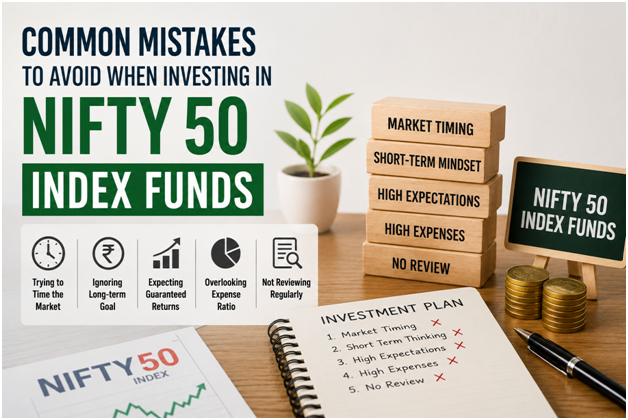
So You Think Index Investing Is Foolproof?
Okay, real talk for a second. A lot of people walk into a nifty 50 index fund thinking it’s basically a “set it and forget it, can’t go wrong” kind of deal. And look, I get why. The pitch sounds clean: fifty big companies, no fund manager picking favourites, low cost, simple math. What could possibly go sideways here?
Quite a bit, actually.
Here’s the thing though, the fund itself isn’t usually the problem. It’s the little decisions around it. The timing, the comparisons, the assumptions you didn’t even realise you were making. I’ve seen friends (and yeah, my younger self too) trip over the same handful of mistakes over and over, like we’re all reading from the same flawed script.
And honestly, picking just any nifty 50 index fund off a list and calling it a day is where half these mistakes quietly begin. So let’s wander through them, one at a time, the way you’d hash it out over coffee rather than a textbook, because rushing this part rarely ends well.
Treating Every Fund as Identical Twins
This one surprises people every single time. You’d assume two funds tracking the same fifty stocks would spit out near identical returns, right? Same index, same companies, same weights. Should be a copy paste situation.
Except it isn’t.
There’s this thing called tracking error, basically the gap between what the actual index does and what your fund manages to deliver after costs and operational hiccups. Cash sitting idle during redemptions, slight delays in rebalancing when the index changes its lineup, the expense ratio nibbling away quietly in the background, all of it adds up. Over one year the gap might look tiny, almost forgettable. Stretch that out to five years though, and suddenly you’re staring at a meaningfully smaller pile of money than the person who picked the more efficient fund. Same index. Different outcome. Wild, isn’t it?
Take three random funds, all chasing the same fifty stocks, and run them for five years. One investor ends up a bit richer than another simply because their fund managed cash a little better, or kept costs a notch lower. Doesn’t sound like much in isolation, but money doesn’t really care about “in isolation,” does it?
So don’t just grab whichever one your neighbour mentioned at a dinner party. Glance at the expense ratio, check how consistent the tracking error has stayed over time, not just one snapshot, and you’re already ahead of most folks.
Chasing Whoever Topped the Chart Last Quarter
Now here’s a trap that’s almost too easy to fall into. Some fund delivers a slightly better three month return and suddenly everyone’s piling in like it cracked some secret code. Hold on, let me think about that for a second, because it doesn’t really add up.
If every fund is holding the same fifty companies in roughly the same proportions, a short term lead usually comes down to small, almost boring factors, how the cash got managed that quarter, a rebalancing decision, maybe just noise. It’s not a skill. There’s no genius stock picker behind the curtain pulling levers, that’s literally not how passive funds work. Chasing last quarter’s winner is a bit like picking a queue at the supermarket because it moves fast for thirty seconds. Tomorrow it might crawl.
What actually matters is whether that fund keeps its costs low and its tracking gap stable month after month, year after year. Consistency beats a flashy three month headline every single time.
Forgetting That Direct Plans Exist
Ugh, this one genuinely irritates me because it’s such an easy fix and so many people just never bother. There are usually two flavours of the same scheme, a regular plan and a direct plan. The direct version skips the distributor commission, which means a noticeably lower annual cost. We’re talking the difference between something like 0.2 percent and close to 1 percent in some cases. Doesn’t sound dramatic on paper. Compound that over fifteen or twenty years on a sizable monthly investment and that gap can quietly cost you lakhs. Actual lakhs. Not pocket change.
If you’re investing through an advisor and you’re fine paying for that relationship, fair enough, that’s a personal call. But if you’re managing things yourself, going direct is basically free money you’re leaving on the table otherwise.
Obsessing Over Past Returns Like They’re a Promise
We’ve all done it. Scrolled through some app, sorted by “best 3 year return,” and gone with whatever sat at the top. Feels logical. Feels safe even.
But past performance is, and I cannot stress this enough, not a guarantee of what happens next. It’s barely even a hint most of the time. Markets cycle. Sectors that carried the index higher last year might just sit flat or drag it down the year after. What actually matters for the long haul is the boring stuff, expense ratio, tracking error consistency, fund size, whether the fund avoids holding excessive cash that just sits there earning nothing useful. None of that is exciting to read about, sure, but it’s the stuff that compounds quietly in your favour while you’re busy living your life.
Panicking the Moment the Market Dips
Markets fall. They always have, they always will, that’s not pessimism, it’s just how equity works. Yet every single correction, people rush to redeem, convinced this time it’s different, this time it won’t bounce back.
Honestly, this might be the most expensive mistake on this entire list, more costly than any expense ratio difference could ever be. Pulling out during a slump locks in the loss permanently. You’ve converted a temporary dip into a real one. And then, ironically, a lot of these same folks miss the recovery entirely because they’re too busy waiting for things to “calm down” before getting back in, except by then prices have already climbed. Staying invested through the wobbly periods, especially if your horizon is genuinely five, seven, ten years out, tends to work out far better than reacting to every headline.
I remember watching someone close to me redeem everything during a particularly rough stretch a few years back, convinced it was the responsible move. Markets recovered, as they tend to do eventually, and they spent the next year quietly kicking themselves.
Skipping SIPs and Trying to Time Lump Sums Instead
I know, I know, everyone wants to be the person who buys at the absolute bottom. Sounds smart. Feels smart. Almost never works out the way it does in your head though, because nobody, and I mean nobody, can reliably call the bottom of a market in advance.
A systematic monthly investment removes that guesswork entirely. You’re buying through the highs and the lows, averaging things out automatically, no emotional decision making required at 11pm because some news headline spooked you. It’s not glamorous. It won’t make for a great story at parties. But it works, quietly and consistently, which honestly is what investing should feel like most of the time anyway.
Ignoring Your Overall Portfolio Mix
This is a subtler one. People sometimes treat their nifty 50 index mutual funds as the entire investment plan, full stop, nothing else needed. But these funds are still equity, still tied to the ups and downs of the broader market, still carrying that very high risk label for a reason. Pairing that exposure with some debt instruments, maybe a bit of international diversification, gives your overall portfolio room to breathe when the large cap segment has a rough stretch. It’s not about distrusting the fund itself, it’s about not putting every single egg in one basket, however solid that basket looks today.
Wrapping This Up, Sort Of
None of these mistakes are dramatic or rare, honestly, that’s almost the unsettling part. They’re small, repeatable, easy to overlook, and they quietly chip away at what could’ve been a genuinely strong long term outcome. The good news, and there really is good news here, is that avoiding them doesn’t require any special talent. Just a bit of patience, checking the boring numbers instead of the flashy headline returns, and resisting the urge to fiddle constantly.
If you’re building wealth through nifty 50 index mutual funds, the real edge isn’t picking some hidden gem nobody else has found. It’s discipline, low costs, and simply staying out of your own way long enough for compounding to do what it does best.