
A pair of spectacles is no longer just something people wear to improve their vision. Today, eyewear has become part of personal style, fashion and everyday lifestyle choices. From branded prescription glasses and designer sunglasses to contact lenses and smart eyewear, consumers are exploring products that combine appearance, comfort and functionality.
This changing preference is creating new opportunities for India’s eyewear industry. The market is expanding beyond traditional optical stores, with online platforms, premium brands and organised retailers competing to attract customers.
According to the Redseer Strategy Consultants’ India Eyewear Market Report, published in July 2025, India’s eyewear market was valued at approximately ₹78,800 crore in FY2025 and is projected to reach around ₹1.48 lakh crore by FY2030. This represents an estimated annual growth rate of 13%.
Prescription eyeglasses account for approximately 73% of the market by value, making them the largest category. Sunglasses and contact lenses add further opportunities across fashion, lifestyle and vision correction.
For manufacturers, retailers, distributors and entrepreneurs, this growth points to a market where healthcare needs and fashion preferences are increasingly coming together.
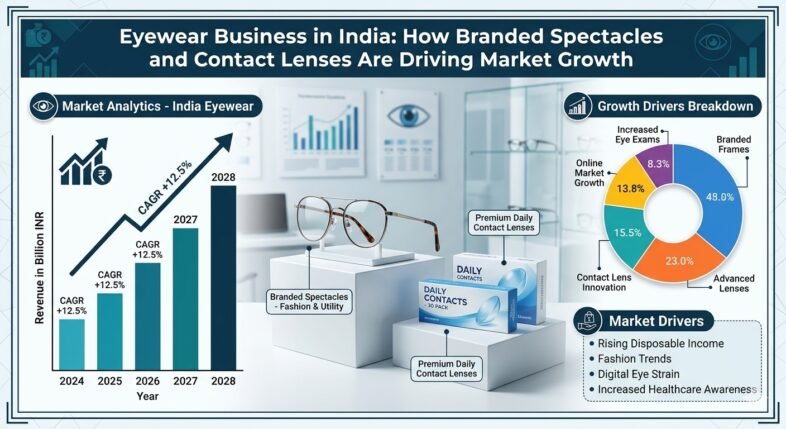
India’s Eyewear Market Is Moving Beyond Traditional Optical Retail
The demand for eyewear is being influenced by changing lifestyles, greater awareness of eye health and a growing preference for organised retail.
Consumers are becoming more particular about the products they purchase. While some look for affordable everyday spectacles, others are willing to spend more on branded frames, advanced lenses and premium designs.
The expansion of online shopping has also made it easier to discover different products and compare prices. At the same time, organised optical retailers are investing in physical stores, eye-testing facilities and digital services.
This combination is creating a wider market for eyewear businesses. Companies are no longer competing only on the availability of prescription glasses. Product design, brand identity, customer experience and after-sales service are becoming important differentiators.
Branded Spectacles Are Becoming a Lifestyle Purchase
Spectacles have gradually moved beyond their traditional role as vision correction products. For many consumers, choosing a frame is now similar to selecting a watch, handbag or other fashion accessory.
Branded eyewear is benefiting from this change. Lightweight frames, minimalist designs, bold colours and premium finishes are attracting customers across different age groups.
Younger consumers may prefer contemporary and colourful styles, while working professionals often look for frames that combine comfort with a polished appearance. Premium buyers, meanwhile, may be interested in designer collections, distinctive materials and specialised lenses.
This is encouraging optical retailers to expand their collections and offer products across different price segments.
The opportunity also extends to fashion collaborations. Eyewear brands can work with designers, celebrities and lifestyle influencers to introduce limited collections and reach customers who view spectacles as fashion accessories.
Private-Label Eyewear Is Opening Doors for Entrepreneurs
One of the interesting business opportunities in this market is the growth potential of private-label eyewear.
Entrepreneurs do not necessarily need to establish a large manufacturing facility to enter the market. They can work with established manufacturers, source frames and develop their own brands through distinctive designs, packaging and marketing.
A business could begin with a focused collection of affordable prescription frames, sunglasses or fashion-led eyewear before expanding into additional categories.
Social media platforms and online marketplaces can help emerging brands reach customers without the immediate expense of operating multiple physical stores.
However, success depends on maintaining consistent quality, offering comfortable products and building a recognisable brand identity. In a competitive market, attractive designs alone may not be enough to retain customers.
Contact Lenses Are Creating Repeat-Purchase Opportunities
Not everyone prefers wearing spectacles throughout the day. Contact lenses offer an alternative for people who want greater freedom during sports, social occasions or everyday activities.
The market includes daily disposable lenses, monthly lenses, toric lenses for astigmatism, multifocal lenses and coloured contact lenses.
Coloured lenses have also attracted interest from consumers who view them as part of their beauty and personal styling choices.
Established companies such as Bausch + Lomb, Johnson & Johnson and Alcon have a presence in India’s contact lens market. Newer brands and digital retailers are also exploring ways to connect with younger consumers.
From a business perspective, contact lenses offer an opportunity to build repeat customer relationships. Since many products need to be replaced regularly, retailers can develop replenishment services, subscription models and convenient online ordering.
However, contact lenses are medical devices that require proper fitting, hygiene and professional guidance. Businesses must prioritise authentic products and customer education rather than treating them simply as fashion accessories.
Online and Offline Optical Retail Are Working Together
The way people purchase eyewear is changing. Online platforms allow customers to browse different frames, compare prices and explore brands without visiting several stores.
Virtual try-on technology has made the experience more interactive by helping customers see how different frames might look on their faces.
However, physical optical stores continue to play an important role. Prescription eyewear requires accurate measurements, suitable lenses and proper fitting. Customers may also need eye examinations, adjustments and after-sales support.
This is encouraging businesses to adopt an omnichannel retail model, combining online convenience with physical store services.
For example, a customer may discover a frame through a digital advertisement, explore it online and then visit a nearby store for an eye test and fitting. Existing customers can return to the online platform for repeat purchases or accessories.
Independent optical retailers can also benefit from this approach by developing websites, offering appointment bookings and using social media to showcase new collections.
Technology Is Changing the Eyewear Experience
Technology is influencing both the products being sold and the way optical retailers operate.
Digital eye-testing equipment, virtual frame trials, advanced lens manufacturing and artificial intelligence-based retail tools are helping businesses improve customer experiences.
Lens innovation is another important area. Photochromic lenses, anti-reflective coatings, progressive lenses and other specialised options allow retailers to serve customers with different vision requirements.
Smart glasses represent another developing category. By combining conventional eyewear with features such as cameras, audio and digital connectivity, they are attracting interest from technology-conscious consumers.
For brands, the challenge is to combine useful features with comfortable designs and competitive pricing.
Business Opportunities Across India’s Eyewear Value Chain
The expansion of the eyewear market is creating opportunities for businesses beyond traditional optical retail.
Frame manufacturing: Businesses can explore affordable, premium and customised frames for domestic and international markets.
Lens production and distribution: Prescription lenses, specialised coatings and advanced lens technologies offer opportunities for manufacturers, laboratories and distributors.
Private-label eyewear: Entrepreneurs can build their own brands by working with manufacturers and developing distinctive designs, packaging and marketing strategies.
Optical retail: Independent stores and organised retail chains can serve different customer groups through affordable and premium product collections.
Contact lens distribution: Authorised distributors and online retailers can create sales channels for established contact lens brands.
Online eyewear platforms: Digital businesses can focus on virtual try-on services, product discovery, customer support and repeat purchases.
Eye-testing services: Optical businesses can strengthen their offerings through professional eye-testing facilities and partnerships with qualified eye-care practitioners.
These opportunities create room for both established companies and smaller businesses. Those that identify a specific customer segment and offer dependable products and services can build a distinctive position in the market.
Premiumisation and Branding Will Shape Competition
As consumers become more conscious of style and product quality, premiumisation is emerging as an important opportunity for eyewear businesses.
Some buyers are willing to pay more for designer frames, specialised lenses, lightweight materials and distinctive designs. Others continue to prioritise affordability, creating demand across multiple price segments.
This means brands need to understand their target customers rather than trying to serve everyone with the same product range.
Brand identity, product quality, pricing and customer service will influence purchasing decisions. Social media campaigns, influencer partnerships and fashion collaborations can help brands improve visibility, but customer trust ultimately depends on the products they deliver.
Retailers also need to focus on genuine products, transparent pricing, trained staff and reliable after-sales support.
The Road Ahead for India’s Eyewear Business
India’s eyewear industry is moving beyond its traditional role in vision correction. Branded spectacles are becoming lifestyle products, contact lenses are creating repeat-purchase opportunities, and technology is changing how consumers discover and purchase eyewear.
The projected market expansion also offers opportunities for frame manufacturers, lens suppliers, private-label businesses, distributors and organised optical retailers.
For entrepreneurs, the opportunity is not limited to opening an optical store or selling branded spectacles. Building a specialised eyewear label, developing an online retail platform or offering professional optical services could also become viable business models.
As fashion, technology and vision care continue to influence consumer choices, businesses that combine attractive designs, reliable products and convenient customer experiences may be well positioned to benefit from India’s growing eyewear market.
