
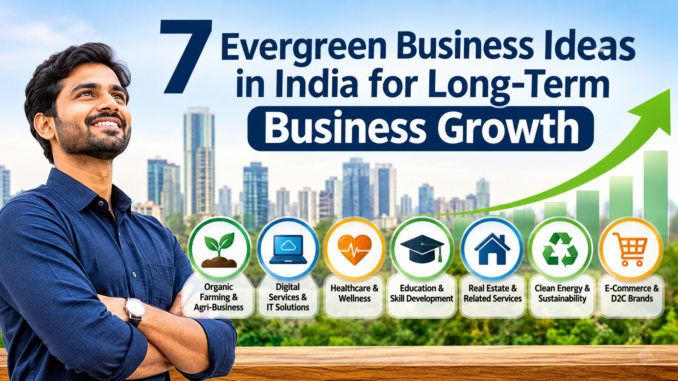
Nov 10: Starting a business is not simply about identifying a product that is selling well today. It is about understanding what people and businesses will continue to need in the years ahead.
Some businesses depend heavily on changing trends, while others are built around essential requirements. Healthcare, food, education, home maintenance, energy, logistics and technology are examples of sectors with long-term relevance. Their services may change with consumer preferences and technological developments, but the underlying demand is likely to remain.
For entrepreneurs in India, these sectors offer opportunities to build businesses around everyday needs and emerging market requirements. An ageing population, urbanisation, digital adoption, changing lifestyles and the expansion of infrastructure are creating new possibilities.
However, a sector with consistent demand does not automatically guarantee business success. Profitability depends on investment, operating costs, competition, customer retention and the ability to deliver a reliable service.
Here are seven evergreen business ideas in India that entrepreneurs can explore for long-term growth.
1. Healthcare and Elderly Care Services
Healthcare is one of the most essential sectors of the economy. People need medical attention, diagnostic services, rehabilitation and ongoing care throughout their lives. This creates demand that is less dependent on short-term consumer trends.
The opportunity extends beyond hospitals and clinics. Home nursing, elderly assistance, physiotherapy, medical equipment rental and diagnostic sample collection are among the services that entrepreneurs can explore.
India’s ageing population is also creating a growing need for organised care services. NITI Aayog’s publication, Reimagining Care: Strategies for Empowering Caregivers in Viksit Bharat@2047, estimates that the country’s elderly population could increase from 149 million in July 2022 to 194 million by 2031 and 347 million by 2050.
As families look for dependable support for older relatives, home-care services and assisted-living solutions could become increasingly relevant.
Entrepreneurs can consider starting with a specialised service rather than establishing a large healthcare facility. However, professional qualifications, trained staff, safety standards and applicable regulations must be considered.
Business opportunities include:
- Home nursing and patient-care services.
- Elderly assistance and caregiving.
- Diagnostic sample collection centres.
- Physiotherapy and rehabilitation services.
- Medical equipment rental and support.
2. Food Processing and Agriculture Businesses
Food is a daily necessity, making agriculture and food processing important areas for long-term business activity. What changes is how consumers purchase, prepare and consume food.
India offers opportunities across packaged foods, dairy products, agricultural processing, fresh produce and food distribution. Changing preferences are also creating space for specialised products such as millet-based snacks, healthier packaged foods, ready-to-cook meals and regional food brands.
The opportunity is not limited to manufacturing. Farmers, food producers, retailers and restaurants need packaging, storage, transportation and distribution services.
For a new entrepreneur, starting with a focused product range or a particular customer segment may be more manageable than investing in a large manufacturing operation immediately.
Food businesses must also pay attention to quality control, food safety requirements, shelf life, packaging and distribution costs. A product may attract initial interest, but repeat purchases depend on consistency and customer trust.
Business opportunities include:
- Packaged food and healthy snacks.
- Millet-based and regional food products.
- Dairy and value-added agricultural products.
- Food processing and packaging.
-
Cold storage and farm-to-market distribution.
3. Education and Skill Development
Education remains a long-term business opportunity because learning needs continue beyond school and college. Professionals need to update their skills, while students and job seekers look for training that improves their employment prospects.
Technology is also changing the skills required across industries. Artificial intelligence, cybersecurity, data analytics, digital marketing and technical trades are creating demand for specialised learning programmes.
NITI Aayog’s publication, Reimagining Skilling for Viksit Bharat@2047, highlights the importance of strengthening India’s skilling ecosystem to prepare the workforce for changing economic and employment requirements.
Entrepreneurs can build training businesses around a specific skill, profession or audience. A small institute could offer practical digital training for graduates, while another business could provide technical certification or corporate learning programmes.
The key is to connect training with practical outcomes. Courses that help learners develop relevant skills and demonstrate their capabilities are more likely to earn credibility.
Business opportunities include:
- Vocational and technical training centres.
- Online professional courses.
- Corporate learning and development.
- Digital marketing and technology training.
-
Certification and career-development programmes.
4. Home Repair, Maintenance and Essential Services
Homes, offices and commercial properties require regular maintenance. Electrical faults, plumbing problems, appliance breakdowns, painting and air-conditioning repairs are routine requirements that property owners cannot always postpone.
This makes home repair and maintenance a practical business opportunity, particularly for entrepreneurs interested in serving a local market.
The business can begin with a specific service, such as electrical repairs or air-conditioning maintenance, and expand as the customer base grows. There is also scope to serve offices, retail outlets, housing societies and commercial buildings through regular maintenance contracts.
Customers increasingly value trained professionals who arrive on time, communicate clearly and provide transparent pricing. Reliable service can help businesses build repeat customers and generate referrals.
Digital booking, online payments, customer reviews and service reminders can make it easier to manage appointments and customer relationships.
Business opportunities include:
- Electrical and plumbing services.
- Air-conditioning installation and maintenance.
- Appliance repair.
- Painting and property maintenance.
-
Office and commercial facility management.
5. Renewable Energy and Energy-Efficiency Services
Electricity is essential for households, factories, offices and commercial establishments. As energy requirements increase, businesses and consumers are exploring ways to manage consumption and adopt cleaner energy solutions.
Solar power, battery storage and energy-efficiency services are creating opportunities for specialised businesses.
The International Energy Agency’s India Renewable Energy Market Report 2026 examines the country’s expanding renewable energy capacity and the role of solar power in future growth.
Entrepreneurs can explore rooftop solar installation, panel maintenance, energy audits and efficient lighting solutions. Housing societies, commercial buildings and industrial facilities may also need support in evaluating and managing their energy requirements.
Unlike some local service businesses, renewable energy operations can require technical expertise, trained personnel, equipment and regulatory compliance. Installation quality and after-sales support are especially important because customers depend on the systems for years.
Business opportunities include:
- Rooftop solar installation.
- Solar panel cleaning and maintenance.
- Battery storage solutions.
- Energy audits for commercial properties.
-
Energy-efficient lighting and equipment.
6. Logistics, Warehousing and Supply-Chain Services
The movement of goods supports almost every major industry. Manufacturers need transportation, retailers require regular inventory replenishment, and online sellers depend on reliable delivery networks.
As e-commerce, organised retail and manufacturing expand, businesses need efficient ways to store, transport and distribute products.
This creates opportunities in logistics and warehousing, including smaller specialised operations. Entrepreneurs do not necessarily need to own a large fleet or warehouse. They can focus on regional delivery, packaging, inventory management or transportation for a particular industry.
Cold-chain logistics is another area worth exploring, particularly for businesses handling food, dairy products, pharmaceuticals and other temperature-sensitive goods.
Infrastructure and connectivity improvements can support the movement of goods across markets. The Reserve Bank of India’s Annual Report 2025–26 provides broader context on infrastructure development and economic activity.
However, logistics businesses need careful cost management. Fuel expenses, vehicle utilisation, delivery schedules, warehouse operations and working capital can influence profitability. Securing dependable customer contracts and maintaining operational efficiency are essential.
Business opportunities include:
- Regional transportation and delivery.
- Warehousing and inventory management.
- Cold-chain logistics.
- Packaging and fulfilment services.
-
Last-mile delivery for retailers and online sellers.
7. Technology, Cybersecurity and Digital Business Services
Technology has become an essential part of business operations. Retailers, hospitals, educational institutions, manufacturers and professional service providers depend on digital systems to manage customers, payments, communication and internal processes.
As businesses become more connected, they also need support with websites, software, cloud infrastructure, cybersecurity and data management.
Artificial intelligence is creating further opportunities. Companies are exploring automation, AI-assisted customer support, data analysis and tools that can reduce repetitive work.
Small and medium-sized businesses may not have the resources to maintain large in-house technology teams. They often depend on external specialists for technical support, security and digital services.
This gives entrepreneurs an opportunity to build specialised service businesses. Instead of investing heavily in developing a software product from the beginning, they could start with IT support, website development, cybersecurity consulting or business automation.
The ability to understand a client’s business requirements and provide dependable technical support can become an important competitive advantage.
Business opportunities include:
- Cybersecurity consulting.
- Managed IT and cloud services.
- Website and software development.
- AI implementation and business automation.
-
Digital marketing and online business support.
Comparing the Seven Evergreen Business Opportunities
Not every business requires the same level of investment, technical knowledge or operational involvement. The following comparison offers a broad starting point for entrepreneurs.
| Business sector | Potential entry model | Key requirement | Operating complexity |
|---|---|---|---|
| Healthcare and elderly care | Home-care coordination or specialised support | Trained professionals and compliance | High |
| Food and agriculture | Small packaged-food brand or distribution | Product quality and food safety | Medium to high |
| Education and skilling | Online courses or specialised training | Subject expertise and credibility | Low to medium |
| Home maintenance | Local repair or maintenance service | Skilled technicians and customer service | Low to medium |
| Renewable energy | Solar maintenance or energy consultancy | Technical expertise and equipment | Medium to high |
| Logistics and warehousing | Regional delivery or fulfilment service | Reliable operations and working capital | High |
| Technology and digital services | IT support, website services or automation | Technical skills and customer acquisition | Low to medium |
These are indicative comparisons, not fixed investment classifications. Actual costs and complexity will depend on the business model, location, scale and regulatory requirements.
Which Evergreen Businesses Are Suitable for Small Entrepreneurs?
For people starting with limited resources, service-based businesses can offer a practical way to test market demand before expanding.
Home repair and maintenance services, digital business support and specialised training can often begin with a focused service offering. Entrepreneurs with professional experience may be able to use their existing skills and build a customer base gradually.
Food businesses can also start with a limited product range, provided the entrepreneur addresses food safety, packaging and distribution requirements. However, manufacturing and inventory costs should be assessed carefully.
Healthcare and renewable energy offer long-term opportunities, but they may require specialised expertise, trained personnel and regulatory approvals. Logistics can also involve significant working capital, depending on the operating model.
The right choice depends on the entrepreneur’s skills, available resources, location and ability to reach customers. Starting small, validating demand and expanding in stages can help reduce avoidable risks.
How to Choose the Right Evergreen Business in India
An industry may have long-term relevance, but that does not mean every business operating in it will succeed. Entrepreneurs need to understand the market before committing their money.
A few practical considerations can help narrow down the options.
Look for recurring demand: Businesses that solve regular customer problems may have better opportunities to generate repeat revenue.
Understand your customers: Identify who will buy your product or service, what they need and how much they are willing to pay.
Assess the investment realistically: Consider equipment, staff, rent, licences, technology, marketing and working capital rather than looking only at the initial setup cost.
Study the competition: Examine existing businesses, their pricing, service quality and customer feedback. Identify where you can provide a more convenient, reliable or specialised offering.
Build customer trust: Consistency, transparent pricing and dependable service are important for attracting repeat customers.
Be ready to adapt: Customer preferences, technology and regulations change. A business needs to evolve rather than depend on the same approach indefinitely.
Conclusion: Build Around Needs That Do Not Disappear
The next successful business idea may not necessarily be the latest trend. It could be a service that people and companies will continue to need, even as the economy and technology change.
Healthcare, food, education, home maintenance, renewable energy, logistics and technology offer different opportunities for entrepreneurs looking to build a business in India.
Each sector comes with its own investment requirements, competition and operational challenges. A healthcare service needs professional expertise, a food business must maintain quality, and a technology company must keep pace with changing customer requirements.
The strongest opportunity is not always the biggest market. It is the one where an entrepreneur understands the customer, can manage costs and consistently deliver value.
For anyone considering a long-term business in India, the starting point should be simple: identify a genuine need, validate demand and build a business that is prepared to serve that need over time
