

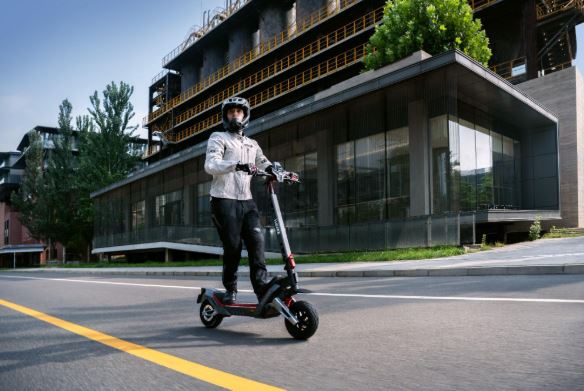
Scooters Are No Longer Just for Smooth City Streets
Most people still assume electric scooters are built for one thing: gliding across freshly paved city streets. That assumption made sense when scooters were mainly used for short commutes between a subway stop and an office. But riding habits have changed. Today riders regularly hit cracked pavement, park gravel paths, campus walkways that turn to dirt near the quad, or boardwalks near the beach — and not every scooter is built to keep up.
If you only compare top speed or design, you can end up with a scooter that struggles the moment the pavement ends. Riders who want more freedom beyond paved streets often look at all terrain electric scooters for adults, which are built around tire size, suspension, and motor torque suited to uneven paths — not just the ideal conditions of a bike lane.
What “Any Terrain” Actually Means — With Real Numbers
“Any terrain” here isn’t extreme off-roading through mud or rock. It means handling everyday complexity: rough pavement, gravel, light dirt, uneven sidewalks, and small slope transitions — plus, for some riders, the occasional weekend trip onto trails or unpaved paths outside the city. The spec that predicts this best is tire diameter and width, and the differences are measurable, not just marketing language.
| Tire size | Best suited for | Trade-off |
| 8–8.5″ | Folding/portable commuters, smooth pavement | Struggles on cracks, gravel, potholes — smaller tires offer greater agility but are less forgiving on rough surfaces |
| 10″ | Daily mixed-surface commuting | Good balance; noticeably better stability and shock absorption than 8.5-inch wheels while staying manageable in size and weight |
| 10.5–11″ | Park trails, campus paths, light gravel | Bulkier, heavier, harder to carry; better cushioning but starts trading off portability |
| 12″+ (self-healing tubeless, 4–5″ wide) | Weekend light off-roading — dirt paths, rugged trails, loose gravel, uneven ground | Heaviest and least portable of the group, but tires in this range are built specifically to handle rugged trails and loose or uneven terrain with confidence, not just survive it |
The jump from 10″ to 12″+ isn’t just about size — it’s usually paired with a tougher, self-healing tubeless construction meant to resist punctures on rockier or debris-covered ground, which a standard 10″ commuter tire isn’t built to handle repeatedly. If your plan is genuinely just daily streets and the occasional gravel patch, the 10–10.5″ range covers you well. But if “weekend trip to the trails outside town” is a real, recurring part of your riding — not a one-off — the 12″+ tier is where scooters stop treating off-road as an occasional inconvenience and start treating it as a designed-for use case.
Suspension: What to Look For, Not Just Whether It Exists
“Has suspension” isn’t a useful spec on its own — the type matters. Single spring shocks reduce basic vibration; dual spring or hydraulic setups handle repeated impacts (seams, curb cuts, gravel washboard) with less rebound and better wheel contact. If your route has more than an occasional pothole, a single-shock scooter will still leave your wrists and knees absorbing most of the hit. Riders covering 5+ miles a day on mixed terrain generally notice the difference between one and two shock points within the first week.
Motor Power: Torque Matters More Than Top Speed Here
A scooter’s top speed number describes flat, ideal conditions — it says little about how it behaves on a 10–15% grade, a loose gravel start, or a loaded rear rack. Two practical markers to check instead:
- Continuous wattage (not just peak wattage) — this is what the motor actually sustains on a climb, not just for a burst.
- Dual motor vs. single motor — dual motor setups generally hold speed better on inclines above roughly 15%, since power is split across both wheels rather than relying on one to push and steer.
If a spec sheet only lists peak power and top speed with no continuous rating or incline percentage, that’s usually a sign the scooter wasn’t tested much beyond flat ground.
Battery Range: Plan for 60–70% of the Stated Number
Manufacturer range figures are almost always measured on flat pavement, at a lighter test rider weight, in mild temperature, at the lowest speed mode. Real mixed-terrain riding changes that quickly — mismatched tire pressure or size alone can cut a scooter’s efficiency by roughly 12%, and overloading beyond the rated weight capacity can cut range by as much as half. A practical planning rule: treat the advertised max range as a ceiling, and plan actual trips around 60–70% of that number, especially if your route includes hills or loose surfaces.
Who Actually Needs This vs. Who Doesn’t
- Skip the upsize if you ride under 3 miles a day exclusively on paved bike lanes and need to carry the scooter onto a bus or train — an 8.5″ folding model is still the better trade-off.
- Go 10″ if your commute mixes decent pavement with occasional cracks, curb cuts, or a gravel shortcut.
- Go 11–12″+ with dual shock and dual motor if you regularly cross park paths, campus dirt sections, or inclines above 10%, or if you’re over roughly 220 lbs and want range and stability to hold up.
Pre-Ride Checklist Specific to Mixed Terrain
- Check tire pressure against the sidewall spec before every ride — underinflation on gravel increases puncture risk more than on pavement
- Test brake response at low speed before hitting an incline, since wet gravel extends stopping distance noticeably versus dry pavement
- Confirm battery covers your planned distance at 60–70% of rated range, not the full advertised number
- Start unfamiliar terrain in a lower speed mode to gauge grip before committing to full throttle
- Avoid deep mud, standing water, or loose sand — traction control on scooters isn’t built for these regardless of tire size
- Wear a helmet and check local regulations, which vary by city for where scooters can legally ride off standard bike lanes
Choose Based on Where You Actually Ride, Not the Spec Sheet
The honest way to shop is to map your real weekly route first — how much of it is smooth pavement versus cracked streets, park paths, or campus dirt — and then match tire size, suspension type, and continuous motor wattage to that, rather than starting from top speed. Brands like NAVEE have leaned into this by pairing wider pneumatic tires and dual-shock suspension on their all-terrain models specifically for riders whose daily route isn’t purely flat pavement. The goal isn’t conquering extreme terrain — it’s not being limited by the terrain you already ride through every day.