

New framework focuses on institutional reform, convergence, digital governance and outcome-based monitoring for tribal development
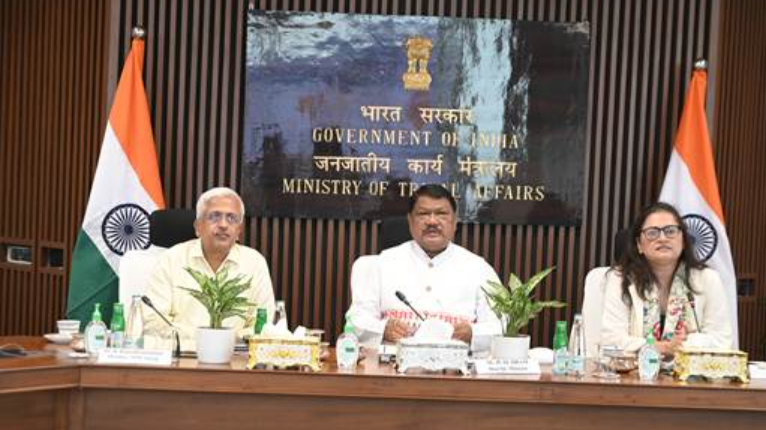
New Delhi: Union Minister for Tribal Affairs Shri Jual Oram and Dr. R. Balasubramaniam, Member, NITI Aayog, on Saturday jointly released the National Framework for Strengthening of ITDAs and ITDPs and the Operational Guidelines for Strengthening of ITDAs and ITDPs, marking a major step towards strengthening last-mile delivery of tribal development programmes across the country.
The two publications are the outcome of a comprehensive, consultative and evidence-based national exercise aimed at improving the functioning of Integrated Tribal Development Agencies and Projects (ITDAs/ITDPs), which serve as key field-level institutions connecting government programmes with tribal communities.
The release ceremony was attended by Secretary, Ministry of Tribal Affairs, Smt. Ranjana Chopra; Additional Secretary Shri Manish Thakur; and senior officials of the Ministry.
Speaking on the occasion, Shri Jual Oram said ITDAs and ITDPs have historically played an important role in translating government initiatives into outcomes for tribal communities. Their significance, he noted, has increased with the expansion of interventions under the Dharti Aaba Janjatiya Gram Utkarsh Abhiyan (DAJGUA) and PM-JANMAN.
Dr. R. Balasubramaniam said the principles of institutional ranking, real-time data-driven monitoring and convergence, which have helped improve outcomes in aspirational districts and blocks, have now been incorporated into the ITDA/ITDP reform architecture.
He said evidence-based administrative interventions can help transform regions that lag behind, and the new framework seeks to apply this approach to the tribal development ecosystem, with ITDAs serving as vehicles for achieving saturation of entitlements at the last mile.
The exercise was undertaken under the overall guidance of Secretary, Tribal Affairs, Smt. Ranjana Chopra, with a focus on moving beyond a uniform approach and developing context-specific and accountable field institutions.
The Ministry began the exercise in April 2026, covering 214 ITDAs/ITDPs across 17 States and Union Territories. The assessment involved Project Officers, State Tribal Welfare Departments and Tribal Research Institutes.
Unlike a desk-based assessment, the exercise incorporated State-level workshops, field visits and direct consultations with officials and institutions at the ground level. The process culminated in an Evidence-Weighted ITDA Diagnostic Scoring Framework, which assesses institutions across 15 parameters covering five institutional domains.
Structured consultation workshops were held across States and UTs during April and May 2026 under the leadership of Dr. Varnali Deka, Director, DAJGUA Division, and Shri Jafar Malik, Deputy Secretary, EMRS. The consultations enabled the Ministry to assess institutional capacity, identify challenges and document successful practices before validating the findings.
A major milestone in the exercise was the National Conclave on Strengthening of ITDAs and ITDPs, held at Vigyan Bhawan, New Delhi, on June 3, 2026, in the presence of President Droupadi Murmu.
The newly released National Framework sets out the assessment methodology and broader strategic direction for institutional strengthening. The Operational Guidelines, meanwhile, translate the recommendations into actionable measures covering institutional restructuring, convergence of schemes, evidence-based planning, digital governance, outcome-based monitoring and capacity building.
For the first time, States will have access to a common institutional assessment methodology through which individual ITDAs can identify gaps and prepare Performance Improvement Roadmaps tailored to their local requirements.
Shri Oram emphasised that the exercise should not be viewed merely as a mechanism for ranking institutions. Instead, its objective is to establish a culture of continuous institutional improvement.
He urged States to conduct State-level reviews involving all ITDA/ITDP Project Officers, prepare institution-specific action plans and introduce quarterly monitoring of institutional performance, drawing on the monitoring approach followed under the Aspirational Districts Programme and Aspirational Blocks Programme.
The Minister also called for measures to strengthen the ITDA/ITDP ecosystem, including improving fund-flow mechanisms and examining the possibility of directly transferring funds to ITDAs. He also stressed the need to increase technical manpower to improve project execution.
Regular meetings of Governing Councils, with active participation from Panchayati Raj Institution representatives and senior State leadership, were also recommended to strengthen convergence, accountability and implementation.
The two publications are expected to provide States with a structured roadmap for transforming ITDAs and ITDPs into more responsive, data-driven and outcome-oriented institutions capable of delivering tribal welfare and development programmes more effectively at the grassroots level.