
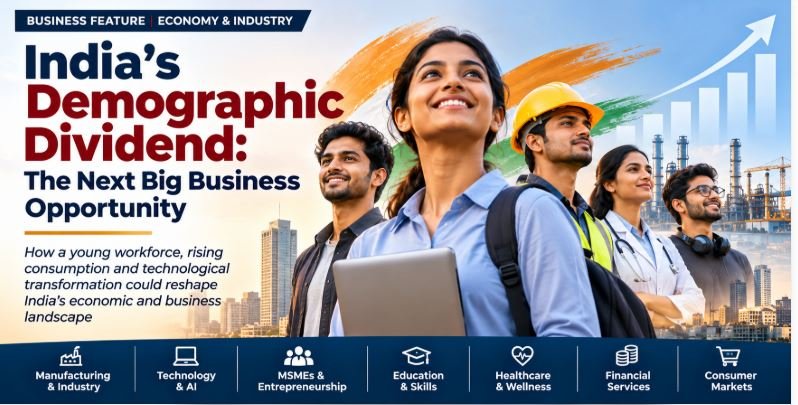
India’s greatest economic opportunity over the next decade may not lie beneath its soil or within its financial markets. It may lie in the aspirations, skills and purchasing power of its people.
With a population exceeding 1.4 billion and a relatively young age structure, India is entering a strategically important phase of demographic transition. A growing working-age population offers the country an opportunity to expand production, strengthen domestic consumption, attract investment and establish itself as a major global economic powerhouse.
For businesses, this demographic shift represents more than a population statistic. It signals the emergence of new consumer markets, an expanding talent pool, changing purchasing patterns and opportunities across manufacturing, technology, financial services, healthcare, education and entrepreneurship.
The concept behind this transformation is known as the demographic dividend.
However, the real business question is whether India can convert its population advantage into productive employment, higher household incomes and sustainable economic growth.
A Young Population, A Growing Economic Opportunity
The demographic dividend occurs when the proportion of the working-age population increases relative to the dependent population. As fertility rates decline, a larger share of people enters the economically productive age group.
India is positioned to benefit from this transition. According to the Reserve Bank of India’s January 2026 analysis, the working-age population (15–64 years) is projected to account for approximately 65.1% of the country’s population in 2031.
The Government of India’s Economic Survey 2025–26 also identifies the coming decade as an important period for India’s demographic opportunity.
For the business community, these developments have significant implications.
A larger working population can increase household incomes, strengthen consumption demand, expand the availability of labour and encourage investment in new industries. More economically active citizens can also contribute to savings, financial inclusion and capital formation.
But population growth alone does not create business growth. The opportunity depends on employment quality, purchasing power, education, productivity and the ability of industries to absorb new workers.
The Consumption Economy: India’s Expanding Consumer Market
One of the most visible effects of demographic change is the transformation of consumer markets.
As more young people enter employment, their consumption requirements evolve. Demand for housing, automobiles, smartphones, financial products, healthcare, travel, entertainment, professional education and lifestyle services can expand.
India’s young consumers are also increasingly connected to digital platforms. Online shopping, digital payments, food delivery, subscription services and app-based financial products are changing how businesses reach customers.
This creates opportunities for companies that understand emerging consumer preferences.
Retailers, e-commerce businesses, consumer brands and financial institutions can benefit from expanding demand, particularly when they develop products suited to different income groups and regional markets.
The next phase of consumer growth will not be restricted to metropolitan cities. Tier-II and Tier-III cities, smaller towns and semi-urban markets are becoming increasingly important destinations for business expansion.
Companies that combine affordability, accessibility, product quality and digital convenience will be better positioned to capture these opportunities.
Manufacturing: Turning India’s Workforce into Industrial Strength
Manufacturing is likely to play a central role in converting India’s demographic advantage into economic value.
A large workforce can support industrial expansion, provided workers possess the required technical capabilities and businesses have access to infrastructure, finance and competitive production systems.
Electronics, automobiles, textiles, pharmaceuticals, food processing, engineering goods, defence manufacturing and semiconductor-related industries offer opportunities for employment and investment.
The expansion of domestic manufacturing can generate jobs across multiple skill levels, from production workers and technicians to engineers, supervisors and management professionals.
It can also create additional opportunities for logistics companies, component suppliers, packaging businesses, industrial service providers and technology firms.
India’s manufacturing ambitions must therefore be supported by a strong supply-chain ecosystem.
For businesses, the opportunity is not limited to establishing large factories. Small and medium enterprises can participate as component manufacturers, specialised suppliers, maintenance providers and service partners.
MSMEs: The Backbone of Employment Generation
Micro, small and medium enterprises have a critical role in India’s demographic dividend.
While large corporations attract significant investment and contribute to exports, MSMEs can generate employment across diverse geographical regions and economic activities.
Small businesses in manufacturing, retail, hospitality, transportation, food processing, construction, digital services and professional consulting can absorb workers with different educational backgrounds.
The growth of MSMEs can also encourage entrepreneurship among young people who wish to establish independent businesses rather than depend entirely on salaried employment.
However, many enterprises continue to face challenges related to access to credit, technology adoption, market connectivity, skilled employees and business formalisation.
Improving access to affordable finance, digital infrastructure, business development services and modern production technologies can help MSMEs become more productive.
For India, strengthening the MSME sector is not simply an industrial policy objective. It is an essential employment strategy.
Education and Skill Development: Building the Workforce of Tomorrow
The demographic dividend cannot be realised without investment in human capital.
India’s expanding workforce needs skills that match the changing requirements of businesses and industries. Traditional academic qualifications alone may not be sufficient in an economy increasingly influenced by automation, artificial intelligence and digital transformation.
Companies are looking for employees with practical knowledge, communication abilities, technical expertise, analytical thinking and problem-solving capabilities.
This creates a significant opportunity for the education and skill-development industry.
Professional training institutes, vocational education providers, online learning platforms, corporate training companies and certification programmes can contribute to workforce development.
Industry-academia partnerships will also become increasingly important.
Businesses should participate in curriculum development, internships, apprenticeships and practical training programmes to ensure that students are prepared for actual workplace requirements.
The future competitiveness of Indian businesses will depend significantly on the quality of their human resources.
Artificial Intelligence: An Opportunity and a Challenge
Artificial intelligence is changing the relationship between employment, productivity and economic growth.
AI-powered systems, robotics, automation and data analytics are transforming business operations across manufacturing, banking, healthcare, retail, logistics and professional services.
For India’s young workforce, this transformation creates opportunities in software development, AI engineering, cybersecurity, cloud computing, data science and technology-enabled business services.
At the same time, automation may reduce demand for certain repetitive tasks and change the skill requirements of existing occupations.
Businesses will need to invest in employee reskilling and continuous learning.
The objective should be to build a workforce that can work alongside technology rather than become increasingly vulnerable to technological displacement.
For entrepreneurs, AI also offers opportunities to create new business models, improve operational efficiency and serve previously underserved markets.
Women’s Economic Participation: An Untapped Growth Opportunity
India’s demographic dividend will remain incomplete unless women participate more fully in economic activities.
Women’s education has improved considerably, but barriers related to childcare, workplace safety, mobility, unequal opportunities and unpaid domestic responsibilities continue to influence workforce participation.
Increasing women’s economic participation can expand the available talent pool, strengthen household incomes and increase the productive capacity of the economy.
Businesses can contribute through flexible working arrangements, safe workplaces, equal employment opportunities, maternity support and professional development programmes.
Women-led enterprises also deserve greater access to credit, technology, mentoring and markets.
For the Indian economy, women’s participation should be recognised as a major component of long-term business competitiveness and inclusive growth.
Healthcare and Financial Services: Emerging Business Opportunities
A growing working population creates additional demand for healthcare, insurance, financial planning and retirement savings.
As household incomes rise, consumers may seek better access to hospitals, diagnostic centres, preventive healthcare, health insurance and specialised medical services.
This creates opportunities for healthcare providers, pharmaceutical companies, medical technology businesses and health-tech startups.
Financial services represent another important growth area.
Young working professionals require banking, savings, insurance, credit, investment and retirement planning products.
Digital financial platforms can help expand access to these services, particularly among first-time consumers and people in smaller cities.
However, financial inclusion must be accompanied by financial literacy, consumer protection and responsible lending practices.
Regional Markets: The Next Frontier of Business Expansion
India’s demographic transition is not uniform. States and regions are experiencing different population trends, workforce characteristics and levels of economic development.
This creates an opportunity for businesses to adopt region-specific expansion strategies.
States with relatively young populations may offer opportunities in labour-intensive industries, education, housing, consumer goods and employment services.
More developed industrial and service economies may offer advantages in advanced manufacturing, technology, financial services and specialised healthcare.
Odisha, for example, has opportunities to connect its workforce with expanding industrial activities in steel, aluminium, mining, port-led development, renewable energy, tourism, food processing and technology services.
The development of industrial corridors, educational institutions, logistics infrastructure and urban centres can strengthen these opportunities.
Businesses that understand local workforce availability, purchasing power, infrastructure and consumer preferences will be better positioned to enter emerging regional markets.
The Challenges Businesses Cannot Ignore
Despite the enormous potential, India’s demographic dividend also presents important challenges.
Unemployment and underemployment can restrict household purchasing power. Skill mismatches can increase recruitment costs and reduce productivity. Unequal access to education and technology can widen economic disparities.
Rapid urbanisation can create pressure on housing, transportation and public infrastructure.
Businesses must also prepare for an evolving labour market in which technological capabilities, workplace flexibility and employee development will become increasingly important.
Another major consideration is the eventual ageing of the population. The current demographic opportunity is temporary, making timely investment in productivity, infrastructure and financial security essential.
Companies should therefore avoid treating demographic change as an automatic guarantee of future demand.
Successful businesses will be those that combine market opportunities with sound financial planning, innovation and long-term investment.
What Should Indian Businesses Do Now?
The demographic transition offers companies an opportunity to rethink their growth strategies.
Businesses should consider five important priorities:
- Invest in people: Strengthen employee training, technical capabilities and leadership development.
- Expand into emerging markets: Explore opportunities in smaller cities, semi-urban areas and regional consumer markets.
- Adopt technology: Integrate AI, automation, digital platforms and data analytics to improve productivity.
- Support inclusive employment: Create opportunities for women, young professionals and workers from different educational and economic backgrounds.
- Build future-ready business models: Develop products and services aligned with changing consumer preferences, technological progress and demographic trends.
The private sector will be particularly important in creating productive employment and translating demographic opportunities into commercial and economic outcomes.
The Road Ahead: A Decade That Could Shape India’s Economic Future
The period between 2026 and 2036 could prove decisive for India’s demographic and economic transformation.
The country has an opportunity to strengthen manufacturing, expand technology-driven services, improve workforce capabilities and develop a more productive business ecosystem.
However, the success of this transition will depend on cooperation between government, industry, educational institutions, financial organisations and entrepreneurs.
Government policies must encourage investment and employment generation. Businesses must focus on productivity and workforce development. Educational institutions must prepare young people for emerging industries.
India also needs to ensure that economic opportunities are distributed across states, cities, towns and rural communities.
The demographic dividend should not be measured only through the number of people entering the working-age population. It should also be measured through the quality of jobs created, improvements in household incomes, workforce productivity and the participation of women in the economy.
Conclusion: India’s Greatest Business Asset Is Its People
India’s demographic dividend represents a significant opportunity for businesses and investors.
A young population can support expanding consumer markets, provide a growing talent pool, encourage entrepreneurship and strengthen the country’s position in global manufacturing and services.
But the opportunity will only become an economic advantage when the population is healthy, educated, skilled and productively employed.
For Indian businesses, the message is clear: the next phase of growth will depend not only on capital, technology and infrastructure but also on the ability to develop and utilise human resources effectively.
The companies that invest in people, embrace innovation and understand the aspirations of India’s emerging workforce could become important participants in the country’s next economic transformation.
India’s demographic dividend is not merely a population advantage. It is a business opportunity, an investment opportunity and a long-term economic growth opportunity. The real dividend will come from turning India’s young population into a productive force that drives national prosperity.
