

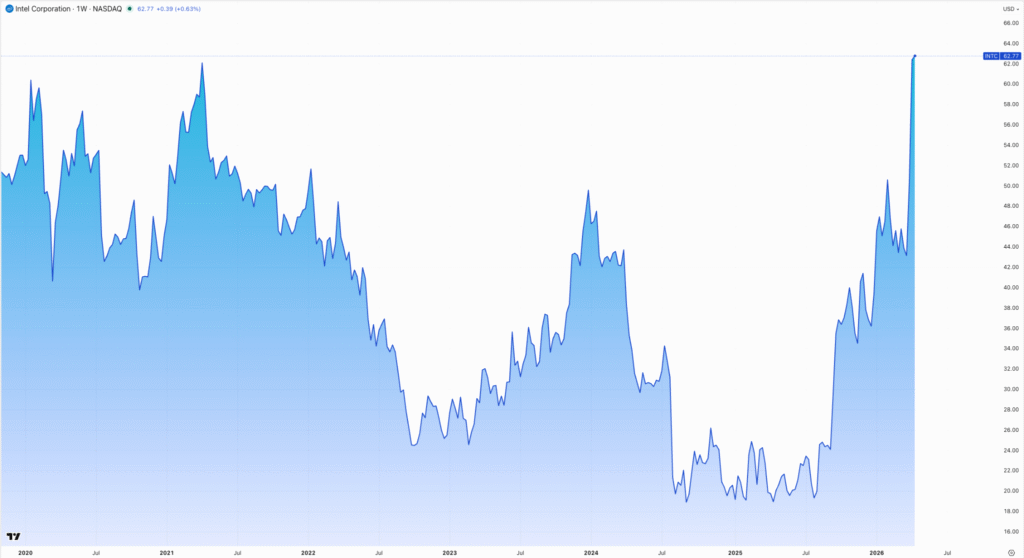
After years of losing investor confidence, Intel has suddenly found itself at the epicenter of a massive market rally, becoming one of the top performers in the S&P 500 index. In a week, shares rose by more than 50%, adding over $100 billion to its market capitalization and marking a record for the company’s growth. Since the beginning of the year, the stock has gained 72%, building on an 84% jump from the previous year. While several factors are at play, they collectively reflect an important shift: the market once again views Intel as a strategic asset in AI infrastructure rather than a lagging player.
The key trigger was a combination of corporate maneuvers and surging external demand. In early April, Intel’s $14.2 billion buyout of Apollo Global Management’s stake in their Irish joint venture signaled management’s confidence in its internal production. At the same time, the company joined the TeraFab project — developed by Tesla, SpaceX, and xAI and aimed at scaling chip production for AI and robotics. These steps have reinforced the perception of Intel as a critical infrastructure player in the new cycle.
Further momentum came from an expanded partnership with Google, which has committed to using multiple generations of Intel Xeon processors for data center AI training and inference. Moreover, the collaboration extends beyond traditional CPUs — the companies are jointly developing infrastructure accelerators (IPUs) that take over network, computing, and system functions. With the market shifting from model training to scalable inference, this direction is gaining importance, as CPUs and related chips are becoming a key link in the overall architecture.
The market is beginning to reassess the role of the CPU in the age of AI. If earlier Nvidia’s dominance seemed to be unconditional due to accelerators, now investors are increasingly realizing that GPUs alone cannot solve the scaling problem. System efficiency requires a balance, and this is where Intel is trying to regain its position by focusing on integrated solutions and contract manufacturing.
Intel’s capitalization approached $310 billion, its highest level in years, moving the company higher on the stock screener. Though still trailing competitors like AMD, Intel’s value has increased 3.5 times since April 2025, reflecting a gradual restoration of confidence in the transformation strategy. Support from the U.S. government and strategic investments from SoftBank and Nvidia have solidified Intel’s image as a systemically important player.
However, this rapid growth has sparked concerns. The stock is trading at more than 90 times projected earnings, exceeding levels seen during the dot-com bubble. The consensus rating remains subdued, and a significant number of analysts point to overheating. The market is pricing in a scenario of successful transformation and restored profitability over the next few years, although the company may post a loss this year.
Thus, Intel’s current rally is not just a reaction to individual news, but a reflection of a broader reassessment of its role in the AI value chain. Investors are betting that the company will be able to integrate into the new infrastructure cycle along with the largest technological players. However, such a sharp increase in the stock simultaneously heightens sensitivity to any signs of a slowdown and leaves investors questioning whether this is a recovery or the start of a new valuation phase.