
Campaign desks rarely fail because they lack another image tab. They fail because Monday’s poster brief, Tuesday’s lookbook, and Wednesday’s grounded product shot all get forced through the same model habit. I checked Nano banana routing inside NovaImage AI as a buying decision: keep speed and precision as separate jobs, then pay credits only when the result lands.
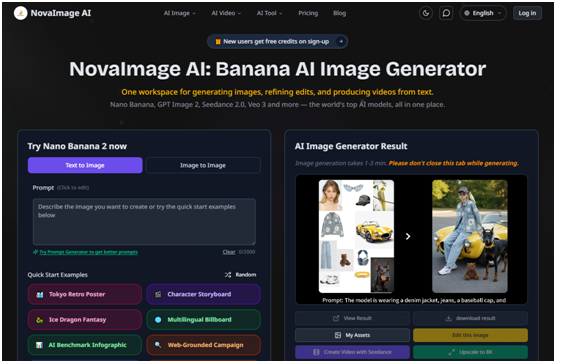
NovaImage AI positions itself as one workspace for image generation, conversational edits, and video handoff with Seedance or Veo. The sharper question for marketing teams is simpler. When should Nano Banana 2 own the brief, and when should Nano Banana Pro take the handoff without leaving the desk?
The Decision Shows Up Mid Campaign Not At Signup
Signup is easy. Mid-campaign is where money leaks. You need a readable launch headline on Monday, a multi-reference outfit set on Tuesday, and a product frame that should match a real SKU on Wednesday. If each job forces a different vendor login, you pay in context switching: re-uploading brand kits, re-explaining type rules, re-checking commercial terms.
A single workspace only helps if the models inside it map to different buyer jobs. Otherwise you bought a bundled brochure. The hidden cost is not only subscription overlap. It is the silent hour spent re-arguing “keep the logo sharp” in a new chat every time the file crosses tools.
That is why routing rules beat vibes. Write the job first. Then pick the model. Do not reverse the order because a teammate liked last week’s sample gallery. If you cannot name the job in one sentence, you are not ready to spend credits.
Also separate “explore” days from “finalize” days on the calendar. Explore days should default to Nano Banana 2. Finalize days should default to Nano Banana Pro. Mixing both modes in the same hour is how teams burn afternoon capacity on pretty rejects.
Score Models On Jobs Not On Vibes
Use four practical scores before you care about slogans.
- Readable multilingual text inside posters and UI mocks
- Reference fusion when outfits, props, or brand kits multiply
- Factual grounding when the product must look like the real thing
- Credit and speed fit for high-volume draft days
On NovaImage AI, Nano Banana 2 is powered by Gemini 3.1 Flash Image. The product page puts it in the speed lane: roughly 1–2 minutes per pass on the model page, Text-to-Image at 2K starting at 5 credits, optional Web Search Grounding for +2 credits, and up to 14 reference images in one request. Quality controls include 1K, 2K, and 4K, with aspect ratios from square 1:1 through cinematic 21:9.
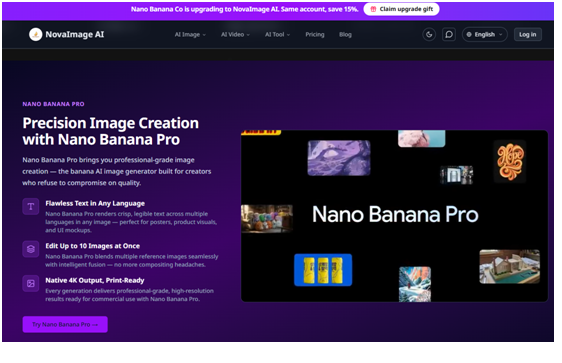
Nano Banana Pro sits on Gemini 3 Pro Image with Thinking Mode for composition planning before render, stronger multi-subject consistency across up to 10 subjects, up to 10-image fusion, and native 2K/4K commercial output. The Pro UI on the site starts at 2K or 4K rather than a 1K starter tier, which matches its production positioning.
Google’s own Flash Image notes also stress image-search grounding and stronger in-image text as distinctive Flash-era capabilities. Inside this platform, that shows up as the Web Search Grounding toggle on Nano Banana 2. Those are different jobs. Scoring them separately stops the false fight of “which banana is best.”
Keep a shared scorecard in the team wiki with the four scores above and the last accepted sample for each. When a new hire asks which model to open, point them at the card instead of a Slack poll. Consistency beats taste arguments.
Side By Side Where Each Model Earns The Brief
Here is a buyer table you can drop into a team wiki without turning it into a fan war.
| Job | Lean Nano Banana 2 | Lean Nano Banana Pro | Why |
| Fast concept volume | Default | Later polish | Lower credit start + Flash speed |
| Poster with exact headline copy | Strong | Default for finals | Pro leans pixel-level type control |
| Lookbook from many outfit refs | Default if refs >10 | Default if fidelity first | 2 supports up to 14 refs |
| SKU that must match real product | Default with grounding | Runner-up | Web Search Grounding is on 2 |
| Multi-character continuity | Use carefully | Default | Pro consistency across subjects |
Read the table as routing rules. Nano Banana 2 is the safe first pick when you are hunting angles, checking factual product look, or feeding a heavy reference stack. Nano Banana Pro is the better desk when the brief is constrained, commercial, and type-sensitive. Failed generations do not burn credits under the published no-charge policy, so wrong routing still hurts time more than wallet — but wrong routing still hurts review calendars.
A practical week might look like this. Monday: Nano Banana 2 at 2K, Web Search off, five poster directions. Tuesday: turn grounding on for the winning product angle so packaging details stay closer to the live listing. Wednesday: move the approved composition to Nano Banana Pro at 4K for the legal and brand pass. Thursday: if you need a short motion cut, hand the still to Seedance from the same workspace instead of exporting into a fifth account.
Friday should be audit day, not more generation. Export the winners, archive the rejected prompts, and note which routing rule saved a review cycle. Without that habit, the desk will drift back to “open whatever model felt lucky last time.”
Where The Platform Itself Adds Buying Value
The model split only works if credits and exports stay in one place. Paid plans advertise private creation, no watermarks, and full commercial use. Yearly Starter sits at $8.2/month for 299 credits, Basic at $24.9 for 1399, and Pro at $49.9 for 3099, with Image Marking, prompt generator, upscaler, and text remover unlocked on the Pro plan tier. Monthly list prices are higher; yearly billing is the “49% off” path the pricing page emphasizes.
One-time packs never expire and can top up a subscription when a campaign spike arrives. Subscriptions refresh monthly and fit desks editing more than about 200 images a month. New users also get complimentary credits to test before spending. That package is the practical reason to keep banana ai image generator work inside one account instead of bouncing files between five logins. You change the model, not the brand kit folder.
Where This Routing Still Needs An Editor
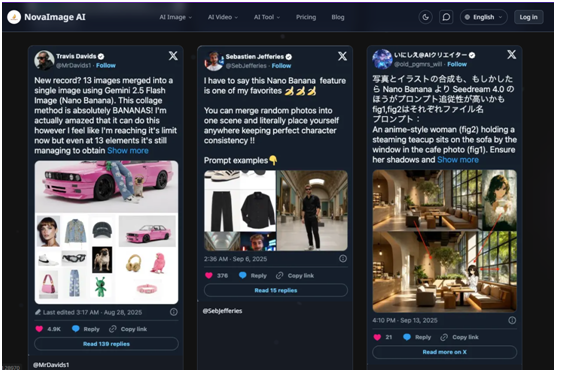
Grounded product shots still need a human check against the live SKU page. Multilingual billboards still need a native speaker to catch wrong glyphs. Multi-character scenes can drift if your references are soft or inconsistent. Treat the models as production assistants, not as a substitute for brand approval.
Who Should Route Nano Banana Jobs This Way
This split fits marketing teams that ship weekly creatives and hate re-uploading the same brand kit. It is less useful if you only need one occasional social still and do not care about type or product accuracy.
If your desk already argues about which model “feels better,” write routing rules instead. Put Nano Banana 2 on volume, grounding, and heavy reference stacks. Put Nano Banana Pro on finals that must survive print or legal review. NovaImage AI is a restrained fit when you want that handoff without leaving the workspace.