

May, 20 : Tata Power EV Charging Solutions Limited (TPEVCSL), a key player in India’s EV charging ecosystem and a subsidiary of The Tata Power Company Limited, has collaborated with Indian Oil Corporation Limited (IOCL) to expand EV charging infrastructure along the Delhi-Mumbai Expressway. As part of this collaboration, TPEVCSL has established ultra-fast EV charging stations at the 63 and 69 Milestones on the Haryana stretch of the expressway.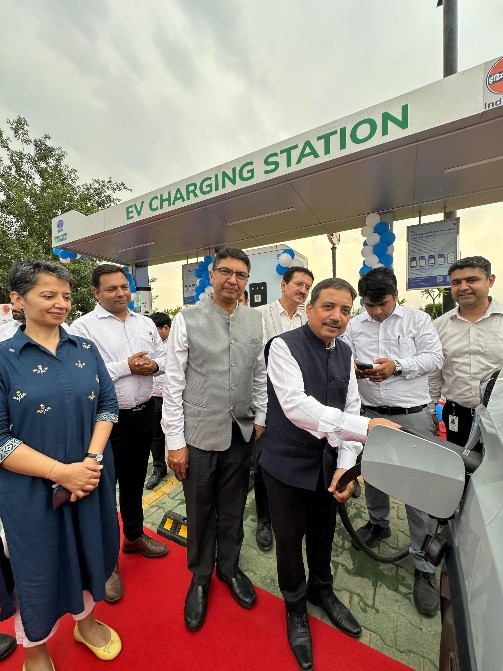
The Delhi–Mumbai Expressway, stretching over 1,350 kilometres, is one of India’s most significant infrastructure corridors, connecting major economic regions across the country. As part of its expansion on the expressway, TPEVCSL has inaugurated a 240 kW ultra-fast EV charging station equipped with four charging guns at the 63 Milestone for traffic travelling from Delhi. The company has also installed another EV charging station at the 69 Milestone on the opposite carriageway, enabling charging access for travellers commuting in both directions. From IOCL, Shri Hemant Rathore, ED&SH, DSO and Shri Ritesh Kumar, SRH, DSO were the chief guests for the inauguration event. Representing IOCL, Shri Hemant Rathore, EDS&H, DSO, and Shri Ritesh Kumar, SRH, DSO, graced the inauguration ceremony as Chief Guests.
The Delhi–Mumbai Expressway(DME) , would stretch over 1,350 kilometres when fully completed, is one of India’s most significant infrastructure corridors, connecting major economic regions across the country. The charging stations have been established at the parking area at Indian Oil’s Wayside Amenities (WSAs). WSA are modern rest and service hubs designed to enhance the highway travel experience for commuters apart from Retail outlet facilities. Spread across approximately 18 hectares when fully developed, these WSAs of 63 and 69th milestone on DME serve as key stopover destinations and host several leading global and national brands like MacD, Starbucks, Haldirams, Third Wave coffee, Subway apart from Retail arcade and Vilage haat.
The chargers are designed to offer fast and efficient charging for EV users travelling on the expressway, helping reduce charging time during long-distance journeys. With the ability to support multiple vehicles simultaneously, the stations will cater to both personal and commercial EV users. The addition of these charging points further expands IOCL’s growing highway charging network across key transit routes in India.
The chargers are designed to offer fast and efficient charging for EV users travelling on the expressway, helping reduce charging time during long-distance journeys. With the ability to support multiple vehicles simultaneously, the stations will cater to both personal and commercial EV users. The addition of these charging points further expands TPEVCSL’s growing highway charging network across key transit routes in India.
Tata Power has expanded its EV Charging network under the brand name of EZ Charge to over 2 lakhs + home chargers, 6,700+ public, semi-public, and fleet charging points, along with 1,200+ E-bus charging points across 690+ cities and towns. Overall, Tata Power EZ Charge has 5 lakhs+ registered customers. These chargers have been strategically deployed at diverse and accessible locations such as highways, hotels, malls, hospitals, offices, bus and commercial vehicle depots, residential complexes, etc. This concerted effort has been instrumental in facilitating the exponential growth of electric mobility in India.
Beyond EV charging, Tata Power Renewable Energy Limited (TPREL) continues to expand its integrated clean energy portfolio, including rooftop solar installations, utility-scale renewable energy projects, and solar cell and module manufacturing, supporting India’s transition toward a more sustainable energy ecosystem. TPREL’s total renewable utility capacity has reached 11.6 GW. Currently, 6.5 GW of this capacity is operational, comprising 5.3 GW of solar and 1.2 GW of wind energy. Additionally, 5.1 GW is under various stages of implementation. These ongoing projects are expected to be completed in phases over the next 6 to 24 months in a staggered manner.