
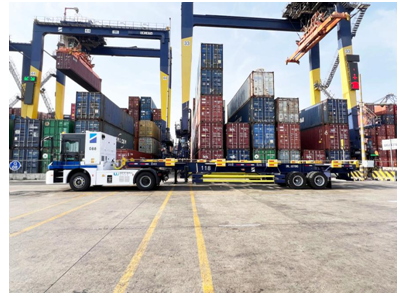
Quick Answer: AI and autonomous vehicles are changing industrial transportation by connecting automated driving with real-time perception, route planning, fleet coordination, operational data, and energy management. Instead of treating an autonomous vehicle as a standalone driverless machine, logistics operators can use AI to coordinate vehicles with cargo, equipment, infrastructure, and other transportation tasks. This makes the technology particularly relevant to ports, airports, factories, and other controlled industrial environments.
Artificial intelligence and autonomous vehicles are often discussed as separate technologies. AI is associated with data processing and decision-making, while autonomous vehicles are associated with sensors, navigation, and automated driving. In industrial logistics, however, their value increasingly comes from putting the two together.
A vehicle that can drive without a human operator is only one part of an automated transportation operation. It still needs to understand its surroundings, choose appropriate routes, respond to changing conditions, receive transportation tasks, and coordinate with other vehicles and equipment.
That is where AI becomes important.
The combination of AI and autonomous vehicles is moving industrial transportation beyond simply replacing a driver. The larger opportunity is to create logistics operations in which vehicles can perceive conditions, make decisions, communicate with operational systems, and execute transportation tasks with less direct human intervention.
What Does AI Add to Autonomous Vehicles?
An autonomous vehicle needs several technologies to operate. Sensors collect information about the environment, positioning systems determine location, onboard computing processes information, and vehicle-control systems translate decisions into movement.
AI adds intelligence to this process.
For example, an autonomous truck operating in a container terminal may encounter other trucks, containers, cranes, designated lanes, temporary obstacles, and changing traffic conditions. The vehicle needs to interpret what it detects and determine how to respond.
This creates a basic operating cycle:
Perceive → Understand → Decide → Act → Receive New Information
The process then repeats as the environment changes.
This is different from simply programming a vehicle to follow a fixed route. Industrial logistics environments are dynamic, and transportation tasks can change throughout the day.
AI therefore helps autonomous vehicles become more responsive to actual operating conditions.
Why Industrial Logistics Is a Strong Use Case for Autonomous Vehicles
Much of the public discussion around autonomous driving focuses on passenger cars and public roads. Industrial logistics presents a different operating environment.
Ports, airports, factories, and logistics centers often contain defined operating areas, repeated transportation tasks, known equipment, and established traffic rules. These characteristics can make them practical environments for deploying autonomous transportation technologies.
At the same time, these environments are far from simple.
A container terminal, for example, may involve quay cranes, yard cranes, trucks, containers, gates, charging or battery-swapping stations, and human-operated equipment. All of these activities can affect transportation.
This means the challenge is not simply making one vehicle autonomous.
The larger challenge is coordinating transportation across the entire operation.
From Autonomous Vehicles to Autonomous Fleet Operations
Consider a fleet of ten autonomous trucks operating in the same terminal.
Each truck may be capable of navigating independently. But if all ten vehicles receive tasks independently, the fleet may still experience unnecessary congestion, inefficient routing, or poor task allocation.
Fleet-level intelligence addresses a different question:
Which vehicle should perform which task, at what time, and through which route?
This is where AI-based scheduling and fleet management become increasingly important.
Westwell’s recent logistics architecture combines autonomous vehicles with an intelligent scheduling and operations management platform. Its ReeWell platform is designed to coordinate operational elements including vessels, vehicles, yards, equipment, personnel, and energy resources. It can also work with both autonomous vehicles and manually operated equipment.
This represents an important shift in thinking.
The objective is no longer simply:
Can this vehicle drive itself?
It becomes:
Can the transportation system intelligently coordinate all of these vehicles and resources?
That distinction is especially important for large industrial sites.
AI and Autonomous Vehicles: How the Technology Layers Work Together
The relationship between AI and autonomous vehicles becomes easier to understand when the technologies are viewed as different layers rather than one single system.
| Technology Layer | Main Role | Example in Industrial Logistics |
| Perception | Understand the surrounding environment | Cameras and LiDAR detect vehicles, obstacles, equipment, and road conditions |
| Autonomous Driving | Control the vehicle | Steering, braking, acceleration, and navigation |
| AI Decision-Making | Interpret information and support decisions | Route selection, obstacle response, task decisions |
| Fleet Management | Coordinate multiple vehicles | Assign transportation tasks and manage vehicle status |
| Operational AI | Coordinate broader logistics activities | Connect vehicles with cargo, equipment, yards, and operational resources |
| Energy Management | Support vehicle availability | Charging, battery swapping, and energy scheduling |
The important point is that these layers do not provide the same function.
A vehicle may have excellent perception technology, but that does not automatically mean the fleet is being managed efficiently.
Likewise, a powerful scheduling platform cannot compensate for poor vehicle-level perception.
The value of AI and autonomous vehicles comes from connecting these layers.
Why Real-Time Perception Matters
Autonomous vehicles cannot rely entirely on static maps and predefined routes.
Industrial environments change throughout the day.
A container may be moved. A vehicle may stop unexpectedly. A lane may become unavailable. Equipment may occupy an area that was previously clear.
Autonomous vehicles therefore need to interpret their surroundings continuously.
Westwell’s Q-Truck, for example, uses an intelligent perception system combining AI stereo cameras and LiDAR for environmental perception and recognition. The company describes the system as using multi-task, multi-source, and multi-field-of-view sensing technologies for complex operating environments.
This illustrates an important principle: autonomous driving depends not only on knowing where the vehicle is, but also on understanding what is happening around it.
Autonomous Vehicles Do Not Always Have to Replace Existing Fleets
One common assumption is that companies need to replace conventional vehicles before they can introduce autonomous transportation.
In practice, industrial operators may need to manage a mixture of autonomous and manually operated equipment.
This is particularly relevant for large logistics facilities that already have substantial transportation infrastructure.
A mixed-fleet environment can allow autonomous vehicles to perform suitable repetitive tasks while conventional vehicles continue handling other operations.
Westwell has documented mixed-traffic autonomous truck operations at container terminals, including a deployment at Thailand’s Laem Chabang Port where autonomous and human-operated trucks operate together.
This approach changes the role of AI once again.
AI does not only need to control an autonomous vehicle. It can also support coordination between different types of vehicles operating in the same environment.
AI Can Connect Vehicles With the Rest of the Logistics Operation
Transportation is rarely an isolated activity.
At a container terminal, an autonomous truck may need to collect a container after a crane completes a handling task. Its next assignment may depend on container location, yard conditions, traffic, and the status of other vehicles.
If the autonomous vehicle only knows its own position, its ability to make operational decisions is limited.
A broader AI system can combine information from multiple operational sources.
Westwell’s recent ReeWell platform is designed around this broader concept. According to the company, the platform creates an intelligent orchestration layer covering vessels, vehicles, yards, equipment, personnel, and energy resources, while supporting real-time operational monitoring and decision-making.
This is an important direction for industrial automation.
The intelligence is no longer located only inside the vehicle.
It extends into the operational system surrounding the vehicle.
Energy Management Is Part of Autonomous Transportation
For electric autonomous fleets, energy is another operational variable.
A vehicle that needs to recharge at the wrong time may become unavailable for a transportation task. If several vehicles require energy replenishment simultaneously, the effect can extend to the wider fleet.
That makes energy management part of transportation planning.
Westwell’s logistics solutions combine autonomous electric vehicles with energy technologies such as battery swapping and intelligent energy management. Its Q-Truck deployments, for example, have used PowerOnair battery-swapping technology to support continuous fleet operations.
The broader lesson is that autonomous transportation cannot be separated completely from energy infrastructure.
For electric fleets, vehicle availability, transportation schedules, and energy replenishment can all influence one another.
AI and Autonomous Vehicles Are Expanding Beyond Ports
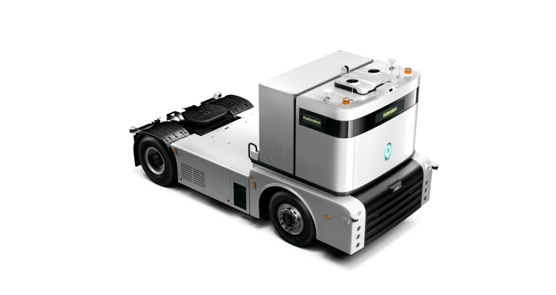
Ports are an important application, but the same concept can apply to other industrial environments.
Airports need to move cargo and equipment between terminals and designated operating areas. Factories need to transport materials between production, storage, and assembly locations. Inland logistics facilities also rely on repeated movement of goods across defined areas.
Westwell currently positions its intelligent logistics solutions across seaports, airports, inland ports, smart factories, and intermodal logistics. Its Physical AI concept focuses on autonomous vehicles and intelligent equipment interacting with the physical environment, while Operational AI acts as an intelligence layer for broader logistics coordination.
This creates a useful distinction.
Physical AI interacts with the physical world.
Operational AI coordinates what happens across the operation.
Autonomous vehicles can therefore become the physical execution layer of a much larger intelligent logistics system.
What Companies Should Consider Before Deploying Autonomous Vehicles
Purchasing autonomous vehicles is not the same as implementing autonomous transportation.
Before deployment, companies need to evaluate the entire operating environment.
1. Which transportation tasks should be automated?
Not every task requires the same level of autonomy.
Repetitive transportation routes and clearly defined workflows may be suitable starting points, while more unpredictable tasks may require a different approach.
2. How will autonomous vehicles interact with existing equipment?
A logistics site may contain autonomous trucks, conventional trucks, cranes, forklifts, and other equipment.
The system needs to account for how these different assets operate together.
3. How will transportation tasks be assigned?
Vehicle-level autonomy does not automatically solve fleet-level scheduling.
Companies should consider how tasks are allocated and how the system responds when priorities change.
4. How will the system respond to changing conditions?
Real environments rarely remain exactly as planned.
Perception, decision-making, and operational systems need to work together when conditions change.
5. How will energy availability affect operations?
For electric fleets, charging or battery swapping should be considered alongside transportation planning rather than treated as a completely separate activity.
6. Can existing infrastructure remain in use?
A phased approach may be relevant for companies that already have established vehicles, equipment, and logistics systems.
These questions help shift the discussion from buying an autonomous vehicle to planning an autonomous transportation operation.
How Westwell Applies AI and Autonomous Vehicles to Logistics
Westwell’s approach is centered on applying AI, autonomous driving, and new-energy technologies to industrial logistics rather than treating autonomous vehicles as isolated products.
Its Qomolo solutions include autonomous electric vehicles, while its broader logistics architecture connects transportation with fleet management, scheduling, operational data, and energy systems.
The company’s 2026 AI Dual Intelligence concept further divides the architecture into Physical AI and Operational AI. Physical AI is represented by autonomous electric vehicles and intelligent cargo-handling equipment, while Operational AI provides an intelligence layer for scheduling and operational decision-making.
This approach reflects a broader change in industrial automation.
The autonomous vehicle is no longer necessarily the final product.
It can become one component of an intelligent transportation network.
The Future of AI and Autonomous Vehicles
The future of AI and autonomous vehicles in industrial logistics is likely to involve deeper coordination between physical equipment and operational intelligence.
Autonomous vehicles can execute transportation tasks. AI can interpret operational data and support decisions. Fleet management systems can coordinate multiple vehicles. Energy systems can help maintain vehicle availability. Infrastructure can provide additional information about the environment.
When these components work together, automation can move beyond individual machines.
The result is a more connected model of industrial transportation in which vehicles are able to participate in broader operational decisions rather than simply follow predefined routes.
For ports, airports, factories, and logistics centers, the key question is therefore not only whether a vehicle can drive autonomously.
It is whether AI and autonomous vehicles can work together with the rest of the logistics operation.
That is where the next stage of intelligent transportation is taking shape.
FAQ About AI and Autonomous Vehicles
What is the role of AI in autonomous vehicles?
AI helps autonomous vehicles interpret sensor information, recognize objects and conditions, support navigation and decision-making, and respond to changes in the operating environment. In industrial logistics, AI can also extend beyond the vehicle to support fleet management and operational coordination.
Are autonomous vehicles the same as AI-powered vehicles?
Not exactly. Autonomous vehicles use multiple technologies, including sensors, positioning, computing, control systems, and AI. AI is one important component that can support perception, decision-making, and operational coordination.
Where are AI and autonomous vehicles commonly used in logistics?
Industrial applications include container ports, airports, factories, inland logistics facilities, and other controlled or semi-controlled environments. These settings often involve repetitive transportation tasks and defined operating areas.
Can autonomous and human-driven vehicles work together?
Yes. Industrial logistics can use mixed fleets in which autonomous and manually operated vehicles share the same operational environment. Westwell has documented mixed-traffic autonomous truck operations in container terminals.
What is the difference between autonomous driving and autonomous logistics?
Autonomous driving focuses primarily on the vehicle’s ability to perceive its environment and operate without continuous human control. Autonomous logistics is broader. It can involve vehicle control, fleet scheduling, cargo movement, equipment coordination, operational data, and energy management.
Conclusion
AI and autonomous vehicles are changing industrial transportation by connecting automated driving with a much broader layer of operational intelligence.
The most important development is not simply the creation of vehicles that can drive themselves. It is the connection between autonomous vehicles, AI decision-making, fleet management, logistics infrastructure, and energy systems.
As these technologies become more integrated, ports, airports, factories, and logistics facilities can move toward transportation operations where vehicles do more than follow routes. They can become intelligent participants in a coordinated logistics network.
For companies exploring autonomous transportation, this broader perspective is important. The question is not only whether an autonomous vehicle can complete a journey. It is whether the vehicle can become part of a system that understands the operation, responds to changing conditions, coordinates resources, and continuously supports the movement of goods.
Website:www.en.westwell-lab.com
Westwell:https://en.westwell-lab.com/about
Email: hello@westwell-lab.com
