
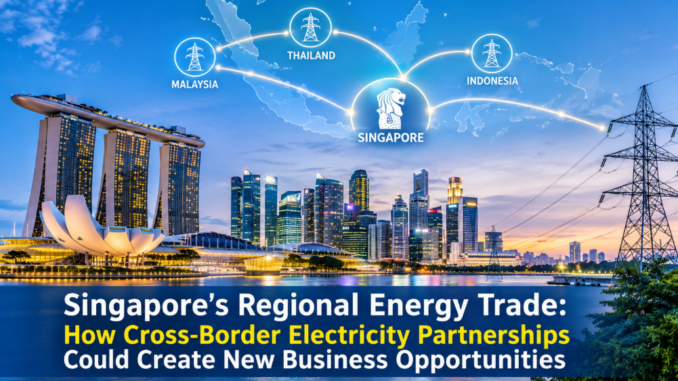
Nov 04: Singapore is strengthening its position in Southeast Asia’s energy market by expanding partnerships to import electricity from neighbouring countries. With rising power requirements from data centres, semiconductor manufacturing and other energy-intensive industries, the country is exploring new ways to secure reliable electricity while diversifying its energy mix.
The expansion of Singapore’s regional energy trade is creating opportunities beyond conventional power generation. Renewable energy developers, infrastructure companies, battery manufacturers, financial institutions and technology providers could benefit as the country develops new electricity connections with Malaysia, Vietnam and other regional markets.
Recent developments in 2026 indicate that these partnerships are moving closer to commercial implementation. Singapore’s approval of a proposed 1.3 GW electricity import project involving Malaysia and Vietnam, alongside separate electricity trade arrangements with Malaysia, highlights the growing importance of cross-border power partnerships.
As the ASEAN Power Grid advances, Singapore could become an important centre for energy investment, infrastructure development and electricity trading in Southeast Asia.
Why Singapore Is Expanding Its Regional Electricity Partnerships
Singapore’s electricity requirements are expected to increase as its economy expands and new industrial investments come online. Data centres, semiconductor manufacturing facilities and digital infrastructure are contributing to rising demand for a dependable electricity supply.
Natural gas currently accounts for around 95% of Singapore’s electricity generation. Although it remains an important part of the country’s energy mix, the government is exploring alternative sources to strengthen energy security and support its decarbonisation objectives.
Limited land availability also makes large-scale domestic renewable energy development challenging. Importing electricity from neighbouring countries provides access to renewable resources that may be more readily available elsewhere in Southeast Asia.
The Energy Market Authority (EMA) has been facilitating proposals to import low-carbon electricity from Australia, Cambodia, Indonesia, Malaysia and Vietnam.
As of August 2026, Singapore had granted Conditional Approvals to 13 electricity import projects with a combined proposed capacity of 9.25 gigawatts (GW). This growing pipeline reflects increasing interest among regional energy companies in developing cross-border electricity partnerships.
The country’s future electricity requirements provide another reason for accelerating these arrangements. According to EMA’s October 2026 Energy Infrastructure Plan, peak electricity demand stood at 8.6 GW in August 2026 and could increase to between 9.9 GW and 13 GW by 2031.
These developments are encouraging greater participation from regional energy companies, infrastructure developers and investors.
Recent Developments Driving Singapore’s Cross-Border Electricity Trade
Several developments in 2026 highlight how Singapore’s regional energy strategy is progressing from planning towards project development.
Singapore Approves 1.3 GW Electricity Import Project Involving Malaysia and Vietnam
On October 26, 2026, Singapore’s Energy Market Authority granted Conditional Approval to Sembcorp Utilities to import up to 1.3 GW of electricity through a regional consortium.
The project involves MY Energy Consortium, with partners including Petronas, Tenaga Nasional Berhad and Petrovietnam Technical Services Corporation.
The proposed initiative will combine offshore wind resources from Vietnam with solar power and battery energy storage infrastructure in Malaysia. Electricity is expected to be transmitted through a regional power corridor connecting the three countries.
The consortium is targeting electricity imports by 2035, subject to regulatory approvals, power purchase agreements, financing and other project requirements.
The development is significant because it demonstrates how companies across different countries can collaborate on large-scale renewable energy projects. It also creates opportunities for infrastructure providers, engineering companies and investors involved in regional power transmission.
Malaysia-Singapore Electricity Trade Gains Momentum
Singapore is also strengthening its electricity partnerships with Malaysia.
In August 2026, EMA granted Conditional Approvals to two companies to import a combined 900 MW of electricity from Peninsular Malaysia.
Sembcorp Utilities received approval for a proposed 300 MW project, while Southern Solar Alliance received approval for 600 MW. Both projects are expected to source electricity generated through solar power and battery energy storage systems in Johor, with commercial operations targeted around 2029.
Separately, Singapore Energy Interconnections, SP Group and Tenaga Nasional Berhad signed a Joint Development Agreement to study a proposed second electricity interconnection of up to 2 GW between Singapore and Peninsular Malaysia.
These initiatives could strengthen electricity connectivity between the two markets and encourage investment in renewable energy generation, transmission infrastructure and storage technologies.
ASEAN Power Grid Creates Opportunities for Regional Cooperation
The ASEAN Power Grid is emerging as an important initiative for connecting electricity networks across Southeast Asia.
Its long-term vision is to enable greater regional electricity trading, allowing countries to share power resources and improve the reliability of their energy systems.
Singapore’s growing partnerships with Malaysia, Vietnam and Indonesia could contribute to this wider regional ambition.
In May 2026, the Asian Development Bank (ADB) and Singapore’s Energy Market Authority renewed their cooperation to accelerate cross-border clean energy projects in ASEAN. The ADB has pledged up to US$10 billion over the next decade towards the ASEAN Power Grid, supporting cross-border transmission, national grid infrastructure and renewable energy development.
This cooperation could help make regional electricity projects more commercially viable and encourage greater participation from private companies and institutional investors.
Five Business Opportunities Emerging from Singapore’s Regional Energy Trade
The expansion of cross-border electricity partnerships could benefit several industries. As projects move towards development, demand for specialised infrastructure, technology and financial services is likely to increase.
1. Renewable Energy Development and Investment
Malaysia, Indonesia and Vietnam have considerable potential for solar and wind energy development. Their renewable resources could become increasingly important as Singapore looks to diversify its electricity supply.
This creates opportunities for renewable energy developers, international investors and engineering companies.
Businesses could participate in solar farm development, offshore wind projects, equipment manufacturing and project management. Singapore-based companies may also explore partnerships with regional developers to participate in renewable energy projects across multiple markets.
Long-term electricity supply agreements could provide additional commercial certainty for projects requiring substantial upfront investment.
2. Subsea Cables and Electricity Transmission Infrastructure
Cross-border electricity trade depends on reliable transmission networks. As regional electricity connections expand, subsea cables, substations and grid infrastructure will become increasingly important.
The proposed connections between Singapore and Malaysia, along with potential electricity corridors involving Vietnam and Indonesia, could generate demand for specialised infrastructure services.
Subsea cable manufacturers, offshore engineering contractors, marine construction companies and electrical equipment suppliers could benefit from these developments.
There will also be opportunities in infrastructure inspection, maintenance and monitoring as new transmission networks become operational.
3. Battery Storage and Smart Energy Technologies
Solar and wind generation depend on weather conditions and are not always available when electricity demand is highest. Battery storage can help manage these variations and improve the reliability of renewable electricity supplies.
This makes energy storage an important part of Singapore’s regional electricity strategy.
Companies developing grid-scale battery systems, energy management software, smart grids and electricity forecasting technologies could find new business opportunities.
There is also potential for partnerships between battery manufacturers, renewable energy developers and electricity utilities to develop integrated energy solutions.
4. Green Financing and Infrastructure Investment
Cross-border energy projects require substantial capital. Renewable energy facilities, subsea cables and transmission networks involve long development periods and complex financial arrangements.
This creates opportunities for banks, infrastructure funds, institutional investors and development finance institutions.
The ADB and Singapore’s EMA renewed their partnership in May 2026 to accelerate cross-border clean energy projects in Southeast Asia. Their cooperation includes improving project bankability, addressing financing challenges and supporting the development of regional transmission infrastructure.
Financial institutions could benefit from opportunities involving green loans, infrastructure financing, project investment and blended finance arrangements.
For investors, the development of regional electricity networks could also create opportunities to participate in long-term renewable energy and infrastructure projects.
5. Energy Trading, Consulting and Regulatory Services
A regional electricity market will require more than power generation and transmission. Companies will also need support with regulatory approvals, electricity trading agreements, project assessments and renewable energy certification.
This could increase demand for legal firms, financial advisers, energy consultants and technology companies.
Businesses with experience in international energy markets could help developers and investors understand different regulatory systems, manage project risks and negotiate long-term electricity supply agreements.
Energy trading platforms and digital solutions for monitoring electricity flows could also become important as regional markets become more interconnected.
Why Singapore Could Become a Regional Energy and Investment Hub
Singapore’s established financial sector, international business environment and regional connectivity give it an advantage in developing cross-border energy partnerships.
The country is already home to international energy companies, financial institutions and infrastructure businesses with experience in large-scale projects. These capabilities could support the financing, management and commercial development of regional electricity initiatives.
The government is also investing in domestic energy infrastructure to prepare for future demand.
Under its five-year Energy Infrastructure Plan announced in October 2026, Singapore is projected to invest up to S$5.3 billion between 2025 and 2029 to expand its electricity grid. The plan includes new transmission substations and an expansion of the transmission cable network.
Singapore is also looking to increase its energy storage capacity from around 350 MWh to just over 1 GWh by 2030.
These investments highlight the importance of strengthening domestic infrastructure alongside regional electricity import arrangements.
For international businesses, Singapore could offer opportunities not only as an electricity market but also as a base for managing regional energy investments, financing arrangements and commercial partnerships.
Challenges That Could Influence Future Energy Investments
Despite the growing momentum, cross-border electricity trade faces several challenges that could influence the pace of commercial development.
Regulatory differences: Countries have different electricity market structures, export policies and approval processes. Greater coordination will be necessary to make regional electricity trading commercially viable.
Infrastructure costs: Subsea cables, renewable energy facilities and transmission networks require significant capital. Developers will need sustainable financing models and long-term commercial agreements.
Energy security: Exporting countries must ensure that electricity commitments do not affect their domestic supply requirements. Governments will need to balance export opportunities with local demand.
Renewable energy certification: Businesses importing renewable electricity will require transparent systems to verify its origin and environmental attributes. Consistent certification frameworks will be important.
Long-term commercial arrangements: Investors need clarity on electricity pricing, payment structures, contractual responsibilities and project timelines before committing significant capital.
Addressing these challenges will be essential to turning proposed electricity connections into operational commercial projects.
The Road Ahead for Singapore’s Regional Energy Market
Singapore’s growing focus on cross-border electricity trade reflects a wider transformation in Southeast Asia’s energy sector. Countries are increasingly exploring ways to share renewable energy resources, strengthen transmission networks and attract investment in regional infrastructure.
The ASEAN Power Grid could provide a long-term framework for this transition, with a vision of achieving greater regional electricity connectivity by 2045.
For businesses, the opportunities extend beyond renewable energy generation. Subsea infrastructure, battery storage, engineering, financing, digital energy management and consulting could all become important growth areas.
Singapore is well positioned to participate in this transformation through its established financial ecosystem, energy market expertise and expanding regional partnerships.
The pace of development will depend on regulatory cooperation, infrastructure readiness and the ability of participating countries to establish commercially sustainable electricity arrangements.
As these partnerships progress, regional energy trade could become a significant source of investment and business opportunities, strengthening Singapore’s position in Southeast Asia’s emerging integrated electricity market.
