
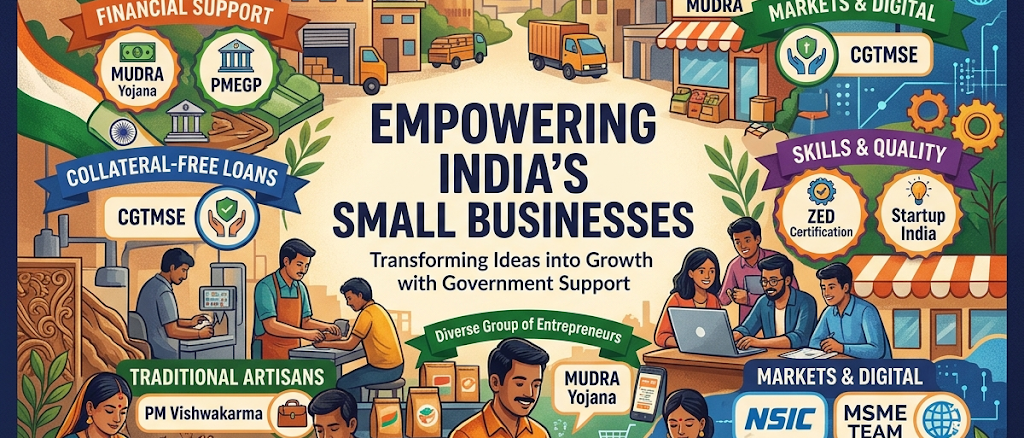
From business loans and government subsidies to skill development and marketing assistance, several government schemes are helping India’s small businesses overcome financial challenges, strengthen operations and explore new growth opportunities.
Starting and running a small business requires more than a good idea. Entrepreneurs need money to purchase equipment, maintain inventory, pay employees, manage daily expenses and reach new customers. For many first-time business owners and small enterprises, arranging this money can be one of the biggest challenges.
Access to finance is particularly important for India’s micro, small and medium enterprises (MSMEs). While some businesses need funds to establish their first unit, others require additional working capital to manage increasing orders, upgrade machinery or expand into new markets.
To address these challenges, the Government of India has introduced several schemes that provide financial assistance, credit guarantees, subsidies, training and business development support. These initiatives are designed to make entrepreneurship more accessible and help smaller enterprises become financially stronger and more competitive.
However, many business owners are either unaware of these opportunities or find it difficult to understand which scheme is suitable for their requirements. Knowing the available options can help entrepreneurs make better financial decisions and avoid depending entirely on personal savings or high-cost borrowing.
Why Government Support Matters for Small Businesses
Small businesses often operate with limited financial resources. Unlike large companies, they may not have sufficient assets, established credit histories or strong banking relationships to secure loans easily.
A retailer may need funds to purchase additional stock, a manufacturing unit may require modern machinery, while a new entrepreneur may need initial capital to establish a business.
Government support programmes address different requirements through loans, subsidies, credit guarantees and technical assistance.
These initiatives can help businesses:
- Arrange funds for starting or expanding operations.
- Purchase machinery, equipment and raw materials.
- Improve access to formal banking services.
- Develop new products and improve quality.
- Create employment opportunities.
- Reach new customers and markets.
- Adopt better technology and production methods.
For entrepreneurs, the important step is to identify a scheme that matches their business activity, financial requirements and eligibility.
Government Schemes Every Small Business Owner Should Know
1. MUDRA Yojana: Financial Support for Small Entrepreneurs
The Pradhan Mantri MUDRA Yojana is among the most recognised government financing programmes for micro and small businesses. It supports non-corporate, non-farm enterprises operating in manufacturing, trading and service activities.
The scheme offers four loan categories:
- Shishu: Up to ₹50,000.
- Kishor: Above ₹50,000 and up to ₹5 lakh.
- Tarun: Above ₹5 lakh and up to ₹10 lakh.
- Tarun Plus: Above ₹10 lakh and up to ₹20 lakh for eligible entrepreneurs who have successfully repaid previous Tarun loans.
These loans are available through participating banks, small finance banks, regional rural banks, NBFCs and microfinance institutions.
How it helps businesses: A small shop owner can use the financing to increase inventory, a service provider can purchase equipment, and a new entrepreneur can invest in essential business requirements. The scheme offers collateral-free institutional credit, subject to lender assessment and applicable conditions.
2. CGTMSE: Helping Businesses Access Loans Without Collateral
Many small businesses struggle to obtain loans because they do not own property or other assets that can be offered as security.
The Credit Guarantee Fund Trust for Micro and Small Enterprises (CGTMSE) helps address this problem by providing guarantee coverage to eligible loans extended by participating lending institutions.
Under the revised framework, the guarantee ceiling has been increased to ₹10 crore for eligible credit facilities.
The scheme supports both new and existing micro and small enterprises.
How it helps businesses: Entrepreneurs can approach participating banks for eligible loans without conventional collateral security. This can improve access to finance for purchasing machinery, managing working capital and expanding operations.
It is important to understand that CGTMSE provides protection to the lending institution. It does not mean that every applicant automatically receives a loan.
3. PMEGP: Support for Setting Up a New Business
The Prime Minister’s Employment Generation Programme (PMEGP) is designed to encourage entrepreneurship and generate employment through new micro-enterprises.
It is particularly useful for individuals planning to establish manufacturing or service businesses.
The scheme provides a government margin-money subsidy linked to bank financing.
The maximum eligible project cost is ₹50 lakh for manufacturing enterprises and ₹20 lakh for business and service enterprises.
The subsidy depends on the beneficiary category and location:
- General category: 15% in urban areas and 25% in rural areas.
- Special category: 25% in urban areas and 35% in rural areas.
How it helps businesses: A person planning to establish a small manufacturing unit, workshop or eligible service enterprise can explore PMEGP to reduce the initial financial burden.
Applicants must fulfil the prescribed conditions, contribute the required amount and obtain bank approval.
4. Startup India: Opportunities for New and Innovative Businesses
For entrepreneurs developing innovative products, technology solutions or new business models, Startup India offers a range of support opportunities.
The initiative aims to create a supportive environment for startups through regulatory assistance, intellectual property support, incubation opportunities and access to funding programmes.
Eligible DPIIT-recognised startups may also qualify for specific tax benefits and other incentives, subject to applicable conditions.
The Startup India ecosystem includes funding support initiatives such as the Startup India Seed Fund Scheme, which was designed to help eligible early-stage startups with activities such as proof of concept, prototype development and product trials. Entrepreneurs should check the current status of individual funding programmes before applying.
How it helps businesses: Startups can explore mentorship, funding connections, incubation facilities and opportunities to develop innovative products without relying entirely on personal capital.
5. PM Vishwakarma: Supporting Traditional Artisans and Craftspeople
India’s traditional artisans and craftspeople play an important role in the country’s small-business economy. However, many face difficulties accessing modern tools, formal credit, training and larger markets.
The PM Vishwakarma Scheme provides integrated support to eligible artisans working across 18 identified traditional trades.
Its major benefits include:
- Recognition through a certificate and identity card.
- Skill development and training.
- A stipend of ₹500 per day during eligible training.
- Toolkit incentives of up to ₹15,000.
- Collateral-free loans up to ₹3 lakh in two stages.
- Support for digital transactions and marketing.
How it helps businesses: Carpenters, potters, tailors, blacksmiths and other eligible artisans can improve their skills, purchase better tools and strengthen their traditional businesses.
6. NSIC: Helping Small Businesses Find Bigger Markets
Access to customers is as important as access to finance. Small manufacturers and suppliers often struggle to compete for larger contracts because of limited marketing resources and procurement knowledge.
The National Small Industries Corporation (NSIC) provides assistance to eligible micro and small enterprises through different support programmes.
These include raw material assistance, marketing support, participation in trade fairs, government procurement facilitation and technology-related services.
Its Single Point Registration Scheme can help eligible enterprises participate in government procurement opportunities, subject to applicable conditions.
How it helps businesses: Small manufacturers can explore opportunities to supply products to government departments and public sector organisations, while marketing assistance can help them connect with potential buyers.
7. MSME ZED Certification: Improving Product Quality and Competitiveness
For small manufacturing businesses, maintaining product quality while controlling production costs is essential.
The MSME Sustainable (ZED) Certification Scheme encourages enterprises to improve manufacturing standards, reduce wastage and adopt environmentally responsible production practices.
The programme offers Bronze, Silver and Gold certification levels. It also provides financial assistance towards certification costs for eligible enterprises.
How it helps businesses: Better production processes, quality control and resource management can help small manufacturers improve customer confidence and become more competitive when working with larger companies.
8. MSME TEAM Initiative: Helping Small Businesses Enter Digital Markets
For many small businesses, selling products beyond their local markets remains a challenge. Digital commerce can create new opportunities, but onboarding, catalogue preparation, packaging and logistics may require additional support.
The MSME Trade Enablement and Marketing (TEAM) initiative aims to help micro and small enterprises participate in digital commerce through the Open Network for Digital Commerce (ONDC).
The programme targets onboarding five lakh micro and small enterprises during 2024–2027, including 2.5 lakh women-owned businesses.
How it helps businesses: Local retailers, manufacturers and small product-based enterprises can explore digital selling opportunities and reach customers beyond their immediate locations.
Which Scheme Is Right for Your Business?
Choosing the right government scheme depends on what a business actually needs. An entrepreneur establishing a new unit may require a different type of assistance from an existing manufacturer planning to purchase additional machinery.
The following examples can help business owners identify suitable programmes.
| Business requirement | Schemes to explore |
|---|---|
| Starting a small business | PMEGP and MUDRA |
| Purchasing machinery or inventory | MUDRA and CGTMSE-backed credit |
| Getting eligible collateral-free credit | CGTMSE |
| Developing an innovative startup | Startup India |
| Supporting traditional artisan work | PM Vishwakarma |
| Finding government procurement opportunities | NSIC |
| Improving manufacturing quality | ZED Certification |
| Entering digital commerce | MSME TEAM |
Entrepreneurs should remember that these schemes have different eligibility conditions. Some support new businesses, while others are available to existing enterprises or specific categories of beneficiaries.
How to Apply for Government Business Support
Accessing government assistance becomes easier when business owners prepare the necessary documents and understand the application process.
Start with Udyam Registration: Eligible MSMEs should register through the official Udyam portal. Registration is free and provides formal recognition as a micro, small or medium enterprise.
Prepare a clear business plan: Explain what the business does, how much funding is required, how the money will be used and what commercial results are expected.
Keep documents ready: Aadhaar, PAN, bank details, business information, project reports and other category-specific documents may be required depending on the scheme.
Apply through the correct channel: Use the relevant government portal, participating bank or authorised implementing agency. JanSamarth can also help applicants explore eligible credit-linked schemes.
Understand the terms before accepting assistance: Check repayment schedules, interest rates, subsidy conditions, contribution requirements and other applicable obligations.
Business owners can also approach District Industries Centres (DICs), MSME development offices and participating banks for guidance.
What Small Businesses Should Consider Before Applying
Government schemes can provide valuable assistance, but business owners should not select a programme simply because it offers a loan or subsidy.
The financial requirement should come first.
For example, a retailer who needs ₹2 lakh to increase stock may explore a suitable MUDRA loan, while an entrepreneur establishing a new manufacturing unit may find PMEGP more relevant.
Similarly, a business with limited collateral may explore eligible credit facilities supported by CGTMSE.
Entrepreneurs should also consider whether they can comfortably repay borrowed funds. A loan should support business activity and revenue generation rather than create unnecessary financial pressure.
Maintaining proper accounts, completing registrations and preparing realistic financial estimates can make the application process more organised.
How Government Schemes Can Strengthen India’s Small Business Economy
The importance of government support extends beyond individual entrepreneurs. When small businesses gain access to finance, technology and wider markets, the benefits can spread across the economy.
New enterprises can create employment, while existing businesses can increase production and demand for raw materials. Better manufacturing facilities can improve product quality, and digital commerce can help local businesses reach customers in other regions.
For women entrepreneurs, artisans and first-generation business owners, targeted programmes can also create opportunities to participate more actively in the formal economy.
However, the effectiveness of these initiatives depends on awareness, accessible application procedures, timely assistance and responsible use of funds.
Banks, government institutions and business associations all have an important role in helping eligible entrepreneurs understand and access these programmes.
Conclusion: Turning Government Support into Business Growth
Government schemes can provide small businesses in India with valuable opportunities to overcome financial barriers, improve operations and expand their market presence.
From MUDRA loans and PMEGP subsidies to CGTMSE credit guarantees, Startup India, PM Vishwakarma and NSIC assistance, different programmes address the practical challenges faced by entrepreneurs at different stages of business development.
For small business owners, the first step is to understand their financial and operational requirements and then identify the support programme that best matches those needs.
Government assistance alone cannot guarantee business success. A clear business plan, proper financial management, customer understanding and consistent execution remain equally important.
Ultimately, these schemes can become meaningful growth opportunities when entrepreneurs use them strategically to build stronger businesses, create employment and contribute to India’s expanding MSME ecosystem.
