
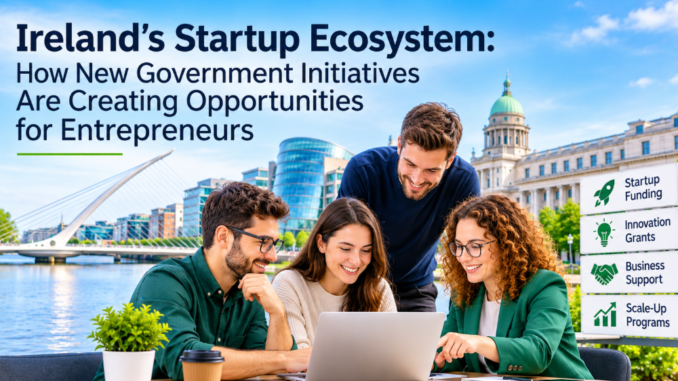
Nov 04: Ireland is making a fresh push to strengthen its startup ecosystem, with new government initiatives aimed at helping entrepreneurs turn business ideas into successful companies. From funding and mentorship to artificial intelligence programmes and international investment opportunities, the country is working to create a more supportive environment for businesses at every stage of development.
A major step came in October 2026 with the launch of Startup Ireland, a national initiative led by Enterprise Ireland. The programme aims to support the creation of 1,000 new startups and increase the number of companies reaching €1 million in annual turnover by 20%.
The initiative reflects Ireland’s ambition to build a stronger domestic business sector, encourage innovation and develop companies that can compete in international markets.
For entrepreneurs, investors and international businesses, the developments could open up opportunities across technology, financial services, healthcare, advanced manufacturing and clean technology.
Startup Ireland: A New Push to Support Entrepreneurs
Launched on October 13, 2026, Startup Ireland brings together government agencies, universities, investors, multinational companies and business support organisations under a coordinated national framework.
Led by Enterprise Ireland, the initiative responds to a common problem faced by many founders: finding the right funding, mentors, technical expertise and business connections without having to navigate multiple support systems.
The government wants to make this process easier and provide clearer pathways for entrepreneurs, from developing an initial idea to establishing a company and expanding internationally.
Startup Ireland has outlined several ambitions for the 2026–2030 period:
- Support the creation of 1,000 new startups.
- Increase the number of startups reaching €1 million in annual turnover by 20%.
- Ensure that 35% of supported startups are female-led.
- Improve access to international investors, customers and business networks.
- Strengthen Ireland’s position as a globally connected innovation hub.
A National Startup Hub is also planned in Dublin, alongside Enterprise Ireland’s city-centre headquarters. It will provide a meeting point for entrepreneurs, investors, researchers and multinational companies.
The hub is expected to offer networking opportunities, specialist expertise and connections with international markets. It will also help overseas entrepreneurs and investors explore Ireland’s startup ecosystem.
For first-time founders, access to experienced business leaders and potential investors can be just as important as financial assistance. A more connected support system could help promising businesses move towards commercialisation and growth.
Source: Enterprise Ireland – Startup Ireland launch, October 13, 2026.
Government Funding Could Improve Access to Startup Capital
Finding finance remains one of the biggest challenges for entrepreneurs, particularly during the early stages of a business.
Ireland’s Budget 2027 includes several measures aimed at supporting enterprise growth, innovation and business investment.
The government allocated €3 million towards establishing Startup Ireland, with the wider initiative designed to encourage new business creation and improve access to support.
Another important development is the €21 million National Accelerator Programme, which will provide structured support to companies at different stages of development.
Budget 2027 also announced the launch of a €500 million Growth and Sustainability Loan Scheme, supported by the European Investment Bank Group. Eligible businesses can access long-term financing, including unsecured loans of up to €500,000, subject to scheme conditions.
The scheme is particularly relevant to SMEs looking to invest in equipment, improve operations, adopt new technologies or strengthen their sustainability practices.
Ireland also continues to support entrepreneurship through tax incentives such as:
- Employment Investment Incentive (EII).
- Start-Up Relief for Entrepreneurs (SURE).
- Start-Up Capital Incentive (SCI).
- Angel Investor Relief.
These measures are intended to encourage private investment and make it easier for entrepreneurs to attract financial backing.
For startups, access to different funding routes can help bridge the gap between developing a product and building a business with a sustainable revenue model.
Source: Department of Enterprise, Tourism and Employment – Budget 2027 announcement, October 7, 2026.
AI Accelerator Opens New Opportunities for Technology Startups
Artificial intelligence is becoming an important part of Ireland’s startup ambitions, particularly as businesses look for ways to improve productivity, automate processes and develop new digital services.
On October 14, 2026, Enterprise Ireland announced the Startup Ireland AI Accelerator Programme under its €21 million National Accelerator Programme.
Delivered by Dogpatch Labs, the programme brings together more than 30 technology, investment and ecosystem partners. These include major companies such as Google, Microsoft, NVIDIA, Amazon, Anthropic, OpenAI and Stripe.
The 12-week programme will select 10 AI startups and provide access to technical expertise, business networks and potential investors.
Participating companies can benefit from:
- At least three hours of one-to-one engineering support each week.
- Potential access to more than €1 million in technology and cloud credits.
- Connections with domestic and international investors.
- Opportunities to develop commercial partnerships.
- Support in preparing for seed and Series A investment.
An important feature is that the accelerator operates on a non-equity basis. Participating startups do not have to surrender company ownership in exchange for programme support.
For founders developing enterprise software, AI-powered applications, automation platforms and specialised technology solutions, this could reduce development costs and improve access to resources that are otherwise expensive.
The involvement of multinational technology companies also creates opportunities for Irish startups to connect with established businesses, understand industry requirements and explore potential customers.
Source: Enterprise Ireland and ThinkBusiness, October 2026.
National Accelerator Programme Supports Businesses Beyond AI
Ireland’s startup ambitions are not limited to artificial intelligence.
The €21 million National Accelerator Programme is designed to support entrepreneurs at different stages, from developing a business idea to preparing for international expansion.
One of its key components is the National Company Accelerator, which includes a €100,000 investment for participating companies to help them grow and scale internationally.
A separate Talent Accelerator is intended for experienced individuals who are interested in entrepreneurship but have not yet established a company or finalised a business idea. It will help participants validate commercial opportunities, form businesses and progress towards pre-seed investment.
Regional pre-accelerator programmes and specialist initiatives are also expected to improve access to business support outside Dublin.
This regional approach matters because startup activity often concentrates around major cities, where investors, universities and technology companies are more accessible.
By connecting entrepreneurs across Ireland with mentors, research organisations and experienced founders, the programme could encourage more business creation throughout the country.
For entrepreneurs, this means greater opportunities to access practical guidance, develop business models and prepare for investment.
Local Enterprise Offices Give Small Businesses Additional Support
Not every entrepreneur is looking to build a technology company or attract venture capital. Small businesses in retail, food production, manufacturing and professional services also need support to establish themselves and remain competitive.
Ireland’s Local Enterprise Offices (LEOs) play an important role in this area, offering eligible businesses guidance, training, mentoring and financial assistance.
Budget 2027 provides an additional €4.5 million for Local Enterprise Offices, supporting the modernisation of their services and the expansion of business support programmes.
The focus also extends to helping smaller companies improve energy efficiency, adopt digital technologies and strengthen their cybersecurity.
This is increasingly relevant as smaller businesses face pressure to improve productivity and compete with larger companies that have greater access to technology and resources.
For example, a small manufacturer may need support to automate production, while a retail business could benefit from digital sales platforms and better customer management systems.
Improving access to business advice and technology support could help more Irish SMEs become productive and commercially sustainable.
Research and Advanced Manufacturing Create New Business Opportunities
Ireland’s startup ecosystem is also benefiting from greater attention towards research, technology development and industrial innovation.
Budget 2027 includes an additional €7.5 million for technology centres, bringing their total funding to €32.5 million. The investment will strengthen collaboration between businesses and research organisations, particularly in manufacturing innovation and artificial intelligence.
The Disruptive Technologies Innovation Fund is also receiving an additional €6.5 million, taking its 2027 allocation to €37.5 million.
These investments could benefit startups working in:
- Advanced manufacturing and industrial automation.
- Artificial intelligence and machine learning.
- Medical technology and life sciences.
- Semiconductor technologies.
- Sustainable materials and clean technology.
- Robotics and industrial digitalisation.
For entrepreneurs, working with research institutions can provide access to specialist expertise and technical facilities. It can also help turn innovative ideas into products that meet actual industry requirements.
The wider opportunity lies in connecting research with commercial demand. Startups that can develop practical solutions for manufacturing, healthcare, energy and other industries may find opportunities to work with established companies and international customers.
International Expansion Could Put Irish Startups on a Bigger Stage
For many startups, the domestic market is only the beginning. Reaching international customers is often essential for achieving sustainable growth.
Startup Ireland places considerable emphasis on helping founders connect with overseas investors, business networks and potential customers.
The proposed National Startup Hub will provide an international entry point for entrepreneurs and investors interested in Ireland. The wider roadmap also includes international accelerator partnerships, soft-landing arrangements in selected markets and stronger mentoring networks.
Enterprise Ireland’s international presence can further help Irish companies explore export markets and identify commercial partners.
Ireland’s position within the European Union is another consideration for international businesses looking to establish a European presence.
However, expanding abroad requires more than funding and networking. Startups must also consider regulatory requirements, intellectual property protection, recruitment, operating costs and competition in their target markets.
The success of these initiatives will ultimately depend on how effectively they help companies secure customers, generate revenue and build sustainable international operations.
Greater Support for Women Entrepreneurs
Another important objective of Startup Ireland is to encourage more women to establish and lead businesses.
The initiative aims to ensure that 35% of supported startups are female-led by 2030.
Access to finance, experienced mentors and professional networks can influence whether entrepreneurs are able to take their ideas forward. Strengthening these areas could encourage greater participation by women in technology, manufacturing, professional services and other sectors.
The planned startup hub, mentoring networks and accelerator programmes could also help founders build relationships with investors and experienced business leaders.
A more inclusive startup environment can widen the country’s entrepreneurial talent pool and encourage innovation across different industries.
Challenges Ireland Must Address
Despite the increased government support, building a successful startup ecosystem will take more than funding announcements and accelerator programmes.
Access to early-stage capital remains an important concern for businesses moving from product development to commercial operations. Startups also need reliable routes to market and customers willing to invest in new products and services.
Operating costs are another consideration. Salaries, office space, energy and other business expenses can put pressure on young companies, particularly before they begin generating consistent revenue.
Finding experienced professionals in AI, software engineering, cybersecurity and other specialised fields can also be challenging.
Ireland must compete with other European startup destinations for entrepreneurs, investors and international talent. Keeping high-growth companies rooted in Ireland while allowing them to expand globally will also be important.
Finally, turning research into commercially successful products requires close cooperation between universities, businesses and investors.
Addressing these challenges will determine whether the country’s new initiatives translate into sustainable businesses, employment and long-term economic growth.
What the New Initiatives Mean for Entrepreneurs and Investors
Ireland’s expanding startup support system could create opportunities across several parts of the business ecosystem.
| Business segment | Potential opportunities |
|---|---|
| AI startups | Engineering support, cloud credits and investor connections |
| Early-stage entrepreneurs | Mentoring, business validation and pre-seed support |
| SMEs | Digitalisation, energy efficiency and long-term financing |
| Venture capital firms | Investment opportunities in high-growth businesses |
| Research institutions | Industry partnerships and technology commercialisation |
| International companies | Partnerships with Irish startups and access to innovation |
| Women-led businesses | Improved access to mentoring and startup networks |
For multinational companies, working with Irish startups could provide access to specialised products, emerging technologies and new business solutions.
For investors, the expansion of accelerator programmes and funding support could create opportunities to participate in the growth of new businesses.
The wider benefits could extend to professional services, recruitment, technology consulting, business advisory firms and other companies supporting entrepreneurs.
Conclusion: Ireland Strengthens Its Ambition to Become a Global Startup Hub
Ireland’s new startup initiatives represent a broader effort to build an economy that supports entrepreneurship, innovation and business expansion.
The launch of Startup Ireland, the €21 million National Accelerator Programme, specialist AI support and additional investment in research and enterprise development provide a stronger support structure for founders.
The real test will be how effectively these initiatives translate into new companies, sustainable employment, successful products and international business growth.
For entrepreneurs considering where to establish their next venture, and investors looking for emerging opportunities in Europe, Ireland is becoming a market worth watching.
As the country works towards its 2030 ambitions, its ability to connect funding, research, technology and international business networks could play an important role in shaping its future economic competitiveness.
