
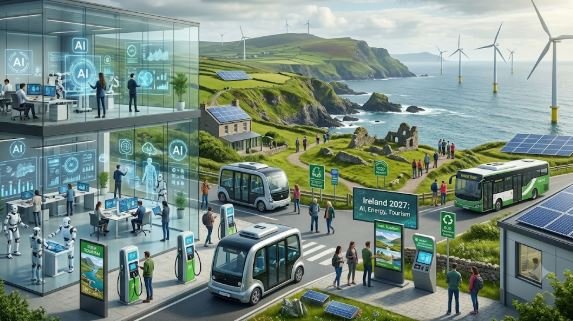
Ireland’s business landscape is approaching an important phase of transformation as investment in artificial intelligence (AI), renewable energy, tourism and advanced manufacturing creates new opportunities across the economy. With businesses facing changing global market conditions, rising operating costs and increasing competition, these sectors are becoming important drivers of investment, productivity and long-term commercial growth. For companies operating in Ireland, 2027 could bring opportunities to expand operations, enter emerging markets, strengthen supply chains and develop new revenue streams.
The government’s €1.3485 billion Budget 2027 allocation for enterprise, tourism and employment underlines the importance of strengthening business competitiveness and supporting innovation. Alongside this, a five-year Sectoral Capital Plan involving €4.7 billion in investment is expected to support enterprise development, research, regional growth and infrastructure. These commitments are creating opportunities for technology providers, renewable energy developers, construction companies, manufacturers, hospitality operators and smaller businesses looking to participate in Ireland’s evolving economy.
The economic outlook also provides an important foundation for business planning. The European Commission forecasts Ireland’s GDP to grow by 3.4% in 2027, while modified domestic demand is expected to increase by 3%. Although energy costs, international trade uncertainty and infrastructure constraints remain important considerations, businesses that align their investments with digital transformation, sustainability and changing consumer demand could find new avenues for growth.
Artificial Intelligence Is Creating New Opportunities Across Irish Industries
Artificial intelligence is expected to remain one of the most influential forces shaping Ireland’s business environment in 2027. From financial services and healthcare to manufacturing, retail and professional services, companies are increasingly exploring how intelligent technologies can improve productivity, reduce operating costs and strengthen their competitive position.
For businesses, the value of AI extends beyond automation. Companies can use these technologies to analyse customer behaviour, forecast demand, improve inventory management, streamline administrative processes and make faster operational decisions.
Ireland’s established technology ecosystem provides a strong foundation for this transition. Its concentration of international technology companies, research institutions and skilled professionals creates opportunities for AI developers, software providers, cybersecurity firms and digital consulting businesses.
Budget 2027 reinforces this direction by increasing the National AI Office of Ireland’s total funding to €3.8 million. The additional resources will support implementation of the EU AI Act, development of an AI regulatory sandbox and national AI literacy initiatives. Another €7.5 million in additional funding for technology centres, including CeADAR and Irish Manufacturing Research, will strengthen collaboration between businesses and research organisations.
For small and medium-sized enterprises (SMEs), these developments could make advanced technologies more accessible. Smaller companies can explore AI-powered customer support, automated accounting, digital marketing, predictive analytics and cybersecurity solutions without establishing large in-house technology departments.
The commercial opportunity also extends to businesses providing AI integration, employee training, data management and software development services. As adoption increases, demand for specialised support will create opportunities for technology consultancies and smaller digital service providers.
However, successful adoption will depend on employee training, reliable digital infrastructure and responsible data management. Businesses that combine technology investment with workforce development are more likely to translate AI adoption into measurable improvements in productivity and revenue.
Renewable Energy Is Becoming Central to Business Competitiveness
Ireland’s transition towards cleaner energy is no longer simply an environmental priority. It is increasingly connected to the country’s ability to attract investment, support industrial development and maintain competitive operating costs.
Manufacturing facilities, technology companies, commercial buildings and data centres require dependable electricity supplies. As these sectors expand, demand for renewable generation, energy storage, grid infrastructure and efficient energy management is becoming increasingly important.
The scale of electricity demand from data centres illustrates the challenge. Central Statistics Office figures show that data centres accounted for approximately 23% of Ireland’s metered electricity consumption in 2025, compared with just 5% in 2015. Their electricity consumption increased by 10% during 2025 to approximately 7,663 gigawatt-hours.
This growing demand creates opportunities for renewable energy developers, electrical engineering companies, battery storage providers, grid infrastructure contractors and businesses specialising in energy efficiency. It also makes the availability of reliable, competitively priced electricity an increasingly important factor in investment decisions.
The government’s Sectoral Capital Plan 2026–2030 includes a €300 million allocation for enterprise decarbonisation, supporting businesses seeking to reduce emissions and transition towards lower-carbon operations. The wider capital investment programme also provides support for enterprise development, innovation and regional economic activity.
For SMEs, energy efficiency offers a more immediate commercial opportunity. Businesses can reduce operating expenses through improved insulation, efficient machinery, smart energy monitoring, renewable electricity installations and upgraded heating systems.
Construction and engineering companies could also benefit from growing demand for energy-efficient commercial buildings, renewable energy installations and industrial infrastructure improvements.
The challenge will be ensuring that renewable generation develops alongside grid capacity and storage infrastructure. Without adequate transmission networks and dependable power supplies, businesses may face higher costs and delays in expanding their operations.
Tourism Offers New Revenue Opportunities for Regional Businesses
Tourism remains one of Ireland’s important indigenous industries, supporting hospitality, transport, food services, entertainment, retail and local employment. Beyond its contribution to visitor spending, the sector creates commercial opportunities for small businesses across cities, coastal communities and rural destinations.
Fáilte Ireland’s Business of Tourism Report 2026 recorded €11.2 billion in tourism earnings during 2025, alongside approximately 229,400 employees working in tourism businesses. Overseas visitors accounted for €5.7 billion in expenditure, excluding fares, while domestic overnight tourism generated €3.6 billion in spending.
These figures underline the economic importance of tourism to businesses operating across the country. Hotels, restaurants, independent accommodation providers, tour operators, transport companies and local retailers all stand to benefit when visitor spending increases.
Budget 2027 allocates an additional €6.65 million to Fáilte Ireland for tourism product and destination development, alongside €2.5 million for Tourism Ireland’s international marketing activities.
The focus on regional tourism is particularly important for smaller businesses. Destinations outside Dublin and other established visitor centres can develop new commercial opportunities through cultural experiences, outdoor activities, heritage attractions, local food and accommodation services.
Businesses in coastal communities, rural towns and heritage locations can attract visitors by developing experiences that reflect local identity. This can help distribute tourism income more widely while creating additional employment opportunities.
Digital marketing and artificial intelligence are also changing how visitors discover destinations and plan their journeys. Tourism businesses that improve their online visibility, booking systems and digital customer experiences can reach international audiences more effectively.
The opportunity is not limited to attracting more visitors. Businesses can also increase revenue by encouraging longer stays, promoting local products and developing experiences that appeal to international travellers seeking distinctive destinations.
Advanced Manufacturing and Life Sciences Strengthen Ireland’s Investment Appeal
Beyond the three major growth drivers, advanced manufacturing and life sciences will remain important to Ireland’s long-term economic development.
Ireland has developed a substantial international business presence in pharmaceuticals, medical technology and technology-enabled manufacturing. These industries generate demand for specialist engineering, research and development, industrial automation, logistics and professional services.
As manufacturers face pressure to improve productivity, reduce emissions and strengthen supply chains, investment in modern production systems and digital technologies is becoming increasingly important.
Budget 2027 supports this ambition through funding for technology centres, research collaboration and the Disruptive Technologies Innovation Fund. An additional €6.5 million has been allocated to the fund, bringing its 2027 investment to €37.5 million.
The government is also supporting the development of Next Generation Strategic Sites to attract investment in high-growth industries, including semiconductors and life sciences.
These initiatives create opportunities for Irish engineering firms, specialist suppliers, research organisations and smaller technology businesses to participate in higher-value industrial supply chains.
For SMEs, collaboration with larger manufacturers and research institutions could provide access to new customers, technical expertise and international business opportunities. Companies offering specialised components, technical services, automation solutions and industrial maintenance can also benefit from investment in advanced production facilities.
Government Funding Is Supporting Start-ups and Business Expansion
Access to finance remains an important consideration for businesses seeking to expand, particularly start-ups and smaller enterprises that may struggle to secure long-term funding.
Budget 2027 includes several measures aimed at strengthening Ireland’s enterprise ecosystem. A €3 million allocation will establish the Start Up Ireland initiative, with an ambition to support 1,000 new start-ups through access to funding, expertise and business development support.
The Growth and Sustainability Loan Scheme is also being expanded to a total of €1 billion, providing eligible businesses with access to longer-term financing. The scheme is designed to support investment in business expansion, productivity improvements and sustainable operations.
In addition, the Ireland Strategic Investment Fund’s proposed €1 billion start-up and scaling investment programme to 2030 is expected to strengthen access to commercial capital for growing Irish companies. This includes a dedicated venture capital allocation for high-growth businesses.
The reduction in the Capital Gains Tax rate from 33% to 31% is another measure intended to encourage entrepreneurship and investment.
For business owners, these initiatives could improve opportunities to finance new equipment, develop products, adopt digital systems and enter overseas markets. However, businesses will need sound financial planning and commercially viable growth strategies to make effective use of available support.
Cybersecurity and Digital Infrastructure Create Demand for Specialist Services
As Ireland’s economy becomes more technology-driven, demand for supporting business services is also expected to increase.
The expansion of AI, cloud computing and connected business systems creates additional requirements for cybersecurity, data protection, software development and digital infrastructure management.
Financial institutions, healthcare providers, manufacturers and retailers must protect customer information and maintain reliable digital operations. This creates opportunities for cybersecurity consultants, managed IT service providers, compliance specialists and software companies.
The growing use of cloud platforms and AI-powered business applications is also increasing the need for data governance, system integration and technology consulting. Smaller companies, in particular, may prefer outsourcing these functions to specialist providers rather than maintaining large internal technology teams.
Professional service businesses can also benefit as companies seek assistance with regulatory compliance, technology implementation, workforce development and international expansion.
Businesses that can offer affordable, reliable and specialised solutions may find opportunities in a market where companies are looking to modernise operations without significantly increasing administrative costs.
Business Challenges That Could Influence Ireland’s Growth in 2027
Despite the opportunities, Ireland’s business environment will continue to face several challenges. Rising operating expenses, labour availability, housing constraints and infrastructure capacity can affect companies seeking to expand.
Energy affordability is particularly important for manufacturers, hospitality businesses and other electricity-intensive industries. The rapid expansion of data centres also places greater pressure on the electricity system, making investment in renewable generation, grid upgrades and energy storage essential.
Smaller businesses may face additional difficulties in adopting AI and other advanced technologies because of limited budgets, skills shortages and uncertainty about implementation costs.
Tourism businesses must also manage seasonal demand, staffing expenses and changing visitor spending patterns. Increasing visitor numbers alone will not guarantee stronger profitability unless companies can maintain service quality and control operating costs.
For start-ups and expanding enterprises, access to finance, skilled employees and suitable commercial infrastructure will remain important considerations.
Addressing these challenges will require coordination between government, infrastructure providers, financial institutions and private businesses. Companies that plan investments carefully, improve operational efficiency and develop adaptable business models will be better positioned to manage uncertainty.
Ireland’s Business Outlook for 2027: Turning Investment into Long-Term Growth
Ireland’s business outlook for 2027 will be shaped by how effectively the country converts investment in technology, renewable energy and tourism into stronger enterprise performance, employment and commercial opportunities. These sectors are not developing independently. Their growing connections are creating opportunities across manufacturing, construction, financial services, hospitality, cybersecurity, logistics and professional services.
For businesses, this transformation represents an opportunity to diversify revenue, enter emerging supply chains and develop services that meet changing market requirements. SMEs and start-ups can benefit from government-backed financing, digital adoption programmes and partnerships with larger companies, while established enterprises can strengthen their competitiveness through automation, sustainable infrastructure and innovation.
The country’s ability to maintain this momentum will depend on addressing energy availability, infrastructure gaps, workforce requirements and rising business costs. Investment alone will not guarantee commercial success; companies must also translate new technologies and funding opportunities into practical improvements in productivity, customer experience and profitability.
As Ireland moves into 2027, the strongest growth opportunities are likely to emerge for businesses that combine digital innovation with sustainable operations and market-focused strategies. With continued support for enterprise development and a growing emphasis on high-value industries, Ireland has the potential to strengthen its position as an attractive destination for investment while creating new opportunities for domestic businesses to scale, compete internationally and contribute to long-term economic growth.
