
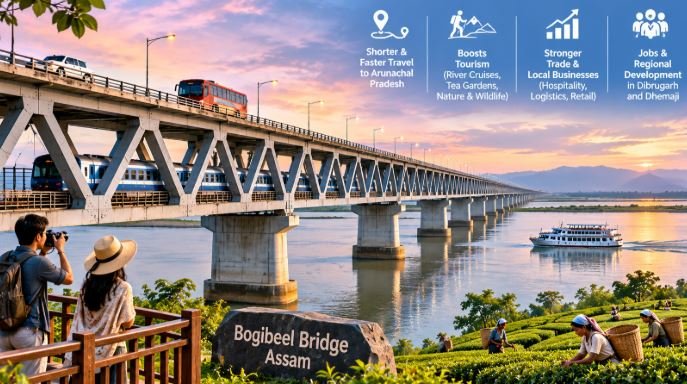
For people living along the Brahmaputra, crossing the river has never been just a matter of distance. It has often meant planning around ferry services, travel schedules and long journeys. The Bogibeel Bridge has changed that experience, bringing communities on the northern and southern banks closer and opening up new possibilities for tourism, trade and business in Upper Assam.
Stretching 4.94 kilometres across the Brahmaputra, the bridge connects Dibrugarh and Dhemaji through a double-deck road-and-rail corridor. Commissioned on December 25, 2018, it carries a three-lane highway on its upper deck and two broad-gauge railway tracks below.
But its real significance is not simply the scale of the structure. It is what better connectivity makes possible. A journey that was once more complicated can now be made more directly. Businesses have improved access to customers and suppliers, tourists can explore more of the region, and local entrepreneurs have a stronger opportunity to serve a wider market.
Tourism Gets a Stronger Gateway to the Brahmaputra
The Brahmaputra is one of Assam’s defining natural attractions. Its wide river landscapes, changing sandbanks, surrounding greenery and distinctive river culture offer considerable potential for tourism. Yet turning that potential into a sustainable business requires more than beautiful scenery. Visitors need reliable transport, comfortable places to stay, good food and experiences that make a journey worthwhile.
The Bogibeel Bridge helps address one important part of that equation: access.
By connecting Dibrugarh and Dhemaji more directly, it makes it easier for travellers to explore destinations on both sides of the river. Visitors to Upper Assam can plan journeys that combine the region’s tea gardens, cultural attractions, river landscapes and nearby nature destinations without depending entirely on ferry crossings.
The bridge itself has also become a point of interest. Its impressive span across the Brahmaputra offers memorable views and attracts visitors interested in sightseeing and photography. Nearby Bogibeel Ghat adds another dimension to the experience, with river cruises and houseboat activities contributing to the area’s tourism appeal.
For travel businesses, this creates an opportunity to develop more complete itineraries rather than treating the bridge as simply a transport link. A visitor might arrive in Dibrugarh, explore a tea estate, enjoy a river experience and continue towards other attractions in the region. The more easily these experiences can be connected, the greater the potential for visitors to stay longer and spend more locally.
A Business Opportunity for Hotels, Restaurants and Local Entrepreneurs
Tourism has a way of spreading economic activity beyond the main attraction. When visitors arrive, they need accommodation, meals, transport, guides and other services. That spending can support a wide range of businesses, many of them small and locally owned.
For entrepreneurs in Dibrugarh, Dhemaji and nearby communities, improved connectivity offers an opportunity to reach customers who may previously have found the journey less convenient. Homestays, small hotels, restaurants, local transport providers, tour operators and handicraft businesses can all benefit if visitor numbers and spending increase.
There is also room for community-based tourism. Local residents can develop guided experiences around traditional food, cultural practices, village life and the natural environment. These activities can give travellers a more meaningful experience while creating additional income opportunities for households.
However, the opportunity will not automatically translate into business growth. Visitors need clean and well-maintained facilities, clear information, dependable transport and easy booking options. Investment in hospitality skills, digital marketing, local infrastructure and visitor services will help businesses turn improved access into regular income.
Better Connectivity Can Strengthen Assam’s Trade and Supply Chains
The bridge’s economic value reaches far beyond the tourism sector. For farmers, traders, manufacturers and transport operators, the ability to move people and goods more efficiently can make a practical difference to everyday business.
Agriculture remains an important part of the local economy. Better connections between the northern and southern banks can help producers reach markets, traders coordinate supplies and businesses organise deliveries more reliably. For goods that require careful handling or timely distribution, predictable transport can be particularly valuable.
Dibrugarh is an important commercial centre in Upper Assam, while improved access to Dhemaji and surrounding areas can strengthen connections between rural producers and larger markets. Businesses can reach suppliers and customers more conveniently, while residents gain easier access to essential services and commercial facilities.
The region’s established industries also stand to benefit. Tea, petroleum-related activities, coal, construction materials and other commodities depend on efficient transport networks. Better road and rail access can support the movement of workers, equipment, raw materials and finished products.
For logistics companies, the bridge provides an important link in the wider regional transport network. Its road-and-rail design gives businesses more ways to plan the movement of goods and connect with other transport facilities.
Bogibeel’s Inland Waterway Link Adds Another Business Dimension
One of the most important developments around Bogibeel is the growth of inland water transport infrastructure.
The Bogibeel Inland Water Transport Terminal, commissioned in 2023 on National Waterway-2, adds a further dimension to the area’s economic potential. The terminal was developed to support cargo and passenger movement, helping connect river transport with road and rail networks.
This matters because the Brahmaputra is not only a natural landmark; it is also a potential commercial transport corridor. River transport can offer an alternative for suitable bulk and heavy cargo, particularly when supported by efficient terminals and connections to highways and railways.
The terminal has an annual cargo-handling capacity of approximately six lakh metric tonnes and supports the movement of commodities including tea, coal, stone aggregates, cement and petroleum-related cargo. This creates opportunities for logistics operators, freight handlers, storage providers and businesses involved in regional distribution.
For local companies, the wider benefit lies in having more than one transport option. A stronger combination of road, rail and waterways can help improve supply-chain flexibility and support the development of commercial activity around Dibrugarh.
Investment Potential: From Transport Infrastructure to Local Enterprise
Major infrastructure projects often create their greatest economic value through the businesses that develop around them. The Bogibeel Bridge is a good example of how improved connectivity can support opportunities across several sectors.
Tourism operators may find scope to develop river experiences and regional travel packages. Hospitality businesses can invest in accommodation and food services. Logistics companies can explore warehousing, freight handling and distribution. Agricultural enterprises may benefit from stronger links to buyers and processing facilities.
There is also an opportunity for supporting services, including vehicle maintenance, packaging, cold storage, retail distribution and digital travel platforms.
Dibrugarh’s position as a regional commercial centre gives it an important role in this development. Dhemaji and nearby communities can also benefit if investment reaches beyond the main urban centres and supports smaller businesses and local producers.
For investors, the key consideration is the wider ecosystem. A bridge improves access, but commercially successful projects also need reliable utilities, suitable land, skilled workers, good local roads and predictable business conditions. Coordinated investment in these areas will determine how effectively the region converts connectivity into sustained economic activity.
Making Tourism Growth Work for Local Communities
There is an important balance to maintain as tourism and commercial activity expand around the Brahmaputra. The river and its surrounding environment are central to the region’s appeal, and development that damages these natural assets could undermine the very tourism opportunities it hopes to create.
River cruises, boating and houseboat operations need appropriate safety standards and responsible operating practices. Tourism facilities should manage waste carefully, while businesses should respect local communities and sensitive riverbank ecosystems.
Local participation is equally important. If tourism growth creates jobs only for outside operators, communities may not receive their fair share of the economic benefits. Training local guides, supporting homestay owners, promoting regional food and crafts, and helping small businesses access finance can make development more inclusive.
The goal should be to build a tourism economy that gives visitors a reason to return while providing residents with reliable opportunities to earn and grow their businesses.
A Bridge with Long-Term Economic Value
The Bogibeel Bridge has already changed the way people and businesses connect across the Brahmaputra. Its importance now lies in how effectively Assam builds on that improved access.
For tourism, it offers a stronger gateway to river experiences, tea-growing landscapes and the cultural attractions of Upper Assam. For business, it supports more efficient movement, better market access and opportunities in logistics, hospitality, agriculture and regional commerce.
The next stage of growth will depend on investment in the services and infrastructure surrounding the bridge. Better visitor facilities, stronger freight networks, skilled local workers and support for small enterprises can help spread its benefits across the region.
Ultimately, the Bogibeel Bridge is more than a route between Dibrugarh and Dhemaji. It is an important link in Assam’s wider economic story, connecting the region’s natural attractions and commercial strengths with opportunities for a more accessible and prosperous future.
