
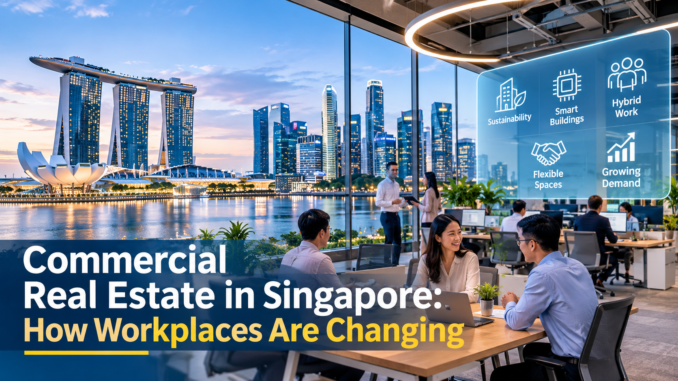
Nov 24: Singapore’s commercial real estate market is evolving as businesses reassess their office requirements, workplace strategies and long-term property investments. Hybrid working, changing employee expectations, technological advancements and sustainability initiatives are influencing how companies choose and use office spaces.
The traditional office, designed around fixed workstations and conventional layouts, is gradually giving way to more flexible and technology-enabled environments. Businesses are no longer evaluating commercial properties solely on location and rental costs. Factors such as employee experience, accessibility, energy efficiency and opportunities for collaboration are becoming equally important.
These changes are also creating new opportunities for commercial property developers, landlords and investors. As Singapore strengthens its position as a regional financial, technology and business hub, demand for modern office spaces is increasingly shaped by the changing requirements of companies operating in the city-state.
Singapore’s Commercial Real Estate Market Shows Resilience
Singapore’s office market continues to attract interest from multinational corporations, financial institutions, technology companies and professional services firms. However, the expectations of office tenants are changing, with businesses placing greater emphasis on building quality, flexibility and accessibility.
According to the Urban Redevelopment Authority (URA), office rents in Singapore’s Central Region increased by 0.8% in the third quarter of 2026, maintaining the same quarterly growth recorded in the previous quarter. The island-wide office vacancy rate declined from 11% in Q2 2026 to 10% in Q3 2026.
The premium office segment experienced stronger rental growth. CBRE reported that Core CBD Grade A office rents increased by 2% quarter-on-quarter to S$12.75 per square foot per month in Q3 2026. Vacancy in this segment declined from 3.3% to 2.6%, reflecting demand for quality office spaces.
These figures highlight an important distinction in Singapore’s commercial property market: demand for premium office buildings is particularly strong, although conditions vary across locations and building categories.
For businesses, this means that selecting an office increasingly involves balancing rental costs, workplace quality and long-term operational requirements.
Hybrid Working Is Changing Office Space Requirements
Hybrid working has become an important consideration in commercial property planning. With employees splitting their time between office and remote work, companies are reassessing how much physical workspace they need.
Instead of providing individual desks for every employee, businesses are exploring shared workstations, collaborative areas and flexible meeting spaces.
This approach allows organisations to make better use of office space while accommodating different working arrangements. It also encourages companies to focus on creating environments that support activities requiring in-person interaction.
For commercial property owners, the change presents an opportunity to offer adaptable office layouts that appeal to businesses with evolving workforce requirements.
The emphasis is shifting from providing larger office spaces to creating workplaces that encourage employees to collaborate, exchange ideas and participate in organisational activities.
Flexible Workspaces Are Attracting Businesses
Flexible offices and co-working facilities are becoming an important part of Singapore’s commercial property landscape.
Startups, small businesses and international companies entering Singapore often prefer office arrangements that do not require substantial upfront investments or long-term leasing commitments.
Serviced offices and co-working spaces provide access to workstations, meeting rooms, internet connectivity and shared business facilities.
Larger companies are also exploring flexible workspace arrangements for project teams, temporary operations and employees working across different locations.
This trend is creating opportunities for commercial landlords to diversify their leasing strategies. Managed offices, serviced workspaces and partnerships with flexible office operators can help property owners reach businesses with different space requirements.
The growing demand for flexibility also means that office landlords must consider how effectively their buildings can accommodate smaller tenants, expanding businesses and changing occupancy patterns.
Smart Buildings Are Transforming Office Management
Technology is changing how commercial buildings operate. Businesses increasingly expect modern office spaces to offer digital infrastructure that improves convenience, security and operational efficiency.
Smart buildings incorporate technologies such as automated lighting, intelligent temperature controls, digital access systems and occupancy monitoring.
These facilities enable property managers to monitor space utilisation, manage energy consumption and improve building performance.
Artificial intelligence is creating additional opportunities for commercial property management. Predictive maintenance, automated facility monitoring and data-driven space planning can help landlords identify operational problems before they become expensive disruptions.
For tenants, technology-enabled offices offer a more connected and convenient working environment.
As Singapore’s technology ecosystem expands, smart building infrastructure is likely to become an increasingly important consideration in commercial property decisions.
Sustainability Is Becoming a Workplace Priority
Sustainability is playing a growing role in Singapore’s commercial real estate sector.
Businesses are paying closer attention to the environmental performance of their offices as they work towards energy efficiency and broader corporate sustainability objectives.
Commercial properties are increasingly incorporating energy-efficient lighting, intelligent cooling systems, water conservation measures and improved waste management facilities.
Green building certifications and environmental performance are also influencing how companies evaluate potential office locations.
For landlords and developers, investing in sustainable building improvements can strengthen the appeal of commercial properties while helping manage long-term operating costs.
For tenants, environmentally responsible workplaces can support corporate sustainability commitments and create more comfortable working environments.
Singapore’s Green Mark certification framework, administered by the Building and Construction Authority, provides a recognised benchmark for improving building sustainability and environmental performance.
As sustainability becomes more closely connected to business operations, properties that combine efficient infrastructure with modern workplace facilities could gain an advantage in attracting corporate tenants.
Employee Experience Is Influencing Office Design
Companies are increasingly recognising that the workplace can influence employee satisfaction, productivity and organisational culture.
As a result, office design is moving beyond traditional workstations and meeting rooms. Businesses are looking for spaces that encourage interaction, collaboration and employee well-being.
Modern commercial workplaces may include collaborative work areas, comfortable breakout spaces, wellness facilities, natural lighting and improved ventilation.
Accessibility is another important consideration. Offices located near public transport, restaurants and everyday services can offer greater convenience to employees.
For commercial property developers, these expectations create opportunities to differentiate their buildings through better amenities and workplace facilities.
The office is increasingly becoming a space for collaboration, professional interaction and team engagement rather than simply a location for completing daily tasks.
AI and Technology Companies Are Creating New Office Demand
Singapore’s growing technology sector is creating another source of demand for commercial office space.
Artificial intelligence companies, fintech businesses and technology startups require workplaces that support innovation, collaboration and business expansion. Their office requirements can differ from those of traditional corporate tenants, particularly when it comes to flexible layouts, advanced connectivity and expansion opportunities.
CBRE’s Q3 2026 research identified artificial intelligence companies as an increasingly significant source of office leasing demand. The activity ranges from startups taking flexible co-working seats to established companies exploring dedicated premises in premium office buildings.
This is an important development for Singapore’s commercial property market. Technology companies are not only occupying traditional office spaces but also creating demand across different workspace formats.
For landlords, attracting technology tenants could provide opportunities to diversify their occupier base. However, buildings must offer suitable infrastructure, connectivity and flexibility to meet their requirements.
The trend also reinforces Singapore’s position as a regional destination for technology, financial services and innovation.
Prime Office Locations Face Increasing Competition
Location remains one of the most important factors influencing commercial property decisions in Singapore.
Established business districts such as Marina Bay, Raffles Place, Tanjong Pagar and Shenton Way continue to attract multinational corporations, financial institutions and professional services firms.
However, the availability of premium office space is becoming increasingly limited.
Knight Frank’s Q3 2026 office market analysis reported that prime office rents in the Raffles Place and Marina Bay areas increased by 1.5% quarter-on-quarter to S$11.87 per square foot per month. Occupancy in these locations reached 97.4%.
This is encouraging some businesses to consider alternatives outside the most expensive parts of the Central Business District.
Commercial locations in the city fringe and other business areas can provide opportunities for companies seeking modern facilities while managing rental expenses. The decision is increasingly based on the balance between a prestigious business address, employee accessibility and long-term operating costs.
For landlords in these alternative locations, the changing requirements of office tenants create an opportunity to attract businesses looking for quality space at more manageable rental levels.
How Commercial Property Landlords Are Adapting
The changing nature of office demand is encouraging landlords to rethink how they manage and upgrade their properties.
Simply offering office space may no longer be sufficient to attract businesses that have more specific workplace expectations. Property owners are increasingly required to consider the overall experience they provide to tenants.
Some important areas of focus include:
-
Modernising existing buildings: Upgrading elevators, cooling systems, common areas and digital infrastructure can improve the appeal of older commercial properties.
-
Introducing flexible leasing arrangements: Offering different office sizes and lease structures can attract startups, growing companies and larger corporate occupiers.
-
Improving sustainability: Energy-efficient systems and environmentally responsible building practices can help meet tenant expectations.
-
Enhancing amenities: Better meeting facilities, food services and employee-friendly spaces can improve the attractiveness of commercial developments.
-
Investing in technology: Smart access, security and building management systems can improve daily operations.
These improvements can help landlords retain existing tenants while positioning their properties to attract new businesses.
What These Changes Mean for Commercial Property Investors
The transformation of workplaces is also changing how investors evaluate Singapore’s commercial real estate sector.
Location, rental income and occupancy remain important, but building quality, sustainability, technological infrastructure and tenant requirements are becoming increasingly relevant.
Investors considering Singapore’s commercial property market should pay attention to several factors.
Building quality: Modern facilities, efficient layouts and reliable infrastructure can make properties more attractive to corporate tenants.
Tenant demand: Understanding the requirements of technology companies, financial institutions and professional services firms can help identify leasing opportunities.
Sustainability: Energy-efficient buildings can appeal to businesses with environmental objectives and may offer opportunities to improve operating efficiency.
Flexible utilisation: Properties that can accommodate different workplace configurations may be better positioned to respond to changing business requirements.
Location: Accessibility, transport connectivity and proximity to business networks remain important considerations.
Investors must also assess rental affordability, financing costs, vacancy risks and future property supply before making investment decisions.
The distinction between premium and secondary office assets is particularly important. Strong demand for Grade A offices does not automatically mean that every commercial property will experience similar rental growth. Investors must evaluate individual buildings, tenant profiles and local market conditions.
Singapore Commercial Real Estate Outlook for 2027
The outlook for Singapore’s commercial real estate market in 2027 will be influenced by office supply, business expansion, rental affordability and the changing requirements of corporate tenants.
One of the key considerations is the limited availability of new premium office developments in the near term.
According to CBRE’s Q3 2026 market assessment, Newport Tower in Tanjong Pagar is the notable addition to the Central Business District’s office pipeline in 2027. More substantial supply relief is expected from 2028, when developments including One Comcentre, The Clifford and The Skywaters are scheduled to contribute new office space.
This supply situation could encourage larger businesses to begin lease negotiations earlier to secure suitable office premises and avoid disruptions to their operations.
Colliers also expects office vacancy to remain low until 2028, supported by demand from technology, financial services and other corporate occupiers.
For 2027, several developments will be worth watching:
-
Demand for premium offices: Well-located buildings with modern facilities could continue attracting corporate tenants.
-
Expansion of AI businesses: Technology companies may create additional demand for both flexible workspaces and dedicated offices.
-
Rental affordability: Rising rents in prime business districts could encourage some companies to explore alternative locations.
-
Building upgrades: Landlords may increase investments in smart infrastructure, energy efficiency and workplace amenities.
-
Future office supply: Upcoming developments and redevelopment projects could influence leasing decisions and market competition.
The market outlook, however, is not uniform across all property categories. Investors and businesses will need to assess individual locations, rental levels and building quality rather than assume that strong premium-office performance will extend across the entire market.
Conclusion: The Future of Workplaces Will Shape Singapore’s Property Market
Singapore’s commercial real estate market is evolving alongside changes in how businesses operate. Hybrid working, flexible office arrangements, smart building technologies and sustainability are influencing the design, management and use of modern workplaces.
The traditional office is not disappearing. Instead, it is becoming a more adaptable environment that supports collaboration, innovation and employee engagement.
For property developers and landlords, the challenge will be to create and maintain buildings that meet the changing expectations of corporate tenants. Investors, meanwhile, will need to look beyond location and rental income to evaluate building quality, sustainability and long-term tenant demand.
As Singapore continues to strengthen its position as an international business and technology hub, the ability to adapt to changing workplace requirements will remain an important factor shaping the future of its commercial real estate sector.
