
Singapore has established itself as one of Asia’s most influential destinations for startups, technology companies and ambitious entrepreneurs. Its appeal goes beyond its business-friendly environment. The country has developed an ecosystem in which government investment, research institutions, venture capital firms, universities and established businesses work together to turn new ideas into commercial opportunities.
For startups, this combination can make a significant difference. Access to funding is important, but early-stage businesses also need experienced mentors, research facilities, skilled professionals, industry connections and opportunities to reach customers. Singapore has invested in building these elements into a connected innovation network.
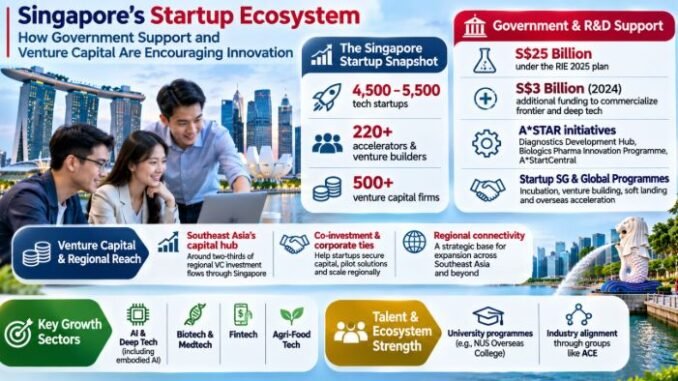
The scale of its startup landscape reflects this progress. Industry estaimates cited in ecosystem reports place the number of technology startups at approximately 4,500 to 5,500, alongside more than 220 accelerators and venture builders and over 500 venture capital firms. Together, these organisations create an environment that supports businesses from early research and product development to investment and international expansion.
Government Support Provides a Strong Foundation for Innovation
One of Singapore’s biggest advantages is the role played by its government in developing the startup ecosystem. Rather than focusing only on attracting businesses, the country has made long-term investments in research, technology development and commercial innovation.
A major part of this approach is the Research, Innovation and Enterprise (RIE) programme. Under its RIE 2025 plan, Singapore committed S$25 billion to research and innovation, with a further S$3 billion announced in 2024. The broader objective is to strengthen scientific capabilities, develop advanced technologies and help promising research reach the market.
This approach is particularly important for startups working in sectors where development can be expensive and time-consuming. Businesses in biotechnology, medical technology, artificial intelligence and advanced engineering often need specialised facilities, technical expertise and significant investment before they can bring products to market.
Public investment helps strengthen the foundation on which these businesses can grow.
Connecting Research with Commercial Opportunities
Research alone does not create a successful business. A promising discovery must be developed into a practical product, tested, refined and introduced to customers. Singapore has placed considerable emphasis on closing this gap between scientific research and commercial application.
Institutions such as the Agency for Science, Technology and Research (A*STAR) play an important role in connecting researchers, companies and industry partners. Its programmes and research infrastructure support businesses working in areas such as diagnostics, biotechnology and advanced manufacturing.
Initiatives including the Diagnostics Development Hub, the Biologics Pharma Innovation Programme and A*StartCentral illustrate how research capabilities can be connected with commercial development.
For startups, this access can reduce some of the barriers associated with building specialised technology. Instead of developing every capability independently, businesses can work with established research organisations, technical experts and industry partners.
This is especially valuable for deep-tech companies, whose products may require years of development before they become commercially viable.
Startup SG and Incubation Programmes Help Entrepreneurs Scale
Funding is only one part of the startup journey. Young businesses also need guidance on product development, business models, customer acquisition, regulatory requirements and market entry.
Singapore addresses these needs through a network of startup support programmes, incubators and venture-building organisations.
Enterprise Singapore’s Startup SG platform supports different stages of the entrepreneurial journey through initiatives designed to encourage business creation, investment and growth. These programmes help connect founders with investors, mentors, business partners and other resources.
The country also works with international venture partners and innovation organisations. Partnerships involving groups such as Breakthrough Energy and Founders Factory help create opportunities for startups to access expertise and connections beyond Singapore.
The Global Innovation Alliance further strengthens international links by connecting Singapore-based businesses with overseas innovation networks. Meanwhile, JTC LaunchPad provides a physical environment where startups, technology companies and supporting organisations can work alongside one another.
These networks help entrepreneurs move beyond the idea stage and develop businesses capable of competing in international markets.
Venture Capital Gives Startups Access to Growth Capital
A strong startup ecosystem needs investors who are willing to support businesses at different stages of development. Singapore has developed a substantial venture capital network that connects founders with local and international sources of funding.
The presence of more than 500 venture capital firms, according to industry estimates, gives startups access to investors with different sector interests, investment strategies and growth expectations.
For early-stage companies, this can provide the capital needed to develop products, recruit specialist talent and test their business models. As businesses mature, larger investment rounds can support expansion, acquisitions and entry into overseas markets.
Singapore’s position as a regional financial and business centre also makes it attractive to international investors. Venture capital firms can use the country as a base for identifying opportunities across Southeast Asia, while startups can build relationships with investors who understand the wider regional market.
However, access to funding does not automatically guarantee success. Investors increasingly look for businesses with credible products, strong management teams, clear customer demand and a realistic path towards sustainable growth.
Singapore’s Regional Position Creates Opportunities Beyond Its Borders
Singapore’s domestic market is relatively small, making international expansion an important consideration for many startups. Its location, connectivity and established business relationships provide companies with a useful base from which to approach neighbouring markets.
Southeast Asia offers opportunities across a wide range of industries, including financial services, healthcare, logistics, education, agriculture and digital commerce. Startups based in Singapore can use its business networks and international connections to explore these markets.
The country also plays a significant role in the region’s investment landscape. Some industry estimates suggest that roughly two-thirds of venture capital invested in Southeast Asia over a recent five-year period flowed through Singapore.
This reinforces its position as an important centre for fundraising, investment activity and regional business development.
For startups, the advantage is not simply geographical. Singapore offers access to multinational corporations, financial institutions, research organisations and potential commercial partners. These relationships can help young businesses secure pilot projects, validate their products and identify customers in other markets.
Corporate Partnerships Help Startups Turn Ideas into Businesses
Large companies can provide startups with something that funding alone cannot always deliver: access to real business challenges and established customer networks.
Singapore’s strong multinational corporate presence creates opportunities for collaboration between emerging businesses and established industry players. Startups can work with larger organisations to test new products, improve existing processes and develop solutions for specific market needs.
Public co-investment initiatives and corporate partnerships can also help reduce some of the risks associated with developing new technologies.
This is particularly relevant for deep-tech businesses. A startup developing an industrial AI platform, a medical diagnostic tool or a new biotechnology solution may need access to specialised equipment, testing environments and industry expertise. Partnerships can make these resources more accessible.
For established companies, working with startups provides an opportunity to explore new technologies without having to build every capability internally.
Deep Tech, AI and Fintech Are Creating New Growth Opportunities
Singapore’s innovation strategy covers a broad range of industries, but several technology-driven sectors are attracting particular attention.
Artificial intelligence: AI is creating opportunities in enterprise software, automation, predictive analytics, robotics and embodied AI. Startups are developing solutions that can help businesses improve productivity, manage information and make better operational decisions.
Biotechnology and medical technology: Research-led companies are exploring new diagnostics, healthcare technologies, biologics and medical devices. Government-backed research infrastructure and industry partnerships can be particularly valuable in these areas.
Financial technology: Singapore’s established financial services industry provides a strong environment for fintech businesses. Opportunities include digital payments, financial infrastructure, risk management, wealth technology and regulatory technology.
Agri-food technology: Innovation in food production, alternative proteins, agricultural systems and supply-chain efficiency is supporting the development of new businesses focused on food security and sustainability.
Industry events such as the Singapore Week of Innovation and Technology (SWITCH) also help bring entrepreneurs, investors, researchers and corporate leaders together. Such platforms encourage knowledge sharing, business networking and the development of new partnerships.
Skilled Talent and Universities Strengthen the Startup Pipeline
A successful startup ecosystem depends on people who can turn ideas into practical solutions. Singapore’s universities and talent-development programmes contribute to this process by connecting education, research and entrepreneurship.
Programmes such as the NUS Overseas Colleges initiative expose students to startup environments in international innovation hubs. This experience helps aspiring entrepreneurs understand how early-stage companies operate, build professional networks and develop commercial thinking.
Universities also contribute through research partnerships, technology transfer and entrepreneurship programmes.
For startups, access to skilled professionals is particularly important in areas such as software engineering, data science, biotechnology, product design and advanced manufacturing. A strong talent pipeline helps businesses develop products while supporting the growth of the wider innovation economy.
Industry associations and startup groups also play a role by bringing founders, investors, corporates and policymakers into closer contact.
Challenges That Singapore’s Startup Ecosystem Must Address
Despite its strengths, Singapore’s startup ecosystem faces challenges that businesses and policymakers must continue to address.
One concern is the cost of operating in a highly developed business environment. Office space, professional services and skilled employees can be expensive, particularly for startups that are still generating limited revenue.
Competition for experienced technology professionals is another issue. As more companies invest in AI, cybersecurity, biotechnology and other specialised fields, attracting and retaining the right talent becomes increasingly important.
Startups must also look beyond Singapore’s domestic market to achieve substantial growth. Expanding into Southeast Asia can bring opportunities, but businesses must navigate different regulations, customer preferences, languages and market conditions.
Deep-tech companies face additional challenges because research and product development often require significant capital and longer commercialisation timelines.
Addressing these issues will be important if Singapore wants to maintain its position as a leading destination for innovation and entrepreneurship.
What Singapore’s Startup Model Means for the Future
Singapore’s startup ecosystem demonstrates how government policy, private investment, research institutions and international partnerships can work together to support innovation.
Its approach is not based on funding alone. Long-term R&D investment provides a foundation for new technologies, while accelerators and venture builders help entrepreneurs develop commercial capabilities. Venture capital firms provide growth funding, and corporate partnerships create opportunities to test and scale solutions.
This connected model is particularly relevant as businesses increasingly look towards AI, biotechnology, advanced manufacturing, financial technology and other knowledge-intensive industries.
For entrepreneurs, Singapore offers access to a network that extends well beyond its borders. For investors, it provides a gateway to emerging opportunities across Southeast Asia. For established companies, it creates opportunities to collaborate with startups and adopt new technologies.
Conclusion
Singapore’s position as a major startup hub has been built through sustained investment, coordinated policy support and strong connections between the public and private sectors. Government-backed research, startup development programmes, venture capital access and international partnerships have helped create an environment where innovative businesses can develop and expand.
The next stage of growth will depend on how effectively the country converts research into commercially successful products, attracts specialised talent and helps startups compete in regional and global markets.
As technology continues to reshape industries, Singapore’s ability to connect innovation with investment and real-world business demand will remain central to its startup ambitions.
