

India’s supply chain landscape is undergoing a significant transformation, driven by expanding manufacturing capabilities, e-commerce growth, infrastructure development and rising customer expectations. Businesses across industries are under increasing pressure to deliver products faster, maintain consistent quality and control operating expenses. In this environment, supply chain cost optimization has become a strategic priority rather than merely a cost-cutting exercise.
Logistics expenses can significantly influence a company’s profitability, particularly in sectors such as manufacturing, retail, pharmaceuticals, FMCG, automotive and consumer goods. Transportation, warehousing, inventory management, packaging and last-mile delivery all contribute to the final cost of getting products from suppliers to customers.
However, reducing these expenses without disrupting operations requires a carefully designed approach. Aggressive cost-cutting can result in delayed deliveries, stock shortages, damaged goods and dissatisfied customers. The real objective is to eliminate inefficiencies, improve resource utilization and build a supply chain that remains both cost-effective and resilient.
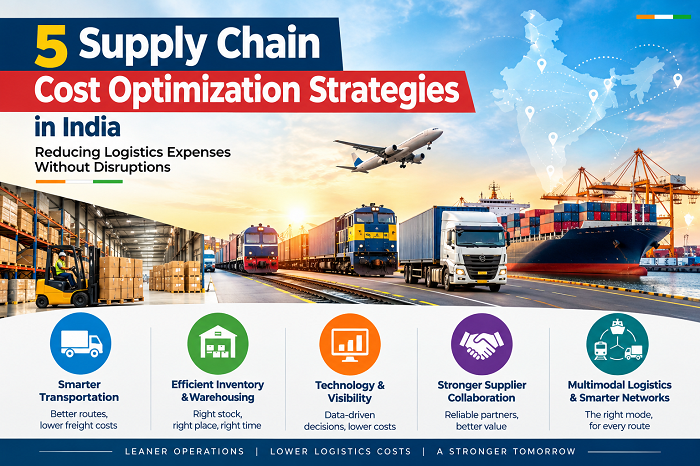
For Indian businesses operating across diverse geographical regions, infrastructure conditions and distribution networks, five practical strategies can help achieve this balance.
1. Optimize Transportation and Freight Management
Transportation is one of the most important areas for supply chain cost optimization in India. Businesses frequently incur unnecessary expenses because of partially loaded trucks, inefficient route planning, fragmented shipments, poor coordination between dispatch teams and inconsistent freight negotiations.
A more structured transportation strategy can reduce these costs without compromising delivery schedules.
Consolidate shipments and improve vehicle utilization
Companies can reduce freight expenditure by combining smaller shipments travelling to similar destinations. Instead of dispatching multiple vehicles with low utilization, businesses can plan consolidated shipments based on delivery locations, order volumes and customer requirements.
For example, a manufacturer supplying products to distributors across several cities can organize dispatches according to geographical clusters. This approach can improve vehicle utilization and reduce the cost per unit transported.
However, consolidation should not delay urgent orders or increase inventory requirements at the destination. Shipment planning must account for delivery commitments and product shelf life.
Use route optimization and transportation analytics
Route planning based solely on distance may overlook traffic conditions, toll expenses, road restrictions, unloading time and delivery windows. Transportation management systems can help businesses identify routes that balance travel time, fuel consumption and total freight costs.
GPS tracking and digital fleet management tools also provide visibility into vehicle movement, delays and delivery performance. Businesses can use this information to identify recurring inefficiencies and improve dispatch planning.
Strengthen freight procurement
Companies should periodically review carrier contracts, compare rates across transport providers and negotiate pricing based on shipment volumes, service quality and route frequency.
A balanced carrier strategy involving preferred transport partners and backup providers can help businesses secure competitive rates while maintaining operational flexibility.
Practical takeaway: Measure transportation cost per tonne, per kilometre, per shipment or per delivered unit, depending on the business model. These indicators reveal whether freight savings are improving actual operating efficiency.
2. Build Smarter Inventory and Warehouse Management Systems
Inventory decisions have a direct impact on logistics costs. Excess stock occupies warehouse space, increases handling requirements and ties up working capital. Insufficient inventory, meanwhile, can result in emergency procurement, expensive expedited transportation and lost sales.
The objective is to maintain the right products in the right quantities at the right locations.
Introduce demand forecasting
Historical sales data, seasonal trends, promotional campaigns, supplier lead times and market conditions can help businesses forecast demand more accurately.
For Indian businesses, demand patterns may vary significantly during festive periods, agricultural cycles, regional events and weather-related disruptions. A forecasting model that incorporates these factors can help companies avoid excessive inventory accumulation before demand peaks.
Forecasts should be reviewed regularly rather than treated as fixed projections.
Apply ABC and XYZ inventory classification
Not every product requires the same level of inventory control.
-
ABC analysis: Classifies products according to their contribution to inventory value or another relevant measure of importance.
-
XYZ analysis: Groups products according to demand variability, helping businesses distinguish predictable items from those with irregular demand.
Combining these approaches enables companies to prioritize high-value inventory, set appropriate safety-stock levels and apply different replenishment policies to different product categories.
Improve warehouse operations
Warehouse expenses can be reduced through better storage layouts, barcode-based tracking, systematic picking processes and efficient goods movement.
Businesses with multiple distribution centres should also evaluate whether inventory is positioned close to actual demand. Strategic warehouse placement can reduce delivery distances, although the benefits must be weighed against additional rent, staffing and inventory-holding costs.
Practical takeaway: Track inventory turnover, order fulfilment rates, stockout frequency, warehouse cost per unit and inventory ageing. The goal is to reduce unnecessary stock while protecting product availability.
3. Use Technology to Improve End-to-End Supply Chain Visibility
Fragmented information remains a challenge for many businesses. Procurement, warehouse, transportation, finance and sales teams may work with separate systems, spreadsheets or manually updated records. This makes it difficult to identify delays, rising expenses and avoidable operational bottlenecks.
Digital integration can help companies make faster and better-informed supply chain decisions.
Connect supply chain processes
An integrated enterprise resource planning (ERP) system, warehouse management system (WMS) and transportation management system (TMS) can connect information across procurement, inventory, dispatch and delivery.
When these systems share reliable data, businesses can monitor stock availability, track shipments, identify delayed orders and coordinate replenishment more effectively.
Smaller enterprises do not necessarily need expensive enterprise-wide implementations. They can begin with targeted digital tools that address their most costly operational problems.
Apply analytics to identify hidden costs
Supply chain dashboards can highlight patterns that are difficult to detect through manual reporting. These include repeated delivery failures, high detention charges, excess packaging expenses, frequent emergency shipments and underutilized warehouse capacity.
Predictive analytics can also help businesses anticipate demand fluctuations, estimate delivery risks and plan resources before disruptions occur.
Measure technology through business outcomes
Technology adoption should be linked to measurable operational improvements rather than the number of systems implemented.
Useful indicators include:
-
Logistics cost as a percentage of sales.
-
On-time, in-full (OTIF) delivery performance.
-
Order cycle time.
-
Forecast accuracy.
-
Cost of expedited shipments.
-
Order fulfilment accuracy.
Practical takeaway: Start with a baseline assessment, digitize the process causing the greatest financial leakage and expand only after demonstrating measurable benefits.
4. Strengthen Supplier Collaboration and Procurement Planning
Supply chain costs often originate before goods enter a warehouse or transportation network. Unreliable supplier schedules, inconsistent product quality, small emergency orders and fluctuating purchase prices can increase the total cost of procurement and distribution.
A supplier offering the lowest quoted price may not always deliver the lowest overall cost.
Evaluate total cost of ownership
Procurement decisions should consider more than the purchase price. Additional costs may include transportation, import duties where applicable, inspection, packaging, storage, rejection rates and the financial impact of late deliveries.
For example, a supplier located farther away may offer a lower unit price but require longer lead times and higher freight expenditure. A nearby supplier with dependable delivery schedules could prove more economical when the full cost is considered.
Coordinate purchasing with production and sales
Sharing demand forecasts and production schedules with key suppliers can improve planning and reduce last-minute orders.
Companies can establish agreed delivery windows, minimum service levels, quality standards and replenishment schedules. Regular performance reviews help both parties identify opportunities to improve delivery reliability and reduce avoidable expenses.
Develop strategic supplier relationships
Businesses should avoid excessive dependence on a single supplier when supply interruptions could halt production. Qualifying alternative suppliers for critical materials can improve resilience and reduce the risk of expensive emergency procurement.
At the same time, supplier diversification should be selective. Managing too many suppliers can increase administrative complexity and weaken purchasing leverage.
Practical takeaway: Evaluate suppliers using a balanced scorecard covering total landed cost, delivery reliability, quality, responsiveness and continuity of supply.
5. Improve Multimodal Logistics and Network Design
India’s expanding road, rail, port and logistics infrastructure creates opportunities to rethink how goods move across the country. Depending on the shipment’s origin, destination, urgency and characteristics, businesses may achieve better cost efficiency by combining different transportation modes.
The most economical solution is not necessarily the fastest mode or the one with the lowest headline freight rate.
Select transportation modes according to shipment requirements
Road transport offers flexibility and is often suitable for regional distribution and last-mile delivery. Rail can be attractive for suitable bulk or long-distance movements, while coastal shipping and inland waterways may offer opportunities on compatible routes.
A multimodal approach can combine the strengths of different modes. For example, rail or coastal transport may handle a suitable long-distance movement, with road transport covering the first and final legs.
Businesses must account for terminal handling, transshipment, storage, schedule reliability and the risk of additional delays before changing established routes.
Review warehouse and distribution centre locations
A poorly designed distribution network can increase freight costs even when individual transport contracts are competitive.
Companies should periodically assess where suppliers, factories, warehouses and customers are located. A network optimization exercise can identify whether inventory should be consolidated into fewer facilities or distributed across strategically positioned regional centres.
The right configuration depends on order density, delivery expectations, product characteristics, infrastructure and demand variability.
Use India’s digital logistics ecosystem
Businesses can assess relevant infrastructure and digital initiatives, including the Unified Logistics Interface Platform (ULIP), where applicable, to improve logistics information access and coordination.
The objective is to improve visibility and planning across the logistics chain, not simply to adopt a new platform. Any implementation should be evaluated against its practical integration requirements and measurable operational benefits.
Practical takeaway: Compare transport options using total delivered cost, transit-time reliability, cargo handling requirements and disruption risk. The cheapest freight quote is not necessarily the lowest-cost logistics solution.
How to Implement These Strategies Without Disrupting Operations
Cost optimization works best when implemented in phases. Changing transport partners, reducing inventory or restructuring warehouse operations across the entire business at once can create unnecessary risk.
A controlled implementation process helps companies capture savings while protecting customer service.
Phase 1: Establish a cost baseline
Analyse freight invoices, inventory carrying costs, warehouse expenses, supplier performance and delivery failures. Identify the largest sources of avoidable expenditure.
Phase 2: Prioritize high-impact opportunities
Select initiatives according to potential savings, implementation effort, financial investment and operational risk.
Phase 3: Run a controlled pilot
Test changes on a selected route, product category, supplier group or warehouse before expanding them across the network.
Phase 4: Measure savings and service quality
Compare actual costs against the baseline while tracking OTIF delivery, stockouts, damage rates and customer complaints.
Phase 5: Standardize and continuously improve
Expand successful changes, document new procedures and review performance regularly to ensure savings are sustained.
Key Performance Indicators for Supply Chain Cost Optimization
Businesses should measure both financial efficiency and service reliability. Otherwise, a reduction in logistics expenditure may conceal deteriorating delivery performance or increased operational risk.
|
KPI |
What it measures |
|---|---|
|
Logistics cost as a percentage of sales |
Overall logistics expenditure relative to revenue |
|
Freight cost per shipment or unit |
Transportation efficiency |
|
Vehicle utilization |
How effectively available transport capacity is used |
|
Inventory turnover |
How frequently inventory is sold or consumed |
|
On-time, in-full delivery |
Reliability of customer order fulfilment |
|
Order cycle time |
Time taken from order placement to delivery |
|
Damage and return rate |
Product losses and reverse-logistics requirements |
|
Emergency freight expenditure |
Cost of unplanned or expedited shipments |
These indicators should be reviewed together. For example, reducing inventory may improve working capital but increase stockouts. Similarly, selecting a cheaper carrier may lower freight expenditure while increasing delivery delays.
A successful optimization programme balances these competing outcomes rather than maximizing a single metric.
Conclusion: Build a Leaner, More Resilient Supply Chain
For Indian businesses, supply chain cost optimization offers an opportunity to improve profitability, strengthen operational discipline and remain competitive in a demanding market. The greatest benefits often come from addressing multiple connected processes rather than focusing exclusively on freight negotiations or warehouse expenses.
Transportation optimization, intelligent inventory management, digital visibility, supplier collaboration and multimodal logistics can collectively improve the efficiency of the supply chain.
However, sustainable savings depend on accurate data, practical implementation and continuous performance monitoring. Companies should avoid across-the-board cost reductions that weaken service quality or leave operations vulnerable to disruption.
The long-term objective is to create a supply chain that delivers the right products, at the right cost, to the right destination, within the promised timeframe. Businesses that treat logistics as a strategic capability rather than a standalone expense are better positioned to support growth, improve customer satisfaction and build resilience in India’s evolving economic environment.