
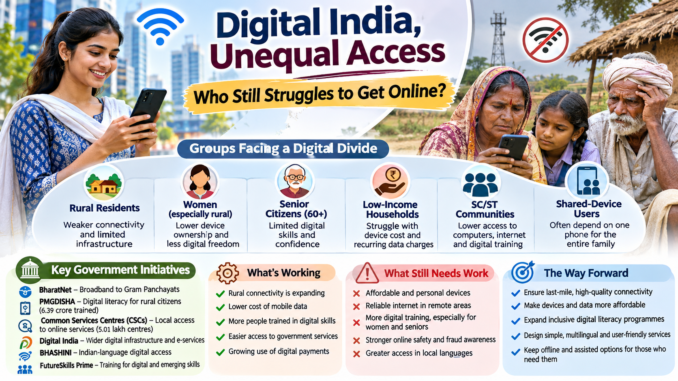
India’s digital transformation has changed the way people study, work, access banking services and interact with government departments. Online payments, digital identity, mobile banking and internet-based public services have made everyday activities easier for millions. However, the benefits of this progress are not equally shared. Rural communities, women, senior citizens, low-income households and socially disadvantaged groups still face difficulties accessing and using digital technology.
The challenge is no longer limited to bringing internet connections to more villages. It is about ensuring that people have affordable devices, reliable connectivity, practical digital skills and the confidence to use online services independently. Government programmes have made important progress, but the next stage of Digital India must focus on turning basic connectivity into meaningful digital participation.
The Digital Divide Is Changing, Not Disappearing
India’s internet infrastructure has expanded considerably. According to the Ministry of Electronics and Information Technology, the number of internet subscribers increased from 25.15 crore in March 2014 to 109.27 crore in March 2026. The cost of mobile data has also fallen sharply, making internet services more affordable for a large section of the population.
Yet, a high number of internet subscriptions does not necessarily mean that every household member has equal access. A family may have one smartphone shared by several people, while a rural household may technically be connected but experience poor network quality.
A 2026 report by the National Council of Applied Economic Research (NCAER) highlights this deeper problem. Its findings point to continuing differences in internet use between men and women, limited online participation among older people and a significant dependence on others for accessing digital services.
The figures underline an important reality: India has made considerable progress in connecting people, but independent and confident digital use remains uneven.
Government Schemes Working to Close the Gap
The government has introduced several programmes to improve internet connectivity, digital literacy and access to public services. Some of the most important initiatives include:
1. BharatNet: Bringing Broadband to Rural India
BharatNet is one of the key programmes aimed at connecting rural areas through high-speed broadband infrastructure. It focuses on extending optical fibre connectivity to Gram Panchayats, creating a foundation for internet services in villages.
As of June 2026, approximately 2.21 lakh Gram Panchayats had been made service-ready under the programme. This is an important step towards improving rural connectivity.
However, the next challenge is ensuring that this infrastructure translates into reliable internet services for households, schools, health centres and local businesses. A fibre connection reaching a Gram Panchayat does not automatically guarantee affordable, dependable access in every nearby village.
2. Pradhan Mantri Gramin Digital Saksharta Abhiyan (PMGDISHA)
PMGDISHA was introduced to improve digital literacy among rural households. It focused on teaching people basic computer and smartphone skills, internet use, digital payments and access to online government services.
According to government figures released in August 2026, more than 6.39 crore people had received training under the programme, exceeding its target of six crore.
However, it is important to note that PMGDISHA concluded on March 31, 2024. Its achievements provide a foundation for future digital literacy programmes, but India still needs continuing training opportunities, particularly for people who have never used digital services independently.
3. Common Services Centres: Digital Services at the Village Level
Common Services Centres (CSCs) play an important role in helping people access online services without needing to operate every digital platform themselves.
Through village-level entrepreneurs, these centres provide access to government certificates, banking-related services, welfare applications and other digital facilities. As of May 2026, around 5.01 lakh CSCs were functional across India, including approximately 3.91 lakh at the Gram Panchayat level.
For people who lack smartphones, computers or digital knowledge, these centres can act as an important bridge. Their effectiveness, however, depends on local availability, service quality, affordability and whether people can access assistance when they need it.
4. Digital India and the Expansion of Online Public Services
The Digital India programme, launched in 2015, provides the wider framework for improving digital infrastructure, online government services and digital empowerment.
Platforms such as DigiLocker, UMANG, Aadhaar-based services and UPI have made it easier for people to access documents, make payments and use public services.
These platforms have also created opportunities for small businesses. Digital payments can help local shops receive money more conveniently, while online services can reduce the time and travel involved in completing administrative tasks.
However, digital services must remain accessible to people who have limited internet access or difficulty using smartphones. Assisted services and alternative offline arrangements are important to prevent digital exclusion.
5. BHASHINI: Making Digital Services More Accessible in Indian Languages
Language is another major barrier to digital participation. Many online platforms are designed primarily around English or a limited number of languages, making them difficult to use for people who are more comfortable communicating in their mother tongue.
The government’s BHASHINI initiative, under the National Language Translation Mission, aims to support Indian-language translation and language technologies. It can help make digital information and services more accessible to people across different linguistic communities.
Its long-term value will depend on how widely these technologies are integrated into public services and whether they work effectively with regional languages, dialects and different levels of literacy.
6. Digital Skills and FutureSkills Prime
Digital literacy is not limited to learning how to operate a smartphone. People increasingly need skills in cybersecurity, online communication, digital finance and emerging technologies.
FutureSkills Prime, a collaborative initiative of the government and NASSCOM, supports training and upskilling in areas such as artificial intelligence and other emerging technologies. Government figures released in August 2026 reported more than 34 lakh registrations and over 23 lakh candidates enrolled or trained through the platform.
Such programmes are important for preparing people for employment in a technology-driven economy. However, advanced technology training must be supported by basic digital education so that people with limited prior exposure are not left behind.
What Has Improved So Far?
Government initiatives have produced measurable progress in several areas:
- Connectivity: BharatNet and mobile infrastructure projects have expanded internet availability in rural and remote areas.
- Affordability: Falling mobile data prices have reduced one of the major costs of internet access.
- Digital services: UPI, DigiLocker, UMANG and online government platforms have made many services easier to access.
- Last-mile support: CSCs provide practical assistance to people who cannot independently use digital platforms.
- Digital literacy: Large-scale training programmes have introduced millions of people to basic digital skills.
- Language access: BHASHINI is helping develop technology that can reduce language barriers.
These developments show that India has built a substantial digital foundation. The remaining challenge is ensuring that the benefits reach people who are still unable to use these services independently.
Who Is Still Being Left Behind?
Despite the progress, several groups continue to experience digital exclusion.
Rural residents may have access to a mobile network but still struggle with weak signals, unreliable electricity and limited broadband infrastructure.
Women, particularly in rural households, may depend on shared smartphones or face restrictions on independent internet use. Limited digital training and concerns about online fraud can further discourage participation.
Senior citizens may find digital banking, online forms and smartphone applications difficult to navigate without assistance. This can make them dependent on relatives or service providers.
Low-income families may be unable to afford personal devices, repairs or regular data plans. Sharing one smartphone among several family members can also affect children’s education and women’s access to online services.
Scheduled Caste and Scheduled Tribe communities in economically disadvantaged and remote areas may face overlapping barriers related to income, education, infrastructure and digital literacy.
The issue is therefore not simply whether a person can connect to the internet. It is whether that person has the freedom, resources and knowledge to use it when needed.
What Is Still Missing?
India’s digital inclusion efforts have created a strong foundation, but several gaps require greater attention.
Affordable personal devices: Lower data prices are useful, but people also need access to smartphones, computers and tablets. Device affordability, repair services and access to suitable technology remain important concerns.
Reliable connectivity: Rural broadband infrastructure must translate into consistent service. Network downtime, weak signals and electricity shortages can make digital access unreliable.
Practical digital education: Training should go beyond basic demonstrations. People need to learn how to make digital payments, access government benefits, use online learning platforms, identify fraudulent messages and protect personal information.
Greater access for women: Digital inclusion programmes should support personal device ownership, independent internet use and safe access to online financial and educational services.
Support for older adults: Senior citizens need simple training, accessible applications, clear instructions and human assistance when digital services become difficult to use.
Regional-language services: Online platforms should work effectively in Indian languages and be designed for people with different levels of reading and technical ability.
Cybersecurity and trust: Fear of online scams, identity theft and financial fraud can prevent people from using digital services. Awareness campaigns, effective grievance redressal and accessible fraud-reporting systems are essential.
Offline alternatives: Essential government services should not become inaccessible simply because someone lacks a smartphone, internet connection or digital skills. Assisted and offline options must remain available.
How Should India Measure Digital Inclusion?
The success of Digital India should not be measured only by the number of internet subscribers, mobile towers or digital transactions. A more meaningful assessment must examine whether people can actually use technology to improve their lives.
A stronger approach would assess the following areas:
- Personal access: How many people own or have regular, private access to a suitable smartphone or computer?
- Connectivity quality: Is the internet reliable, affordable and available when people need it?
- Independent use: Can users complete tasks such as online payments, government applications and video consultations without depending on someone else?
- Digital literacy: Can people identify suspicious links, protect passwords, manage online accounts and recognise fraud?
- Gender and social equality: Are women, older adults, rural residents and disadvantaged communities benefiting at the same rate as other groups?
- Economic outcomes: Does digital access help people find employment, improve education, manage businesses or access financial services?
- Service accessibility: Are digital platforms available in regional languages, easy to navigate and supported by effective grievance systems?
These indicators should be measured through regular household surveys, practical digital-skills assessments and independently verified service-quality data. Results should be published separately for rural and urban areas, gender, age, income and social groups. This would help policymakers identify which communities are being reached and where further investment is required.
What Needs to Happen Next?
The next stage of digital inclusion requires cooperation between the government, telecom companies, educational institutions, businesses and community organisations.
The government needs to strengthen last-mile connectivity, expand affordable device access and create continuing digital literacy programmes after the conclusion of earlier training initiatives.
Telecom companies can contribute by improving network reliability in underserved areas and offering affordable services that meet the needs of low-income users.
Schools and colleges should provide students with access to computers, internet facilities and practical digital education. Community centres can organise regular training sessions for women, senior citizens and people who have limited experience with technology.
Businesses and technology developers also need to design simpler applications, improve regional-language support and make digital platforms accessible to people with disabilities and limited literacy.
Most importantly, citizens should have a choice. Online services should make life easier, not create another barrier for those who cannot use them.
Conclusion: Digital India Must Work for Everyone
India has made considerable progress in building its digital infrastructure and expanding access to online services. BharatNet, CSCs, Digital India, BHASHINI and digital-skilling initiatives have helped bring technology closer to millions of people.
However, the digital divide remains a challenge because access to the internet does not automatically create digital independence. A person may live in a connected village but lack a personal smartphone. A woman may have access to a family device but not the freedom to use it. An elderly person may own a phone but struggle to complete a basic online transaction.
The real measure of India’s digital progress will be whether people can use technology confidently, safely and independently. The focus must now move from simply connecting more people to ensuring that every individual has the opportunity to benefit from the digital economy. Only then can Digital India become genuinely inclusive.
