
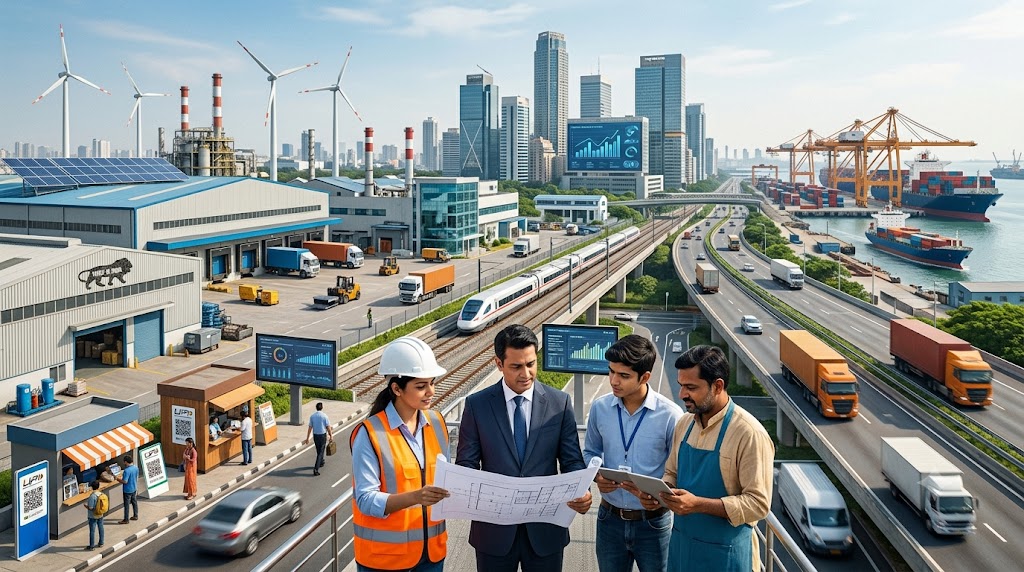
India’s economic growth is creating fresh opportunities for businesses across manufacturing, technology, retail, infrastructure and services. A large domestic market, expanding digital economy, policy support for local production and rising demand for modern products and services are strengthening the country’s position as a major destination for investment. However, sustaining this momentum will depend on how effectively businesses manage rising costs, skill shortages, regulatory requirements and global economic uncertainty.
For companies of all sizes, India’s growth story is about more than rising economic output. It is also about changing consumer expectations, new markets, evolving supply chains and the need to build businesses that can remain competitive over the long term.
A Strong Growth Outlook Supports Business Confidence
India has remained among the fastest-growing major economies, supported by domestic consumption, public infrastructure spending and the continued expansion of its services sector. The Reserve Bank of India’s growth outlook for FY2026–27 has placed real GDP growth at around 7.1%, reflecting the economy’s underlying resilience, although the final outcome will depend on domestic conditions and global developments.
For businesses, sustained growth can translate into stronger demand for goods and services, greater investment interest and opportunities to expand into new markets. Retailers may benefit from increased household spending, while manufacturers can explore new customer segments and service providers can respond to the changing needs of businesses and consumers.
Yet economic growth does not benefit every industry or region equally. Companies must understand where demand is increasing, whether customers can afford their offerings and how local market conditions influence purchasing decisions.
Domestic Consumption Creates New Market Opportunities
India’s large population and expanding consumer market offer significant opportunities for businesses. Demand is evolving beyond essential goods towards branded products, organised retail, digital services, healthcare, education, travel and convenient shopping experiences.
The growth opportunity is not limited to metropolitan cities. Tier-II and Tier-III cities are becoming increasingly important markets as connectivity improves, digital payments become more accessible and consumers gain access to a wider range of products and services.
Businesses that understand regional preferences and local spending patterns can build stronger customer relationships. For example, retailers can adapt product ranges to local demand, while small manufacturers can use digital channels to reach customers beyond their immediate markets.
However, rising consumption also brings greater competition. Customers have more choices and increasingly compare prices, quality, convenience and after-sales service. Companies will need to deliver genuine value rather than depend solely on discounts or aggressive marketing.
Digital Transformation Is Reshaping Business Operations
India’s digital infrastructure has changed the way businesses receive payments, communicate with customers and manage operations. The Unified Payments Interface (UPI) processed approximately 20 billion transactions in a month during 2025, demonstrating the scale of digital payments in everyday commerce.
For small businesses, digital payments can improve transaction convenience and reduce dependence on cash. E-commerce platforms and digital marketplaces can help local enterprises reach wider audiences, while cloud-based accounting, inventory management and customer relationship tools can make operations more efficient.
Artificial intelligence is also creating opportunities in customer service, demand forecasting, fraud detection and routine administrative work. Businesses that adopt suitable digital tools may be able to improve productivity and make faster, better-informed decisions.
However, technology adoption requires careful planning. Small enterprises may face challenges related to implementation costs, employee training, cybersecurity and data protection. Digital transformation is most effective when it solves a clear business problem rather than simply following a trend.
Manufacturing and Infrastructure Can Strengthen Competitiveness
Manufacturing remains a key area of opportunity as India seeks to expand domestic production, develop supply chains and reduce dependence on selected imports. Production-linked incentive schemes, the Make in India initiative and investments in transport and logistics infrastructure are intended to strengthen industrial capacity and attract investment.
Sectors such as electronics, pharmaceuticals, renewable energy equipment, automobiles, components and food processing offer opportunities for manufacturers and their supplier networks. Growth in these industries can also create demand for packaging, logistics, maintenance, warehousing and specialised business services.
Infrastructure investment is equally important. Better roads, rail connectivity, ports and logistics facilities can reduce travel times and improve access to markets. The PM Gati Shakti initiative aims to improve coordination in infrastructure planning, while continued investment in transport networks can help businesses move goods more efficiently.
Nevertheless, companies must assess the practical conditions of each location. Land availability, reliable electricity, water access, transport connectivity and proximity to suppliers and customers can significantly affect operating costs. Policy incentives alone cannot guarantee commercial success.
The Services Sector Remains a Major Growth Engine
India’s services sector continues to play a central role in economic activity, with information technology, financial services, consulting, telecommunications, healthcare, tourism and business-process services contributing to employment and exports.
Digital delivery has enabled many Indian companies to serve international clients without requiring a physical presence in every market. As global businesses invest in technology, analytics, cybersecurity and automation, Indian service providers have opportunities to move towards higher-value work.
At the same time, businesses must prepare for changing skill requirements, global competition and tighter expectations around productivity and service quality. Companies that invest in employee development and specialised capabilities are better positioned to secure long-term contracts and build customer confidence.
Trade agreements can also create new export opportunities by improving market access and reducing certain trade barriers. However, businesses must carefully examine the status and provisions of each agreement, including rules of origin, product standards, customs procedures and sector-specific conditions, before making expansion decisions.
Key Challenges Businesses Cannot Ignore
Despite the favourable growth outlook, companies continue to face several operational and financial pressures.
Cost volatility: Changes in crude oil prices, imported raw-material costs, exchange rates and freight charges can affect production expenses and profit margins. Businesses with limited pricing power may find it difficult to pass these increases on to customers.
Infrastructure gaps: While connectivity is improving, logistics efficiency and access to reliable infrastructure remain uneven across locations. Delays in transportation or supply availability can disrupt production and increase working-capital requirements.
Skills and employment: Businesses need workers with the right technical, digital and managerial capabilities. Skill shortages can slow expansion, increase recruitment costs and make technology adoption more difficult.
Regulatory compliance: Tax requirements, labour regulations, environmental standards, licensing and sector-specific rules can add to the administrative burden, particularly for smaller enterprises with limited in-house expertise.
Uneven purchasing power: Economic opportunities differ across states, cities and income groups. Businesses that rely on a single customer segment or geographical market may face slower growth if local demand weakens.
Managing these risks requires disciplined financial planning, diversified suppliers, stronger compliance systems and regular reviews of business performance.
MSMEs Have an Important Role in the Growth Story
Micro, small and medium enterprises are essential to India’s manufacturing, retail, services and employment ecosystem. They supply components to larger companies, support local markets and create livelihoods across urban and rural areas.
Digital platforms, formal credit channels and improved logistics can help MSMEs expand their reach and become part of larger supply chains. However, access to affordable finance, delayed customer payments, limited technology adoption and rising input costs remain important concerns.
For smaller businesses, growth does not necessarily mean rapid expansion. Improving cash-flow management, maintaining accurate financial records, investing selectively in technology and building dependable customer relationships can provide a stronger foundation for sustainable progress.
Larger companies can also support this ecosystem by developing local suppliers, offering timely payments and helping smaller partners meet quality and compliance standards.
Building a Business Strategy for Long-Term Growth
India’s economic prospects create opportunities, but businesses need a clear strategy to turn them into measurable results. Companies should assess customer demand before expanding, monitor costs closely and identify markets where their products or services offer a distinct advantage.
Investment in workforce training, digital systems and supply-chain resilience can help improve productivity. Businesses should also maintain adequate working capital and test their financial plans against scenarios involving slower sales, higher interest costs or sudden increases in input prices.
For companies entering new regions or export markets, understanding local regulations, consumer preferences and competitive conditions is equally important. Expansion decisions should be based on realistic demand forecasts and sustainable returns rather than growth expectations alone.
The Road Ahead
India’s economic growth offers a broad platform for enterprise, innovation and investment. A large domestic market, digital adoption, infrastructure development and opportunities in manufacturing and services can support businesses seeking to expand their reach.
The next phase of growth, however, will depend on productivity, skills, efficient infrastructure and the ability to make economic opportunities more widely accessible. For businesses, success will come from combining ambition with careful execution: understanding customers, managing financial risks and investing in capabilities that create lasting value.
India’s growth story is therefore not simply about how fast the economy expands. It is also about how effectively businesses convert that expansion into stronger operations, sustainable employment and long-term competitiveness.
