
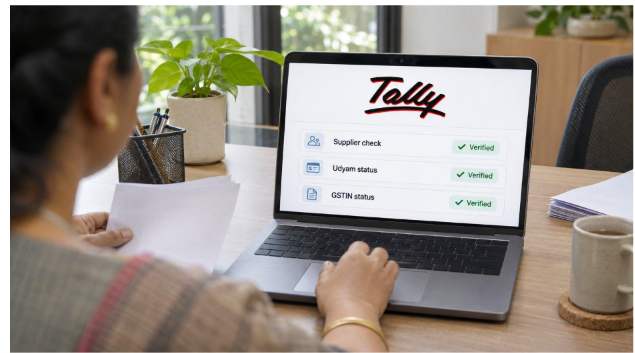
Before you sign a vendor agreement, approve a payment, or extend credit to a new supplier, there are two checks that every business in India should run without skipping. One tells you whether the business is a registered MSME. The other tells you whether their tax identity is legitimate. Together, they give you a far clearer picture than any introductory email or brochure ever would. These are not bureaucratic formalities. They are basic due diligence steps that have become more important as business relationships move faster and documentation gets less.
What Udyam registration confirms
The Government of India’s MSME registration system assigns every eligible business a Udyam Registration Number, commonly referred to as a URN. This number confirms that the business has been officially classified as a Micro, Small, or Medium Enterprise under the current definition set by the Ministry of MSME.
- When a supplier or vendor presents themselves as an MSME, which matters for payment timelines under MSME Act provisions, for government tender eligibility, and for certain credit facilities, you should be able to confirm that claim independently.
- A certificate printed on paper is not enough. The verification has to come from the government portal itself.
- Udyog Aadhar verification is the process of cross-checking a business’s registration status and enterprise classification using its URN. It tells you the business name and whether the registration is active.
- For procurement teams and compliance officers, this is a crucial step. It removes the risk of transacting with businesses that have falsely claimed MSME status.
If you are a buyer and you delay payment to a supplier beyond 45 days without knowing they are a registered MSME, you will face interest liability under the MSMED Act. If you verify status in advance, it will protect you from that exposure.
What a GSTIN verification reveals
A 15-digit GSTIN is the tax identity of any business registered under India’s GST framework. It replaces the older system of separate Excise, VAT, and Service Tax IDs with a single consolidated number. In theory, this makes compliance simpler. It also means that anyone receiving a GSTIN from a new vendor needs to verify it before a single transaction is recorded against it.
- A GST search done through the government portal pulls up the legal name of the business, its trade name, the type of taxpayer, regular, composite, or otherwise, the state of jurisdiction, and the registration status. These details tell you a great deal before you process so much as a purchase order.
- Fake and cancelled GSTINs remain a genuine problem. When your business claims Input Tax Credit on purchases made from a vendor with an invalid or cancelled GSTIN, that credit is denied.
- You also expose yourself to departmental scrutiny. If the transaction is flagged in a GST audit, the consequences go beyond losing the ITC; there are penalties and interest to consider as well.
Verifying a GSTIN before the first transaction is not excessive caution. It is a simple compliance measure.
Why these checks should come with your accounting system
Running these verifications separately from your accounting process creates a documentation gap. The check happens, the result is noted somewhere, and then it gets forgotten by the time the invoices arrive and the books are being updated; that is where errors happen.
- The better approach is to use accounting software that connects these verification steps to your actual records. When a new vendor is added, their GSTIN should be validated at the point of entry, not weeks later when a notice arrives.
- Verified supplier details should carry forward automatically into purchase invoices and GST filings, without being retyped or re-entered at each step.
- A well-designed system will also handle GST rate application automatically across different invoice types, composite supplies, exempt transactions, and mixed supplies, so that your GSTR-1, GSTR-3B, and GSTR-9 always reflect the correct figures.
- E-invoicing and e-way bill generation should happen from within the same workflow, not through a separate portal login every time. For MSME businesses in particular, having records that are organised, audit-ready, and consistently updated is what makes compliance manageable.
The moment your books, your GST filings, and your vendor records are maintained in three different places, the workload multiplies and the risk of inconsistency rises.
Conclusion
Neither check alone is sufficient. A business can have a valid GSTIN and no MSME registration. Another can claim MSME status without a corresponding GST registration appropriate to their scale. Running both checks together gives you a fuller understanding of who you are dealing with.
This is especially relevant for businesses that onboard multiple vendors across states, work on government contracts, or operate in sectors where payment terms and credit decisions are tied directly to supplier classification and tax compliance status. Verification is not the final step in due diligence, but it is the most efficient first step.
