
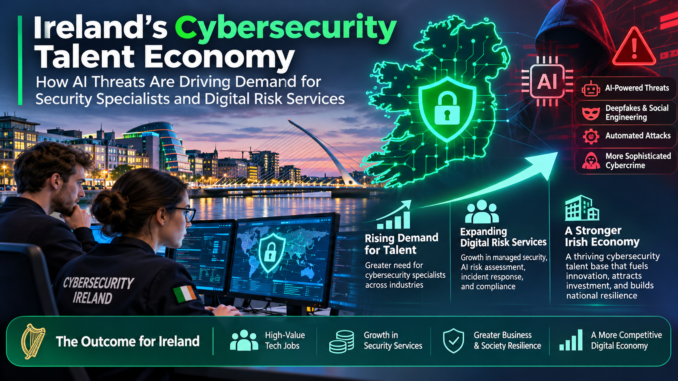
Nov 18: Ireland’s technology sector is entering a new phase of growth as artificial intelligence transforms the way businesses operate and exposes organisations to increasingly sophisticated cyber threats. From financial services and healthcare to technology companies and international business operations, organisations are investing in stronger cybersecurity systems to protect sensitive information, maintain customer trust and manage digital risks.
This changing environment is creating fresh opportunities in Ireland’s employment market. Demand for cybersecurity professionals is expanding beyond traditional IT security roles to include AI security specialists, cloud security engineers, digital risk consultants and data protection experts. At the same time, companies are exploring cybersecurity outsourcing and managed security services to access specialist expertise without building large in-house teams.
The growing need for these capabilities is strengthening the connection between cybersecurity jobs in Ireland, technology investment and the country’s wider digital services economy.
AI-Powered Cyber Threats Are Changing Business Security Requirements
Artificial intelligence is changing both sides of the cybersecurity landscape. Businesses are using AI to improve threat detection, automate security monitoring and identify unusual network activity. However, cybercriminals are also using AI tools to develop more convincing phishing campaigns, automate attacks and exploit weaknesses in digital systems.
This creates a more complicated security environment for organisations. Traditional approaches based on fixed rules and periodic security checks may not be sufficient to address threats that can evolve rapidly.
Ireland’s financial services, technology, pharmaceutical and professional services sectors have particular reasons to strengthen their cybersecurity capabilities. These industries process sensitive customer information, manage valuable intellectual property and rely on interconnected digital platforms.
The EY Ireland Cyber Leaders Index 2026 highlights the growing concern among cybersecurity leaders. Its survey of 161 cybersecurity professionals and senior leaders found that 35% identified AI-related threats as a leading concern, while 47% said rapid AI advances and the changing threat environment were making cybersecurity more difficult to manage.
These findings demonstrate why businesses increasingly need professionals who understand both conventional cybersecurity practices and the risks associated with AI adoption.
Ireland’s Growing Digital Skills Market Is Creating New Career Opportunities
Ireland has developed a substantial technology workforce, supported by multinational technology companies, financial institutions, software businesses and a growing ecosystem of digital service providers. As these organisations expand their use of cloud platforms, automation and AI, demand for specialised digital skills is also increasing.
The Expert Group on Future Skills Needs (EGFSN), in its September 2026 assessment, estimated that Ireland employed approximately 168,800 digital specialists in 2025. The report projects that this workforce could grow to around 215,400 by 2030, reflecting the continuing importance of digital expertise to the Irish economy.
The assessment also identifies cybersecurity as one of the fastest-growing technology skill areas. Depending on the growth scenario, the annual supply shortfall for digital specialists could reach approximately 5,500 to 7,700 workers.
For people entering the technology sector, this creates opportunities to develop careers in areas such as:
-
Cybersecurity analysis and security operations
-
AI security and threat intelligence
-
Cloud infrastructure and network protection
-
Digital risk assessment and governance
-
Data privacy and regulatory compliance
-
Incident response and cyber resilience
The expansion of these roles could also benefit recruitment firms, technology training providers and specialist outsourcing companies serving Irish businesses.
Which Cybersecurity Skills Are Employers Looking For?
As cyber risks become more complex, employers are looking for professionals who can combine technical knowledge with business and risk-management capabilities.
Cybersecurity analysts remain important for monitoring systems, investigating suspicious activity and identifying potential vulnerabilities. Security operations centre specialists help organisations respond to threats, while penetration testers assess systems to identify weaknesses before attackers can exploit them.
The growth of AI adoption is also creating demand for more specialised expertise. Businesses need professionals who can assess the security of AI applications, protect training data, identify model-related vulnerabilities and manage risks associated with automated decision-making systems.
Other important areas include:
-
Cloud security: Protecting data, applications and infrastructure hosted on cloud platforms.
-
AI security: Identifying vulnerabilities in AI systems and reducing risks linked to their deployment.
-
Threat intelligence: Monitoring emerging cyber threats and helping businesses prepare for potential attacks.
-
Identity and access management: Ensuring that employees, customers and third-party providers have appropriate access to digital systems.
-
Governance and compliance: Helping organisations meet data protection, cybersecurity and industry requirements.
Employers are also likely to value professionals who can explain technical risks in commercial terms. Cybersecurity decisions increasingly involve senior management, making communication, strategic planning and regulatory awareness important alongside technical expertise.
Cybersecurity Outsourcing Is Creating New Business Opportunities
The cybersecurity skills shortage is creating opportunities for service providers that can deliver specialised expertise to businesses across Ireland.
Not every organisation can afford to maintain a dedicated team covering threat monitoring, incident response, cloud security, compliance and risk assessment. Outsourcing allows businesses to access these capabilities through specialist service providers.
Managed security services are becoming particularly relevant. Providers can monitor networks, identify suspicious activity, manage security alerts and support incident response. Cybersecurity consulting firms can also help organisations conduct risk assessments, strengthen internal policies and prepare for regulatory requirements.
This creates opportunities for several segments of Ireland’s business services market:
-
Managed security service providers
-
Cybersecurity consulting companies
-
IT outsourcing and infrastructure management firms
-
Cloud security specialists
-
Data protection and compliance consultants
-
Cybersecurity recruitment and training providers
The EY Ireland Cyber Leaders Index 2026 also points to the importance of investment in this area. While 25% of surveyed respondents reported increased cybersecurity budgets over the previous six months, 31% viewed cybersecurity as an enabler of safe AI adoption.
This suggests that cybersecurity spending is increasingly connected to business transformation rather than being treated only as an operational expense.
For outsourcing companies, the opportunity lies in offering services that help organisations adopt new technologies while managing the associated risks.
SMEs Need Affordable Cybersecurity Solutions
Large organisations are not the only businesses facing growing cyber risks. Small and medium-sized enterprises also depend on digital payments, cloud-based software, online customer platforms and third-party technology providers.
However, smaller businesses may not have the financial resources or technical personnel required to maintain comprehensive cybersecurity operations.
This creates demand for affordable and scalable services. Managed security providers can offer monitoring, vulnerability assessments, endpoint protection and incident response support through service arrangements that are more accessible than building an internal security department.
Cybersecurity consultants can also help SMEs identify their most significant vulnerabilities and prioritise investment. Basic improvements such as multi-factor authentication, employee awareness training, regular software updates and reliable data backups can strengthen an organisation’s security position.
For service providers, SMEs represent an important customer segment. As digital adoption increases across retail, professional services, manufacturing and hospitality, cybersecurity requirements are likely to become part of routine technology spending.
AI Adoption Is Increasing Demand for Digital Risk and Compliance Experts
The expansion of AI across business operations is creating new questions around data security, accountability and regulatory compliance.
Organisations deploying AI tools must consider what information is being processed, where that data is stored and whether third-party systems have appropriate security controls. They also need to understand the risks associated with confidential business information being shared through external AI platforms.
These concerns are increasing the importance of digital risk specialists who can work across technology, legal, compliance and business teams.
Ireland’s position as a European base for multinational technology and financial services companies makes these capabilities particularly relevant. Organisations operating across multiple markets must consider different regulatory obligations and ensure that their cybersecurity practices support their wider compliance responsibilities.
The National Cyber Security Centre’s National Cyber Risk Assessment 2025 highlights the importance of addressing evolving technology risks, geopolitical developments and supply-chain vulnerabilities. Its findings reinforce the need for organisations to strengthen threat detection, cyber resilience and third-party security management.
As AI becomes more deeply integrated into business processes, professionals who understand cybersecurity alongside data governance and regulatory requirements could become increasingly valuable.
Education and Upskilling Will Be Important for Closing the Skills Gap
Ireland’s ability to benefit from cybersecurity investment will depend partly on developing a workforce with the right technical and professional skills.
Universities, technology institutes and professional training providers can support this requirement through specialised courses in network security, cloud infrastructure, ethical hacking, digital forensics and AI security.
Employers also have a role to play by investing in continuous professional development. Cyber threats change rapidly, and security professionals need regular training to understand emerging attack methods, new technologies and evolving compliance requirements.
For people considering a career in cybersecurity, practical experience is particularly important. Industry certifications, laboratory-based training, internships and entry-level security operations roles can provide a foundation for more specialised positions.
Businesses may also benefit from training existing IT employees in cybersecurity practices rather than relying entirely on external recruitment. This approach can help organisations address immediate skills gaps while building long-term internal capabilities.
Ireland’s Technology Sector Could Benefit From Cybersecurity Investment
Cybersecurity is becoming an important part of the infrastructure supporting Ireland’s digital economy. As businesses adopt AI, expand cloud operations and connect more services through digital platforms, the need to protect these systems will continue to influence technology investment.
The growing demand for cybersecurity professionals could support several related industries, including software development, IT consulting, recruitment, professional training and managed technology services.
Ireland’s established multinational business presence also creates opportunities for companies that can provide specialised cybersecurity services to international clients. Local providers with expertise in AI security, cloud protection, regulatory compliance and digital risk management may be able to serve organisations operating across European and global markets.
For international service providers, Ireland could offer opportunities to establish partnerships, develop specialist teams and support businesses seeking access to cybersecurity expertise.
However, the country’s ability to capture this opportunity will depend on addressing skills shortages, encouraging investment in training and ensuring that businesses of different sizes can access effective security solutions.
The Road Ahead for Ireland’s Cybersecurity Talent Economy
The growing use of AI is changing the nature of cybersecurity work. Businesses no longer need protection only against conventional network attacks; they must also assess risks associated with automated systems, cloud infrastructure, data sharing and increasingly sophisticated digital threats.
For Ireland, this shift presents both an employment opportunity and a business growth opportunity. Demand for cybersecurity jobs in Ireland is likely to extend across technical security roles, AI risk management, compliance, consulting and managed services.
The country’s expanding digital workforce provides a foundation for this development, but the projected shortage of specialist skills highlights the importance of education, professional training and international talent attraction.
As organisations continue to invest in AI and digital transformation, cybersecurity will become an essential part of their business strategies. Companies that can combine technology expertise with effective risk management will be better positioned to support this transition, creating new opportunities across Ireland’s technology and outsourcing economy.
