

Text-to-video generation feels like a recent breakthrough — but the story of AI-generated video starts decades earlier than most creators realize. From rule-based animation systems in university labs to diffusion-model platforms that produce broadcast-quality video from a single sentence, the AI video generator has traveled an extraordinary distance in a short time.
Understanding that history matters for creators who use these tools today. Knowing what early systems could and could not do clarifies why modern platforms like VidspotAI represent a genuine technical leap — and why the gap between first-generation AI video tools and current ones is measured not just in years, but in entire paradigm shifts.
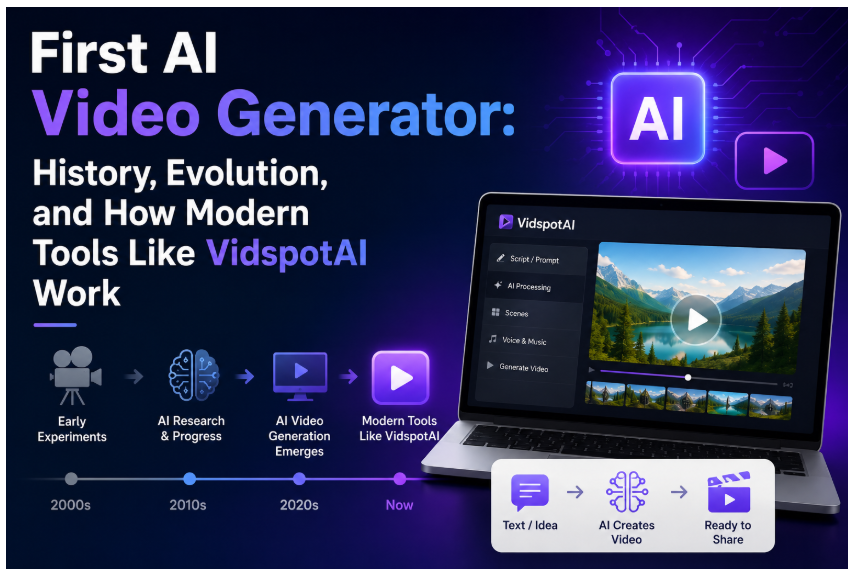
What Is an AI Video Generator?
An AI video generator is a software platform that converts text prompts, scripts, image inputs, or audio descriptions into complete video content using artificial intelligence models. The output includes synchronized visual scenes, voiceover narration, on-screen captions, background music, and scene transitions — all generated without a camera, studio, or manual editing timeline.
Modern AI video generators like VidspotAI use diffusion models, large language models, and neural synthesis pipelines to produce videos that are publish-ready for YouTube, Instagram Reels, TikTok, and Facebook. A creator inputs a script or topic, selects a generation model and language, and VidspotAI delivers a complete video in under 5 minutes.
This capability did not arrive fully formed. It developed across six decades of incremental progress in computer graphics, generative modeling, and neural network architecture.
How Did AI Video Generation Begin?
The earliest AI-generated visuals were not videos at all — they were static computer graphics produced by rule-based programs in the 1960s. Three researchers laid the groundwork that would eventually make AI video generation possible.
Georg Nees and the First Computer Graphics Exhibition (1965)
Georg Nees worked at Siemens in Germany and experimented with the Zuse Graphomat Z64 plotter, discovering that the machine could produce controlled graphic output. In 1965, Nees became the first generative computer graphic artist to exhibit work publicly, displaying algorithmic drawings at Stuttgart College. Nees demonstrated that machines could produce visual output through mathematical instruction — a foundational premise for every AI video generator that followed.
Frieder Nake and Algorithmic Art (1963)
Frieder Nake produced his first algorithmic artwork in 1963 using a computer, a tape machine, and a drawing machine. Nake’s work established that abstract visual content could emerge from computational processes without a human hand executing each stroke. In 1999, Nake founded Project CompArt, an archive of computer art that documented the early history of machine-generated visuals.
A. Michael Noll and 3D Computer Animation (1961)
- Michael Noll began experimenting with computer-generated visuals at Bell Labs in New Jersey in 1961, after a colleague’s plotter produced an error that resembled an interesting visual pattern. Noll explored pseudorandomness in visual systems and became the first United States computer artist to exhibit work at the Howard Wise Gallery. Noll’s experiments with motion and 3D animation laid early conceptual groundwork for the animated output that AI video generators produce today.
What Was the First AI-Generated Video System?
The direct predecessor to modern AI video generators was AARON — a rule-based creative system developed by artist and programmer Harold Cohen beginning in the late 1960s. Cohen completed AARON’s first functional version in 1973, making it the earliest documented AI system capable of generating original visual content autonomously.
How AARON Worked
AARON did not use machine learning, neural networks, or training data — the technologies that power modern AI video generators. Instead, AARON operated on rule-based programming: Cohen manually coded every artistic principle the system needed, including how to draw lines, connect lines into shapes, construct human figures, balance compositions, and apply color.
Cohen spent decades refining these rules. AARON’s early output was monochrome line drawings that Cohen colored by hand. By the 1980s, Cohen updated AARON to select and apply colors independently and generate recognizable real-world subjects including foliage and human figures. Harold Cohen exhibited AARON’s output at major institutions including the Tate Modern and the Whitney Museum of American Art.
What AARON’s Limitations Reveal About Modern AI Video Generators
AARON’s constraint was fundamental: Cohen had to predict and manually code every possible scenario the system might encounter. If a situation arose that Cohen had not anticipated and programmed, AARON could not respond. This ceiling — where the system’s capability was strictly bounded by its programmer’s foresight — is precisely what modern AI video generators overcame through neural network training.
VidspotAI, by contrast, learns from vast datasets of visual and audio content, enabling it to handle novel prompts, unusual subjects, and diverse languages without requiring a developer to pre-code each outcome. The difference between AARON and VidspotAI is the difference between a rule book and a trained intelligence.
How Did AI Video Generation Evolve From AARON to Modern Platforms?
The evolution from AARON’s rule-based drawings to platforms like VidspotAI passed through three distinct technological generations.
Generative Adversarial Networks (GANs) — 2014 to 2020
Generative Adversarial Networks, introduced by Ian Goodfellow in 2014, transformed AI image and video generation by replacing rule-based programming with adversarial learning. GANs deploy two neural networks simultaneously: a generator that produces visual content and a discriminator that evaluates whether the output appears real. These two networks train against each other, with the generator improving until its output consistently fools the discriminator.
GANs enabled AI systems to generate realistic faces, landscapes, and short animated sequences from learned patterns rather than coded rules — a fundamental shift from Cohen’s approach with AARON. However, GAN-based video generation produced outputs that often lacked temporal consistency: objects changed shape between frames, faces distorted during motion, and longer sequences degraded rapidly.
DALL-E and Diffusion Models — 2021 to Present
In January 2021, OpenAI released DALL-E, a transformer-based model that generated images directly from text descriptions. DALL-E demonstrated that natural language prompts could control visual output with sufficient fidelity for practical use. OpenAI released DALL-E 2 in June 2023, upgrading to diffusion-based architecture — a process that adds structured noise to training images and trains the model to reverse that noise, producing highly detailed output from text prompts.
Diffusion models resolved many of the consistency problems that plagued GAN-based video generation. Applied to video, diffusion architecture produces frame sequences with coherent motion, stable subjects, and realistic temporal flow — the technical foundation that platforms like VidspotAI build upon.
Modern AI Video Generators — 2023 to 2025
Modern image to video AI platforms combine advanced video diffusion models, large language models for script understanding, neural text-to-speech systems, and automated post-production workflows. VidspotAI exemplifies this end-to-end image to video AI architecture by allowing creators to start with a text prompt, script, or image and automatically generate scenes, synthesize motion, create voiceovers in 140+ languages, render captions, and export videos in multiple formats. The result is a publish-ready video produced with minimal effort and no manual editing required.
How Does VidspotAI Work as a Modern AI Video Generator?
VidspotAI applies the full lineage of AI video generation technology — from the rule-based creativity demonstrated by AARON to the diffusion-model synthesis pioneered by DALL-E — into a single, accessible production platform.
Step 1: Input Your Script or Prompt
VidspotAI accepts a text prompt, a full script, or a topic description as the starting point. The platform’s language model processes the input to structure scene sequences, identify visual subjects, and generate a narration script — all in the creator’s chosen language from a library of 140+ options.
Step 2: Select a Generation Model
VidspotAI provides multiple AI video generation models, allowing creators to match visual style to content category. A product explainer video requires different motion treatment than a documentary-style educational video or a social media reel. Model selection gives creators control over output aesthetic without requiring technical expertise.
Step 3: Generate and Export
VidspotAI renders the complete video — including motion, voiceover, on-screen text, and background music — in under 5 minutes for standard lengths. The platform exports in 16:9 (YouTube), 9:16 (Instagram Reels, TikTok), and 1:1 (Facebook) from the same generation, eliminating redundant rendering for each platform.
What Makes VidspotAI Different From Earlier AI Video Generators?
The distance between AARON in 1973 and VidspotAI in 2025 is measurable in specific capabilities:
| Capability | AARON (1973) | GAN-Based Tools (2018) | VidspotAI (2025) |
| Input type | Coded rules only | Image inputs | Text prompts, scripts, images |
| Language support | N/A | English only | 140+ languages |
| Output length | Single image | 2–4 seconds | Long-form (8–15 minutes) |
| Voiceover synthesis | None | None | Integrated, 140+ languages |
| Multi-platform export | None | Single format | 16:9, 9:16, 1:1 simultaneous |
| Generation time | Hours to days | Minutes per clip | Under 5 minutes (full video) |
| Editing required | Full manual | Significant | None for standard output |
VidspotAI eliminates the post-processing step that defined every prior generation of AI video tools. Earlier platforms — including GAN-based generators and early diffusion tools — produced raw clips that required assembly, voiceover, captioning, and format conversion in separate applications. VidspotAI delivers a finished video directly.
VidspotAI Pricing Plans for AI Video Generation
VidspotAI structures pricing around generation volume and parallel processing capacity — both critical variables for creators and agencies working at scale.
| Plan | Monthly Cost | Annual Generations | Simultaneous Exports |
| Basic | $10 | ~3,600 | 4 |
| Standard | $20 | ~12,000 | 8 |
| Professional | $41 | ~36,000 | 12 (stealth mode included) |
| Unlimited | $83 | ~96,000 | 16 (priority queue) |
Annual billing reduces all plans by 30%. No watermark appears on any paid plan. VidspotAI provides trial credits for new users to evaluate output quality before committing to a subscription.
How to Identify AI-Generated Video in 2025
Just as Harold Cohen’s AARON raised early questions about the authenticity of computer-generated art, modern AI video generators have intensified the need for tools that verify whether video content is AI-produced or human-filmed. Several technical signals help identify AI-generated video:
Temporal inconsistencies: Objects change shape, color, or position between frames in ways that contradict physical continuity — a residual artifact from early GAN-based generation that persists in lower-quality tools.
Facial and hand rendering errors: AI video generators still occasionally produce hands with incorrect finger counts or facial features that shift subtly across frames.
Background uniformity: AI-generated outdoor scenes often produce unnaturally consistent lighting across a wide background — absent the variation that natural light produces across time.
Audio-visual sync drift: In longer videos, AI-synthesized voiceover can drift out of synchronization with generated scene transitions — detectable by measuring lip-sync against audio waveforms.
Metadata absence: Authentic camera-recorded video embeds device metadata (camera model, GPS, timestamp) in file headers. AI-generated video files typically carry no device-origin metadata.
VidspotAI’s output, produced by diffusion-based synthesis and neural text-to-speech, maintains high temporal consistency and audio-visual synchronization — quality indicators that distinguish professional AI video generation from lower-tier tools.
FAQs: AI Video Generator History and Modern Platforms
What was the first AI video generator? The first AI system capable of generating original visual content autonomously was AARON, developed by Harold Cohen beginning in the late 1960s and first demonstrated in 1973. AARON generated static drawings using rule-based programming — not video. True AI video generation emerged in the 2010s with GAN-based systems and reached full-pipeline capability with diffusion-model platforms in 2023–2025.
How does VidspotAI generate video from text? VidspotAI generates video from text by processing the input script through a large language model to structure scene sequences, applying a diffusion-based video synthesis model to generate visual content, synthesizing voiceover through a neural text-to-speech system in the creator’s chosen language, and rendering the complete output with captions, music, and platform-specific formatting — all in under 5 minutes.
How many languages does VidspotAI support for AI video generation? VidspotAI supports 140+ languages for voiceover synthesis, including Arabic, Hindi, Urdu, Spanish, Mandarin, French, Portuguese, and English — making VidspotAI the broadest multilingual AI video generator available to general creators in 2025.
What is the difference between GAN-based video generation and diffusion-based video generation? GAN-based video generation trains two competing neural networks — a generator and a discriminator — to produce realistic visual content. GAN-based systems struggle with temporal consistency in longer clips. Diffusion-based video generation, used by VidspotAI, adds structured noise to training data and trains the model to reverse that noise, producing more stable, detailed, and temporally consistent output across longer video sequences.
Did Harold Cohen’s AARON use machine learning? AARON did not use machine learning or neural networks. AARON operated exclusively on rule-based programming — Cohen manually coded every artistic principle the system followed. Modern AI video generators like VidspotAI use deep learning trained on large datasets, enabling the system to handle novel prompts without requiring a developer to pre-code each scenario.
Can AI-generated video be detected? AI-generated video can be detected through temporal inconsistencies between frames, facial and object rendering errors, unnatural background uniformity, audio-visual sync drift in longer sequences, and the absence of device-origin metadata in file headers. Detection tools analyze these signals algorithmically to assign confidence scores for AI authorship.
How long can VidspotAI generate video? VidspotAI supports long-form video output — enabling creators to produce 8–15 minute videos from a single script input. Most competing AI video generators cap clip length at 4–10 seconds per generation, requiring manual assembly for longer content.
Summary
The AI video generator has evolved from AARON’s hand-coded rule system in 1973 — producing monochrome line drawings one at a time — to diffusion-based platforms that generate complete, narrated, multi-language videos in under 5 minutes. Each generation of technology — rule-based programming, GANs, transformer models, and diffusion synthesis — built on the limitations of its predecessor.
VidspotAI represents the current apex of that evolution: a platform that combines diffusion-based video synthesis, neural voiceover in 140+ languages, multi-platform format export, and long-form video capability in a single workflow accessible to creators without technical backgrounds. Harold Cohen spent decades manually coding AARON’s every capability. VidspotAI delivers a finished YouTube video from a text prompt in the time it takes to make coffee.