
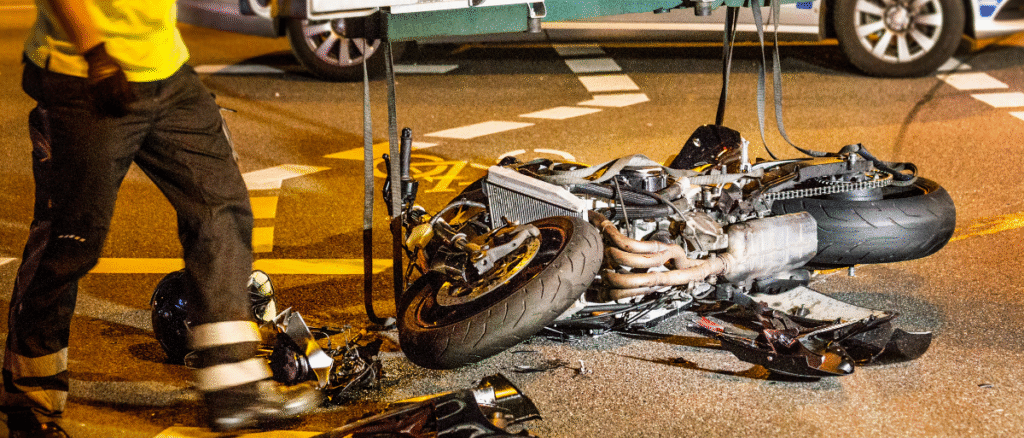

In a city of gridlock and giants, a single miscalculation between a motorcycle and a commercial truck can produce catastrophic, life-altering consequences — and a complex legal battle to match.
New York City is one of the most unforgiving environments in the world for motorcyclists. Narrow lanes on the FDR Drive, blind-spot-heavy intersections in the Bronx, and the constant surge of delivery trucks threading through Midtown create a daily gauntlet. When a motorcycle — weighing perhaps 500 pounds — collides with a commercial truck that can weigh up to 80,000 pounds, the physics are merciless.
The catastrophic scenarios
The most deadly scenario is the underride collision — where a motorcycle slides beneath the rear or side of a trailer. Without an adequate underride guard, the truck’s chassis can strike the rider at head or chest level, often proving fatal. This underride collision is especially common on expressways like the BQE, where trucks travel at speed alongside lane-splitting or fast-moving motorcycles.
A second, tragically common scenario is the left-turn broadside. A truck driver turning left at an intersection — say, the chaotic junction of Atlantic and Flatbush Avenues in Brooklyn — misjudges the speed of an oncoming motorcycle or simply fails to see it. The rider strikes the truck’s side at full speed, often with no time to brake. The resulting injuries include traumatic brain injury (even with a helmet), shattered femurs, and internal hemorrhaging.
“In a city where trucks make hundreds of turns through dense residential corridors every hour, the opportunity for motorcycle blind-spot collisions is not occasional — it’s structural.”
Dooring-adjacent impacts pose another risk: a truck parked on a Manhattan side street swings its cargo door open without checking, forcing a motorcyclist to swerve violently into traffic. The secondary collision — often with a moving vehicle — can be as devastating as the initial near-miss. Add to this the merge crush, where a truck drifts into an adjacent lane occupied by a motorcyclist on multi-lane roads like the Cross Bronx Expressway, and the range of catastrophic scenarios becomes disturbingly wide.
The injury profile
Motorcycle-truck collisions produce injuries at the severe end of the trauma spectrum. Spinal cord damage resulting in partial or full paralysis, traumatic amputations from tire contact, crush injuries to the pelvis, and severe road rash requiring skin grafting are all documented outcomes. Survivors frequently face years of rehabilitation, chronic pain, and permanent disability — injuries with lifelong economic and emotional costs.
How personal injury attorneys approach these cases
For attorneys, motorcycle-truck cases are among the most document-intensive in personal injury law. The first priority is evidence preservation. Commercial trucks are required by federal and state law to maintain electronic logging device (ELD) data, black box recordings, and maintenance records. Attorneys issue immediate legal holds to prevent this data from being overwritten — a process that must begin within days of the accident.
Liability in these cases is rarely simple. A personal injury truck attorney will investigate not just the truck driver’s conduct, but also the trucking company’s hiring and training records, the vehicle’s inspection history, and whether fatigue or hours-of-service violations contributed to the crash. In New York, comparative negligence rules mean that even a motorcyclist found partially at fault can still recover damages, though proportionally reduced.
Damages calculations in severe cases run into the millions, accounting for emergency medical costs, future care needs, lost lifetime earnings, and pain and suffering. Expert witnesses — accident reconstructionists, medical specialists, and vocational economists — are routinely retained. Motorcycle accident attorneys also scrutinize whether the at-fault party carries sufficient commercial insurance, as NYC trucking operations are often required to carry policies far larger than standard auto coverage.
In a city that never slows down, the legal aftermath of a motorcycle-truck collision can be as prolonged and complex as the recovery itself. Having an attorney who understands both the urban dynamics of New York traffic and the federal regulations governing commercial carriers can make an enormous difference in the outcome.