
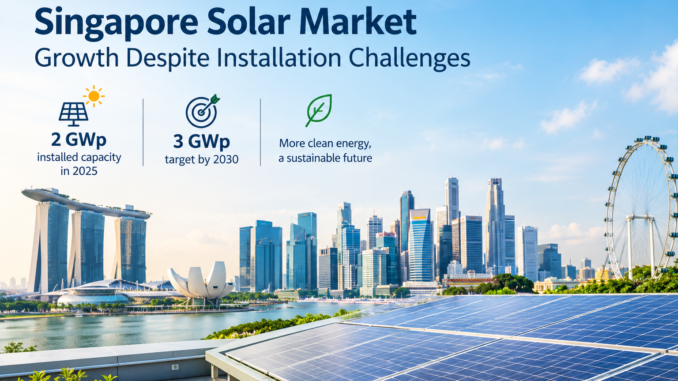
Oct 24: Singapore’s solar market is expanding despite limited land, restricted rooftop space and unpredictable weather. After reaching 2 gigawatt-peak (GWp) of installed solar capacity in 2025, Singapore raised its target to 3 GWp by 2030. The move creates opportunities for solar developers, commercial property owners and companies offering renewable energy technologies.
According to Singapore’s Energy Market Authority (EMA), rooftop installations account for more than 80% of the country’s installed solar capacity. The government is also exploring solar panels over car parks, suitable land and water surfaces to make better use of available space.
For businesses, the growing Singapore solar energy market offers potential benefits, including lower grid electricity consumption, improved energy management and new opportunities in solar installation, financing and energy storage. However, project costs, building suitability and return on investment remain important considerations.
Singapore Solar Market Growth: Key Developments in 2026
Singapore’s solar expansion reflects a long-term effort to diversify its electricity supply and make better use of domestic renewable energy sources.
The country achieved 2 GWp of installed solar capacity in 2025, exceeding its earlier deployment target. In March 2026, the government increased its ambition to 3 GWp by 2030, encouraging the development of solar installations across more viable surfaces.
At the 3 GWp level, solar systems could generate approximately 2,800 gigawatt-hours of electricity annually, equivalent to the yearly electricity needs of around 500,000 households, according to the EMA’s estimates.
The government is supporting deployment through initiatives such as SolarNova, which facilitates solar installations across public-sector properties, and programmes targeting industrial real estate.
These developments matter to businesses because they signal continued investment in solar infrastructure and supporting technologies. They do not, however, guarantee that every building or solar project will be commercially viable.
Why Is Singapore’s Solar Energy Market Growing?
Businesses Want Greater Control Over Energy Costs
Electricity is a significant operating expense for many factories, warehouses, offices and commercial facilities. Installing solar panels can help suitable businesses generate electricity on-site and reduce the amount they purchase from the grid.
The financial benefit depends on the property’s electricity consumption, available roof space, installation cost and the timing of energy use.
For example, a warehouse with a large, unobstructed rooftop and substantial daytime electricity demand may be a stronger candidate for solar than a building with limited roof space or significant shading.
Businesses should assess their actual electricity consumption before deciding on system size. A larger installation is not necessarily more profitable if much of the electricity generated cannot be used effectively.
Government Targets Are Encouraging Investment
Singapore’s 3 GWp solar target for 2030 gives developers and technology providers a clear indication of the country’s renewable energy priorities.
As installations expand, demand may arise for engineering services, system design, solar maintenance, monitoring technology and financing solutions.
Commercial and industrial properties are particularly relevant because they can offer large roof areas for installations. Nevertheless, structural capacity, existing rooftop equipment and building access can limit the space available.
Solar Technology Is Expanding Beyond Rooftops
Conventional rooftop installations remain central to Singapore’s solar strategy, but they are not the only option.
Floating solar farms, solar canopies over car parks and building-integrated photovoltaic systems can make use of spaces that might otherwise be unsuitable for traditional solar farms.
These approaches are especially relevant in a city where land is limited. Their commercial viability still depends on engineering requirements, installation costs, maintenance and the amount of electricity they can generate.
Solar Installation Challenges in Singapore
1. Limited Land and Rooftop Space
Singapore’s compact geography makes large ground-mounted solar farms difficult to develop at scale. This is one reason rooftop installations account for such a substantial share of installed capacity.
However, not every rooftop can accommodate solar panels. Air-conditioning equipment, ventilation systems, maintenance walkways and shading can reduce the usable area. Structural limitations may also require additional assessment or reinforcement.
Solar developers need to evaluate each property individually rather than assume that a large roof automatically makes a project viable.
2. Weather and Intermittent Solar Generation
Singapore receives substantial sunlight throughout the year, but cloud cover can cause solar electricity generation to fluctuate. Solar panels also stop producing electricity at night.
This variability makes energy management important for businesses that need a consistent electricity supply.
Battery storage can help retain surplus solar electricity for later use, while forecasting and monitoring tools can improve planning. However, storage adds cost, and its suitability depends on the property’s energy profile and financial objectives.
3. Upfront Installation Costs
A solar installation involves more than purchasing panels. Costs can include inverters, mounting structures, electrical work, engineering assessments, installation and ongoing maintenance.
Businesses must compare these expenses against the electricity savings expected over the system’s useful life.
Solar leasing and power purchase agreements may offer alternatives to paying the full installation cost upfront. The terms vary, so property owners should carefully review payment arrangements, maintenance responsibilities, contract duration and expected savings.
4. Building Approvals and Coordination
Solar installations may require coordination among property owners, building managers, engineers and relevant authorities.
Shared rooftops, condominium management requirements and existing building infrastructure can complicate planning. Commercial properties may also need to accommodate maintenance access and operational requirements.
Engaging qualified professionals early can help identify technical or approval-related issues before a business commits significant capital.
How Singapore Is Overcoming Solar Deployment Challenges
Floating Solar Projects
Floating solar enables panels to be installed on suitable water surfaces instead of occupying conventional land.
Singapore’s Tengeh Reservoir is home to a 60 MWp floating solar photovoltaic farm developed by Sembcorp. The project demonstrates how existing water infrastructure can contribute to the country’s renewable energy ambitions.
Floating installations still require careful planning around engineering, water management, environmental considerations and maintenance, but they provide an additional deployment option where land is scarce.
Solar Canopies Over Car Parks
Solar canopies can turn suitable open-air car parks into electricity-generating spaces while also providing shade for parked vehicles.
The government has identified car park canopies and other innovative solar deployments as part of its effort to reach the 3 GWp target.
For businesses and property operators, these projects may offer a way to use existing developed areas more productively. Feasibility will depend on site design, structural requirements, costs and access to electrical infrastructure.
Building-Integrated Solar Technology
Building-integrated photovoltaics, or BIPV, incorporate solar technology into building components such as façades or other architectural surfaces.
This can create additional opportunities when rooftops are unsuitable or space is limited. However, BIPV projects require careful consideration of construction costs, building design, energy output and maintenance.
For engineering firms and solar technology providers, these projects create opportunities to develop solutions for dense urban environments.
Business Opportunities in Singapore’s Solar Market
Solar Installation and Maintenance
Solar developers and engineering companies can offer site assessments, system design, installation, electrical integration, performance monitoring and maintenance.
Companies with experience in commercial and industrial properties may be able to serve customers seeking to make productive use of their rooftops.
Reliable maintenance is also important because system performance can affect the expected financial return.
Solar Financing and Power Purchase Agreements
Some businesses prefer to avoid a large upfront investment in solar equipment.
Depending on the arrangement, a solar provider may install and maintain the system while the customer pays through a lease or purchases electricity under a power purchase agreement.
These models can make solar more accessible, but the financial benefits depend on the contract price, electricity tariffs, system performance and other terms. Businesses should compare the total cost against alternative energy arrangements before signing.
Battery Storage and Energy Management
As solar deployment grows, managing changes in electricity generation becomes increasingly important.
Battery storage, energy monitoring systems and forecasting tools can help businesses understand consumption patterns and manage available electricity more effectively.
Providers offering these technologies may find opportunities to work with solar developers, factories, warehouses and commercial property owners.
Solar Solutions for Commercial and Industrial Buildings
Factories, warehouses and offices can be potential customers for solar systems when they have suitable rooftops and sufficient daytime electricity demand.
Developers can help property owners assess roof suitability, estimate expected electricity generation and compare installation or financing options.
The strongest opportunities will be those supported by sound technical assessments and realistic financial projections.
How Businesses Can Evaluate a Solar Installation
Before investing in solar panels, businesses in Singapore should follow a structured feasibility process.
1. Assess the property. Check usable rooftop space, structural suitability, shading, access and existing equipment.
2. Review electricity consumption. Examine bills and consumption patterns to estimate how much solar electricity the business could use directly.
3. Compare financing options. Evaluate direct purchase, leasing and power purchase agreements, including maintenance responsibilities and contract conditions.
4. Estimate the financial return. Consider installation costs, expected electricity savings, maintenance, equipment replacement and applicable incentives. Avoid relying on headline payback periods without a property-specific assessment.
5. Confirm technical and regulatory requirements. Consult qualified solar professionals and the relevant authorities about approvals, electrical connections and building requirements.
This process can help businesses determine whether a solar project fits their operational needs and investment objectives.
Singapore Solar Market Outlook Towards 2030
Singapore’s target of 3 GWp of solar capacity by 2030 points to continued efforts to expand renewable electricity generation.
Future deployment is expected to make greater use of suitable rooftops, industrial properties, floating installations and innovative structures such as solar canopies. Improvements in solar technology, monitoring and energy storage may also help address some practical limitations.
However, solar energy will remain only one part of Singapore’s broader electricity strategy. Limited land and variable sunlight mean that solar generation alone cannot meet all the country’s electricity needs.
For businesses, the outlook creates opportunities across installation, financing, maintenance and energy management. Companies that understand the technical requirements and financial realities of each project will be better positioned to identify viable opportunities.
Conclusion
Singapore’s solar market continues to grow despite land constraints, installation complexity and intermittent generation. The country’s 3 GWp target for 2030 is encouraging the use of rooftops, water surfaces and other suitable spaces to expand solar deployment.
For businesses, opportunities extend beyond solar panels to include engineering, maintenance, financing, battery storage and energy management. Yet growth in the overall market does not automatically make every project profitable.
A careful assessment of building suitability, electricity consumption, installation costs and financing options remains essential. With realistic planning and appropriate technology, solar power can become a practical part of Singapore’s wider energy transition.
