
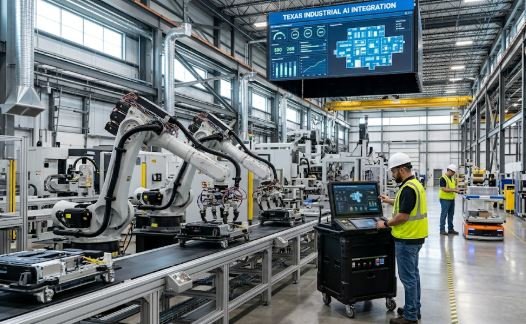
Texas is reinforcing its position as a major manufacturing and industrial investment hub in the United States, with artificial intelligence increasingly shaping the sector’s growth and competitiveness. As manufacturers navigate rising production costs, labour constraints, supply chain pressures and growing demands for operational efficiency, AI is emerging as an important tool for improving business performance. Companies across industries, from semiconductor production and advanced electronics to automotive components, chemicals and industrial machinery, are exploring intelligent automation, predictive maintenance and data-driven production systems to strengthen productivity and manage costs. This shift is extending beyond factory operations, creating new investment opportunities for technology companies, industrial suppliers, engineering firms and smaller enterprises supporting Texas’s manufacturing ecosystem.
AI Adoption Is Reshaping Texas’s Manufacturing Landscape
The integration of AI into manufacturing is gaining momentum as businesses look for practical ways to improve production efficiency and maintain their competitive position. According to the Federal Reserve Bank of Dallas, 56.8% of surveyed Texas manufacturers reported using AI in May 2026, compared with 49.4% in May 2025. A further 18.9% indicated plans to adopt the technology within the following 12 months.
This growing adoption reflects a shift in how manufacturers approach technology investment. Rather than viewing AI simply as an innovation initiative, businesses are increasingly assessing its ability to reduce operational expenses, improve production consistency and support better commercial decisions.
Smart Factories Improve Production Efficiency
AI-powered smart factories are changing how manufacturing facilities manage their daily operations. By connecting machinery, sensors, robotics and production management systems, manufacturers can monitor factory performance and identify inefficiencies more effectively.
These connected systems can help businesses optimise production schedules, manage material usage and reduce delays across manufacturing processes. Automated monitoring also allows production managers to respond more quickly to operational problems.
For manufacturers operating at scale, even modest improvements in production efficiency can generate meaningful savings and strengthen operating margins.
Predictive Maintenance Helps Businesses Control Costs
Unexpected equipment failures can result in production interruptions, expensive repairs and delayed customer deliveries. AI-powered predictive maintenance offers manufacturers a more proactive approach to managing these risks.
By analysing information from industrial sensors, AI systems can identify unusual patterns in machinery performance, including changes in temperature, vibration and pressure. Maintenance teams can use these insights to identify potential faults and schedule servicing before equipment failure disrupts operations.
For Texas manufacturers, this approach can improve equipment reliability, reduce emergency maintenance expenses and support more consistent production schedules.
AI-Powered Quality Control Reduces Manufacturing Waste
Maintaining product quality is essential for manufacturers competing in demanding domestic and international markets. AI-based computer vision systems are helping businesses improve inspection processes by identifying defects, surface irregularities and assembly errors during production.
Unlike conventional inspection methods, automated vision systems can examine products continuously and identify variations at high production speeds.
This can reduce defective output, material wastage and costly rework while helping manufacturers maintain consistent quality standards. Industries such as electronics, automotive components and precision engineering stand to benefit from these capabilities.
Digital Twins Support Smarter Industrial Investment
Digital twin technology is creating new possibilities for factory planning and operational management. By developing virtual representations of physical machinery, production lines and manufacturing facilities, businesses can simulate different operating conditions before making changes to actual infrastructure.
Solutions from companies such as NVIDIA and Siemens allow manufacturers to examine factory layouts, evaluate equipment configurations and identify production bottlenecks in virtual environments.
This can help businesses make better capital investment decisions, reduce implementation risks and improve the planning of new manufacturing facilities.
Robotics and Automation Address Workforce Challenges
AI-enabled robotics is helping manufacturers manage repetitive, physically demanding and time-sensitive activities. Collaborative robots can work alongside employees, while automated mobile robots can transport materials and support internal logistics.
These systems can improve production throughput, reduce manual handling and allow employees to concentrate on technical supervision, maintenance and quality management.
For businesses facing labour shortages and increasing workforce expenses, automation offers an opportunity to improve operational flexibility while making better use of available employees.
Texas Attracts Investment in Advanced Manufacturing
Texas’s expanding AI ecosystem is creating opportunities not only for businesses adopting the technology but also for companies manufacturing the hardware and infrastructure that support it.
Partnerships involving NVIDIA, Foxconn and Wistron are contributing to the development of advanced AI server and computing infrastructure in the state. Meanwhile, semiconductor investments are strengthening Texas’s role in the production of strategically important electronic components.
Samsung Austin Semiconductor’s operations generated an estimated $10.9 billion in economic activity across Central Texas in 2025, demonstrating the wider economic significance of advanced manufacturing investment.
These developments create business opportunities for industrial suppliers, engineering companies, logistics providers, equipment manufacturers and specialised technology service firms.
Workforce Development Becomes a Business Priority
The growing use of AI is increasing demand for employees with technical, digital and manufacturing skills. Businesses need workers who can operate automated equipment, interpret production data and manage AI-supported industrial systems.
In October 2026, the Manufacturing Institute and Texas State Technical College announced a partnership to introduce AI-focused manufacturing training across technical education programmes and industry networks. The initiative supports a broader ambition to equip 40,000 current and future frontline manufacturing workers with AI skills by 2028.
For manufacturers, workforce development is becoming an essential part of technology investment. Employees with relevant skills can help businesses integrate new systems more effectively, improve operational decision-making and reduce dependence on external technical support.
Opportunities for Small and Medium-Sized Manufacturing Businesses
AI adoption is also opening new possibilities for smaller manufacturers across Texas. Affordable software platforms, connected equipment and cloud-based production management systems are making selected AI applications more accessible to businesses with limited technology budgets.
Small and medium-sized enterprises can use these tools to monitor inventory, improve production planning, automate quality inspections and manage equipment performance.
There are also opportunities for startups and technology service providers to develop specialised solutions for industrial customers. Predictive maintenance services, robotics integration, manufacturing software, industrial cybersecurity and sensor-based monitoring are emerging areas of commercial interest.
For smaller manufacturers, the most practical approach is to begin with specific operational challenges and expand AI adoption as measurable business benefits become evident.
Challenges Manufacturers Must Consider
Despite its growing potential, integrating AI into manufacturing requires careful planning and investment. High implementation costs, outdated machinery, cybersecurity risks and limited access to specialised employees can create barriers, particularly for smaller businesses.
Manufacturers must also ensure that AI platforms can integrate with existing production systems and provide reliable information for operational decisions.
A phased adoption strategy can help businesses manage these challenges. Starting with applications that address equipment downtime, inventory inefficiencies or product defects allows manufacturers to evaluate returns before committing to larger technology investments.
Outlook
Artificial intelligence is becoming an increasingly important driver of industrial competitiveness across Texas, influencing how manufacturers invest, manage production and develop their workforce. The combination of advanced manufacturing infrastructure, technology investment and a broad industrial supply chain is creating opportunities for businesses at different stages of the manufacturing ecosystem.
For manufacturers, the long-term advantage will depend on how effectively they translate AI capabilities into lower operating costs, improved product quality, greater productivity and stronger customer relationships. At the same time, technology providers, industrial suppliers and smaller enterprises can benefit from the growing demand for intelligent manufacturing solutions. As Texas continues to expand its advanced industrial capabilities, AI is set to play a central role in shaping the state’s manufacturing investment landscape and creating new avenues for sustainable business growth.
