
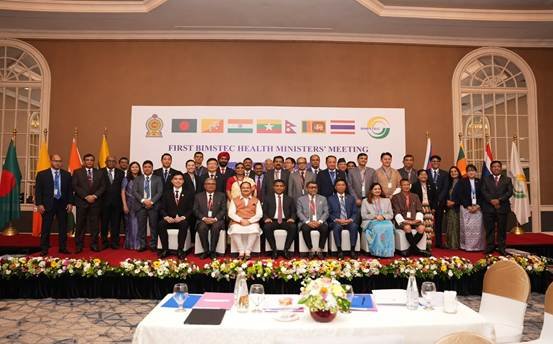
Colombo, Nov 12: India has taken an important step towards strengthening healthcare cooperation in the Bay of Bengal region, with the first BIMSTEC Health Ministers’ Meeting in Colombo unanimously adopting a Joint Ministerial Statement and a common public health roadmap for 2026–2030.
Union Health Minister J.P. Nadda represented India at the meeting, where member countries agreed to work together on key health priorities, including disease prevention, pandemic preparedness, digital healthcare, traditional medicine and better access to quality medical services.
A major outcome was India’s announcement to host the BIMSTEC Centre of Excellence in Traditional Medicine at Jamnagar, Gujarat. The centre will promote research, training and knowledge-sharing among member countries, giving traditional medicine a stronger platform for regional cooperation.
India also announced significant healthcare assistance for Sri Lanka. An agreement was exchanged to provide 100 additional fully equipped ambulances, backed by Indian grant assistance of around USD 5.28 million. India will also support the setting up of 50 Medical Kiosks or Health ATMs at primary healthcare centres to improve access to diagnostic services and telemedicine.
These initiatives build on India’s wider commitment to improving healthcare access across the region. During the meeting, Nadda highlighted India’s experience in primary healthcare, digital health services and public health infrastructure, and offered to share its expertise with other BIMSTEC countries.
The Union Health Minister also held bilateral discussions with the health ministers of Sri Lanka and Nepal to explore further areas of cooperation.
The meeting brought together representatives from all seven BIMSTEC countries. They agreed to hold health ministers’ meetings every two years, with Thailand offering to host the next meeting in 2028.
The decisions are significant for the region as they move healthcare cooperation beyond individual initiatives towards a shared approach. Better disease monitoring, emergency preparedness, medical infrastructure and knowledge-sharing can help member countries respond more effectively to common health challenges and improve healthcare access for their people.
